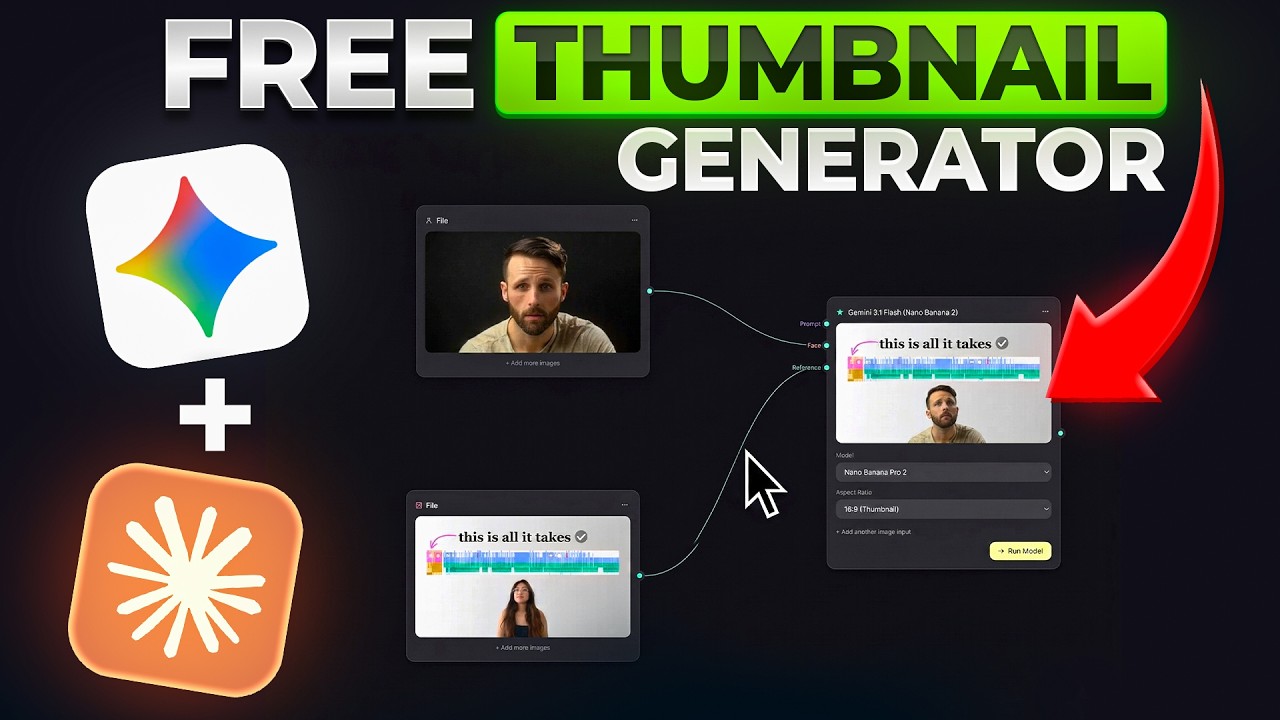
I Was Wasting Hours on Thumbnails…So I Built This
Keywords
Summary
168 words
Critical Evaluation
Value of the Information & Strength of the Argument
The video provides a high-value, practical demonstration of building a custom AI tool. It offers a clear, step-by-step guide that viewers can follow, with real-time testing and debugging that adds authenticity. The argumentation is based on personal experience and practical results, showing the tool’s effectiveness in generating thumbnails that match the creator’s face and desired text. The creator also highlights the cost savings compared to subscription services like Weaviate. However, the evaluation of the AI models is subjective and lacks comparative benchmarks or systematic testing. The video does not address potential limitations or failure cases, which would strengthen the argumentation.
Scientific Rigor, Source Quality, Title Accuracy
The video is a tutorial, so scientific rigor is not the primary focus. The creator references specific tools and APIs (Ideogram, Gemini, Cloudflare, Notion, YouTube Data API) and provides links to the GitHub repository and his newsletter. The sources are relevant and directly support the content. The title accurately reflects the content, and the video delivers on its promise. The creator does not cite any external scientific literature, which is expected for this type of content. The public comments (if any) are not provided, so no analysis of public reception is possible.
207 words
Title / Content Match
The title accurately reflects the video's content: the creator demonstrates building a tool to automate thumbnail design, saving time and effort.
Quality & Reliability
7/10
The video is a practical tutorial demonstrating the construction of a custom AI-powered thumbnail generator. It provides a clear, step-by-step walkthrough of the technical implementation, including API integration, database setup, and deployment. The creator shows real-time testing and debugging, which adds credibility. However, the content is largely anecdotal and lacks rigorous scientific validation or comparative analysis of the tools used. The claims about the effectiveness of the models are based on personal experience rather than systematic evaluation.
Chapters
- Why I hate designing thumbnails
- The infinite canvas approach (and why I'm building my own)
- Choosing the AI models: Ideogram + Gemini
- Starting the build in Cursor
- Building the swipe file system
- Getting API keys (Ideogram + Google AI Studio)
- Pulling thumbnails from Notion
- Adding YouTube playlist thumbnails
- Setting up YouTube Data API in Google Cloud
- First version live — does it actually look good?
- Testing the app and finding bugs
- First image generation test
- Setting up the database (Cloudflare D1 + R2)
- Cloudflare setup walkthrough
Cited Sources
- GitHub repository for the thumbnail generator — The open-source code for the app built in the video.
- AI bootcamp enrollment — Promotional link for the creator's AI bootcamp.
- AI For Mortals newsletter — Newsletter subscription link mentioned in the description.
Concurring Sources
- Ideogram API — The video uses Ideogram for image generation, and the API is referenced as a key component.
- Gemini API — The video uses Gemini (Nano Banana) for image generation, and the API is referenced as a key component.
Contribution & Novelties
The video presents a novel approach to thumbnail generation by combining an infinite canvas interface with AI models that can use face references and reference thumbnails. The creator demonstrates a practical workflow that integrates multiple APIs and services, resulting in a tool that is customizable and open-source. This is a valuable contribution for content creators looking to automate their workflow.
Pour aller plus loin :
- Ideogram API documentation — Official API documentation for Ideogram, one of the models used.
- Gemini API documentation — Official documentation for Google’s Gemini API.
- Cloudflare D1 documentation — Official documentation for Cloudflare’s D1 database.
- Cloudflare R2 documentation — Official documentation for Cloudflare’s R2 storage.
- Weaviate — The platform that inspired the infinite canvas interface.
119 words
Radar Profile
The radar profile shows high scores in quantity of information and technical level, reflecting the detailed tutorial nature. The quality of information and reliability are moderate, as the content is based on personal experience rather than systematic evaluation. Overall, the video is informative and practical, but lacks scientific rigor.