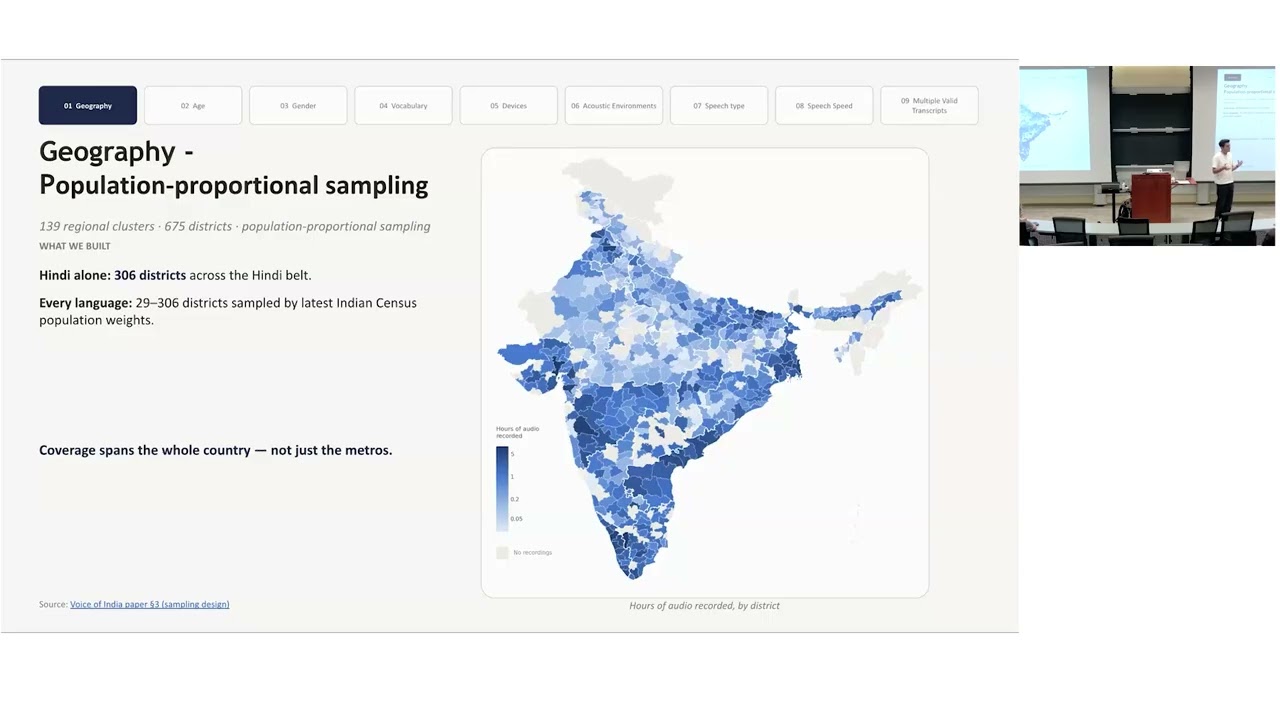
Shobhit Banga, Large Scale Human Evaluations – Rethinking Evaluations for Today’s Voice Models
Keywords
Summary
147 words
Critical Evaluation
Value of the Information & Strength of the Argument
The talk provides valuable insights into the practical challenges and benefits of large-scale human evaluation for voice models. The speaker’s argument is compelling, supported by concrete examples from his projects, such as the impact of multiple valid transcripts on word error rates and the discovery of model-specific weaknesses. He effectively demonstrates that human evaluation can be done at scale within reasonable time and cost, challenging the common resistance to human-in-the-loop approaches. The argumentation is persuasive, though it relies heavily on anecdotal evidence and the speaker’s own experience rather than systematic comparison with alternative methods.
Scientific Rigor, Source Quality, Title Accuracy
The talk is based on the speaker’s own projects and experience, which lends authenticity but limits scientific rigor. No external sources are cited, and the methodology is described at a high level without full transparency. The title accurately reflects the content, which is a case for large-scale human evaluation. The speaker’s claims about cost and time are plausible but not independently verified. The talk would benefit from more detailed methodological disclosure and peer-reviewed validation.
183 words
Title / Content Match
The title accurately reflects the content, which focuses on the case for large-scale human evaluations in voice model assessment.
Quality & Reliability
7/10
The speaker is a practitioner with direct experience in large-scale human evaluation, but the talk is largely anecdotal and lacks peer-reviewed validation or detailed methodological transparency. The claims about cost and time are plausible but not independently verified.
Key Moments
Markers derived by PSI from the transcript: the creator did not define chapters.
- Introduction and background of the speaker
- Motivation for large-scale human evaluation
- Voice of India benchmark: design principles and nine axes
- Data collection process and speaker recruitment
- Multiple valid transcripts and their impact on error rates
- Results and insights from the benchmark
- Cost and time analysis, and feasibility for other languages
- TTS leaderboard project and its design
- Conclusion and call to action for researchers
Cited Sources
- Voice of India benchmark — Mentioned as an ASR benchmark for Indian languages, presented at Interspeech 2026.
- TTS leaderboard — Mentioned as a project for evaluating TTS models across languages and domains.
Concurring Sources
- Interspeech 2026 — Conference where the Voice of India benchmark was presented.
Contribution & Novelties
The talk provides a practical blueprint for conducting large-scale human evaluations of voice models, demonstrating that it is feasible in terms of time and cost. It highlights the importance of considering multiple valid transcripts, which is often overlooked in ASR benchmarks. The speaker’s experience offers actionable insights for researchers and practitioners.
Pour aller plus loin :
- Interspeech — The conference where the Voice of India benchmark was presented.
- Word Error Rate — A key metric discussed in the talk.
- Text-to-Speech — Background on TTS technology.
- Human-in-the-loop — Concept central to the talk’s approach.
93 words
Radar Profile
The radar profile shows high scores in quantity of information and quality of information, reflecting the talk's rich content and practical insights. The technical level is moderate, as the talk is accessible to a broad audience. The global reliability is moderate, due to the anecdotal nature of the evidence.