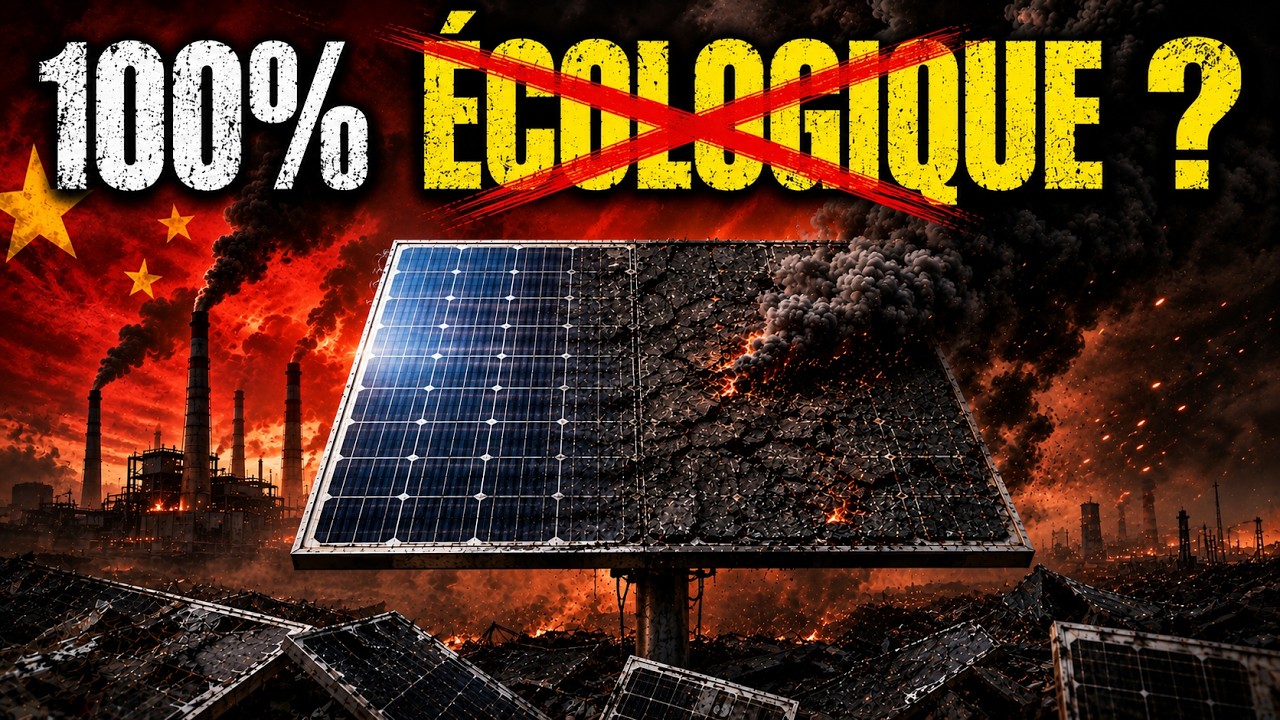
Le Solaire Chinois : La Plus Grosse Arnaque Écologique De L'Histoire ?
Chinese Solar: The Biggest Ecological Scam in History?
Keywords
Summary
166 words
Critical Evaluation
Value of the Information & Strength of the Argument
The video provides valuable insights into the Chinese solar industry’s dominance and its hidden costs. It effectively argues that while solar panels are not an ecological scam from a climate perspective, they raise serious ethical and strategic concerns. The argumentation is solid, using data from the IEA and university reports to support claims. The creator distinguishes between climate impact and ethical/strategic issues, avoiding oversimplification. However, the video could benefit from more direct citations and a more balanced presentation of counterarguments.
Scientific Rigor, Source Quality, Title Accuracy
The video references credible sources such as the International Energy Agency and reports from Sheffield Hallam University, which adds to its scientific rigor. However, it does not provide specific URLs or detailed citations, making verification difficult. The title is somewhat sensationalist but the content is more nuanced, addressing the question directly. The video’s analysis of the UFLPA and its implications is accurate, but it could have explored European regulatory responses more deeply. Overall, the sources are reputable but the lack of explicit references weakens the overall rigor.
182 words
Title / Content Match
The title is provocative but the content addresses the question directly, concluding that solar is not an ecological scam, though it highlights ethical and strategic issues.
Quality & Reliability
7/10
The video provides a nuanced analysis of the Chinese solar industry, citing credible sources like the IEA and university reports. However, it lacks direct citations to specific studies and relies on the creator's interpretation, which may introduce bias.
Chapters
Cited Sources
- International Energy Agency (IEA) reports on solar PV — Cited for data on coal share in solar manufacturing and carbon payback times.
- Sheffield Hallam University reports on Xinjiang solar supply chain — Cited for research on forced labor and the reasons for locating polysilicon production in Xinjiang.
- Uyghur Forced Labor Prevention Act (UFLPA) — Referenced as the U.S. law banning imports from Xinjiang.
Concurring Sources
- IEA report on solar PV — Supports the claim about coal's share in solar manufacturing and carbon payback.
- Sheffield Hallam University research — Supports the claims about forced labor and Xinjiang's role.
Dissenting Sources
- Chinese government statements — The Chinese government denies forced labor allegations, which contradicts the video's claims.
Contribution & Novelties
The video offers a nuanced perspective that challenges both pro-solar and anti-solar narratives. It highlights the carbon payback period as a key metric, which is often overlooked in discussions. It also brings attention to the strategic dimension of solar recycling, which is rarely discussed. The video’s analysis of the UFLPA and its implications for global supply chains is particularly insightful.
Pour aller plus loin :
- Solar panel carbon footprint — Provides background on the carbon footprint of solar panels.
- Polysilicon production — Explains the energy-intensive process of polysilicon production.
- Uyghur Forced Labor Prevention Act — Details the U.S. law and its implications.
102 words
Radar Profile
The radar profile shows high scores in information quantity and quality, indicating a well-researched video. The technical level is moderate, making it accessible to a general audience. The overall reliability is good, but the lack of explicit citations slightly reduces the score.
💬 Sur les 0 commentaires analysés, aucune tendance n'est disponible.