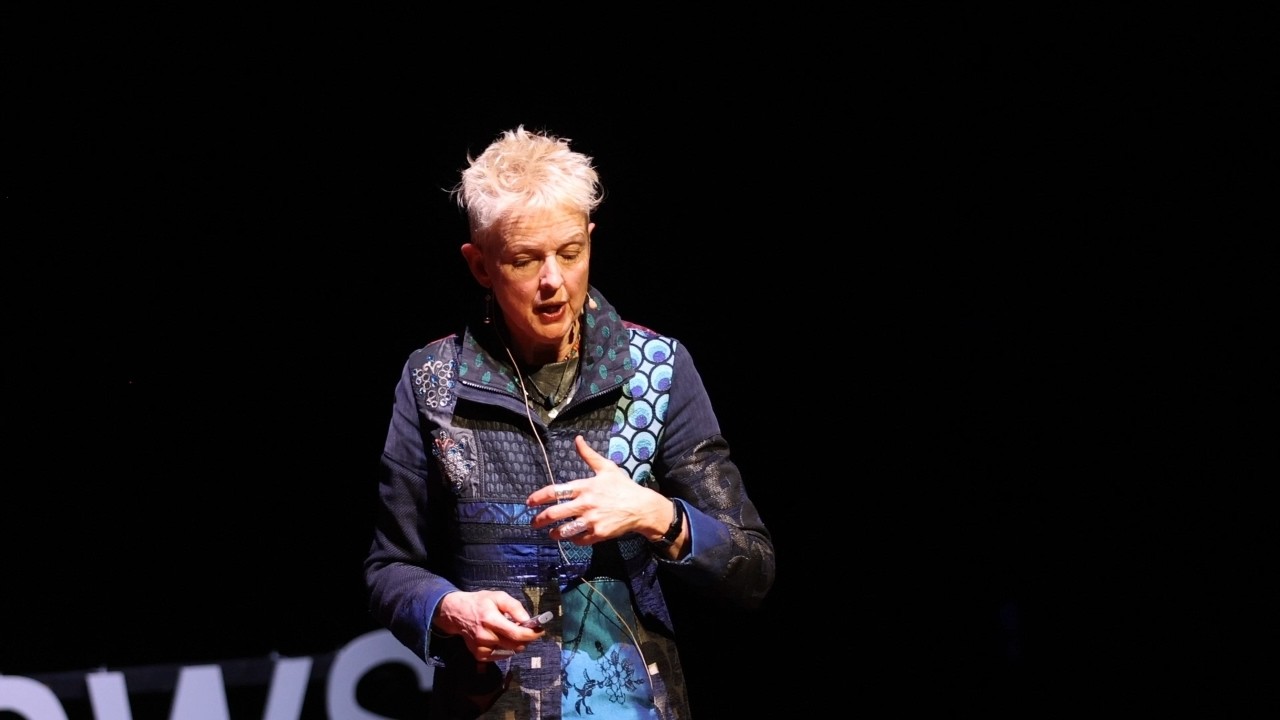
Being in Your element | Julie Brook | TEDxUniversityofStAndrews
Keywords
Summary
184 words
Critical Evaluation
Value of the Information & Strength of the Argument
The talk offers valuable insights into the creative process and the relationship between an artist and their environment. Brook’s argument is built on personal anecdotes and reflections rather than empirical evidence, but it is coherent and compelling. She effectively conveys the importance of practical engagement, resourcefulness, and community in fostering creativity. The narrative is well-structured, moving from her initial experience in Jura to international projects, and finally to a community-focused piece. While the talk is subjective, it provides a unique perspective that could inspire others to reflect on their own alignment with their environment. The argumentation is solid within its scope, though it lacks broader scientific or theoretical grounding.
Scientific Rigor, Source Quality, Title Accuracy
The talk is a personal account, and Brook does not cite external sources or scientific literature. She references her own works and experiences, which are authentic but not independently verifiable. The title accurately reflects the content, as the entire talk revolves around the concept of ‘being in your element’ as illustrated by her practice. The talk is not intended as a scientific presentation, so the absence of citations is not a flaw, but it limits the rigor from a scientific standpoint. The speaker’s credibility is established through her extensive professional career and the detailed descriptions of her projects.
222 words
Title / Content Match
The title accurately reflects the content: the speaker explores the concept of 'being in your element' through her own artistic practice and experiences in nature.
Quality & Reliability
7/10
The talk is a personal, experience-based account by a practicing artist, offering authentic insights into her creative process and philosophy. It is not a scientific study, but it is coherent, reflective, and grounded in years of professional practice. The claims are subjective and not empirically verifiable, but they are presented as such, which maintains intellectual honesty.
Key Moments
Markers derived by PSI from the transcript: the creator did not define chapters.
- Introduction: Julie Brook defines 'being in your element' as alignment between interior and environment.
- Brook describes her decision to live in a natural cliff arch on Jura and the practical preparations.
- She explains the importance of practicality and resourcefulness in her practice, including building shelters.
- Brook discusses creating a garden and channeling the energy of improvisation into her art.
- She talks about her travels in Libya and the influence of Tuareg guides on her understanding of landscape.
- Brook describes working in Namibia with Himba women and the significance of red ochre.
- She discusses collaborative work in a marble quarry in Namibia and the importance of teamwork.
- Brook talks about her project in Japan, creating steps in a quarry and the community's response.
- She reflects on the fire stacks and their deeper meaning related to time and gravity.
- Brook concludes with the 'Tideline' project and the idea of community engagement.
Cited Sources
- TEDx Program — The talk was given at a TEDx event, and this link provides general information about the TEDx program.
Concurring Sources
- TEDx Program — The talk is part of the TEDx series, which aims to share ideas worth spreading, aligning with the speaker's intent to inspire.
Contribution & Novelties
The talk offers a personal and artistic perspective on the concept of ‘being in your element,’ emphasizing the importance of aligning one’s inner self with the environment. It provides a unique case study of an artist living and working in remote landscapes, highlighting the role of practicality, resourcefulness, and community in creative practice. While not scientifically novel, it contributes to the discourse on human-environment interaction and creativity.
Pour aller plus loin :
- Biophilia hypothesis — Related to the innate human tendency to connect with nature, which underpins Brook’s philosophy.
- Place attachment — Explores the emotional bond between people and places, relevant to Brook’s deep connection to Jura.
- Ecotone — Brook mentions the intertidal zone as an ecotone; this concept is central to ecology and her ‘Tideline’ work.
127 words
Radar Profile
The radar profile shows moderate scores across all dimensions, with slightly higher quality and reliability due to the authentic personal experience, but lower technical level and information quantity due to the subjective nature of the talk. The talk is not scientifically rigorous but offers valuable qualitative insights.
💬 No comments were provided for analysis.