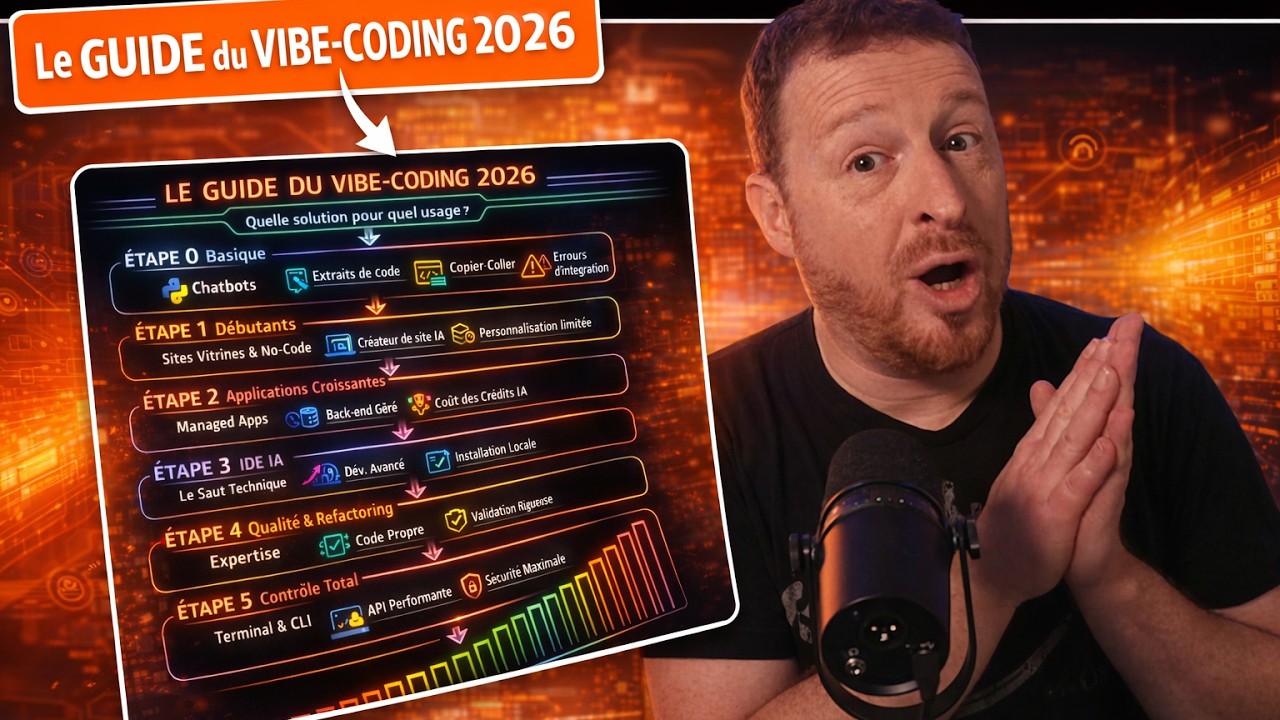
Le guide du vibe-coding 2026 quelle solution pour quel usage
The guide to vibe-coding 2026 which solution for which use
Keywords
Summary
162 words
Critical Evaluation
Value of the Information & Strength of the Argument
The video provides a valuable, practical framework for understanding the landscape of AI-assisted development tools. The argumentation is clear and logical, presenting a progression from simple to complex tools. The creator’s personal experience and examples add credibility, though the lack of external sources or data weakens the overall argument. The value lies in the actionable guidance for choosing the right tool based on project needs and user expertise.
Scientific Rigor, Source Quality, Title Accuracy
The video is an expert opinion piece, not a scientific study. The creator does not cite external sources, but his practical experience is evident. The title accurately reflects the content, which is a guide to vibe-coding tools. The video is well-structured and informative, but the lack of citations and reliance on personal opinion limits its scientific rigor. The video includes a brief mention of a sponsor (Hostinger) but it is not a full sponsorship segment.
158 words
Title / Content Match
The title accurately reflects the content, which is a practical guide to choosing vibe-coding tools based on use case.
Quality & Reliability
7/10
The video offers a clear, structured overview of vibe-coding tools, but relies on personal opinion and experience rather than rigorous scientific evidence. The presenter's expertise is evident, but claims are not backed by citations or data.
Key Moments
Markers derived by PSI from the transcript: the creator did not define chapters.
- Introduction to the concept of vibe coding and the need for a guide.
- Level 0: Using chatbots like ChatGPT, Claude, and Gemini for code generation.
- Level 1: No-code website builders like Hostinger AI, Base44, and 10Web.
- Level 2: Managed app platforms like Bolt, Lovable, and Hostinger Horizons.
- Level 3: AI-powered IDEs like Cursor, Windsurf, and Google Anti-Gravity.
- Level 4: Collaborative environments like Claude Code and Codex for large projects.
- Level 5: Terminal-based CLI tools like Claude Code CLI for maximum control.
- Conclusion and summary of the six levels.
Cited Sources
- Renaud Dékode's website — The creator's website, where discussions and additional resources are available.
Concurring Sources
- Vibe coding - Wikipedia — Provides a general overview of vibe coding, consistent with the video's definition.
Contribution & Novelties
The video provides a clear, structured taxonomy of vibe-coding tools, which is a useful contribution to the discourse. It helps users understand the landscape and choose the right tool for their needs.
Pour aller plus loin :
- Vibe coding - Wikipedia — Provides background on the term and its evolution.
- Claude Code - Anthropic — Official page for Claude Code, a tool mentioned in the video.
- Cursor - AI Code Editor — Official page for Cursor, an AI-powered IDE.
- Bolt.new - StackBlitz — Official page for Bolt, a managed app platform.
91 words
Radar Profile
The radar profile shows high scores in information quantity and quality, indicating a content-rich video. The technical level is moderate, suitable for a general audience. The overall reliability is good, though not backed by external sources.
💬 Sur les 0 commentaires analysés, aucune tendance n'est disponible.