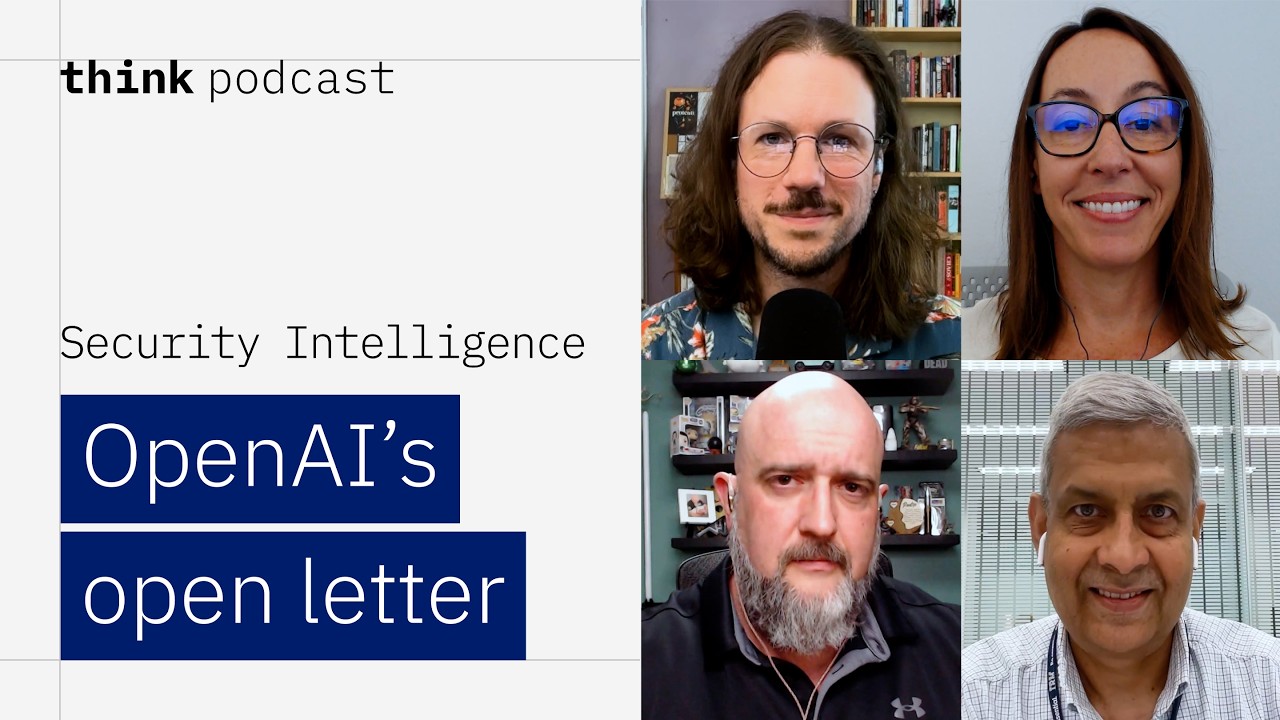
Why OpenAI is calling for a ‘cyber defense surge.’ Plus: Find Evil! winners and TeamPCP losers
Keywords
Summary
192 words
Critical Evaluation
Value of the Information & Strength of the Argument
The episode provides valuable insights into the current state of AI in cybersecurity, particularly the shift toward collective defense and the development of autonomous agents. The panelists offer a balanced perspective, acknowledging both the potential benefits and risks. For instance, they discuss the open letter’s call for sharing remediation strategies as a logical next step beyond traditional threat intelligence sharing. They also critically examine the Find Evil! hackathon results, noting that while autonomous investigation is credible, response actions still require human oversight. The argumentation is solid, with panelists drawing on their professional experience and referencing real-world incidents like the Hugging Face hack and the LightLM breach. However, some points could be more deeply explored, such as the technical details of the winning agents or the specific challenges of implementing AI in diverse organizational contexts.
Scientific Rigor, Source Quality, Title Accuracy
The podcast demonstrates a reasonable level of scientific rigor, with panelists citing specific events and organizations (e.g., SANS Institute, Flare, NVIDIA’s Open Security AI Alliance). The discussion is grounded in their expertise, though they do not provide direct citations to primary sources. The title accurately reflects the content, covering all three main stories. The episode includes a disclaimer about opinions and AI-assisted transcription, which adds transparency. However, the lack of detailed references or links to the discussed reports limits the ability to verify claims independently. The panelists do not explicitly mention any sources beyond the open letter and the hackathon results, so the reliance on their expertise is evident.
258 words
Title / Content Match
The title accurately reflects the main topics covered: OpenAI's open letter on cyber defense, the Find Evil! hackathon winners, and the unmasking of TeamPCP.
Quality & Reliability
7/10
The podcast features expert panelists from IBM X-Force and IBM Security Research, providing informed commentary on recent cybersecurity events. The discussion is balanced, acknowledges potential criticisms (e.g., the open letter as a publicity stunt), and distinguishes between investigation and response in autonomous agents. However, the episode is primarily a discussion of news items without deep technical detail or independent verification of claims.
Chapters
Cited Sources
- Security Intelligence Podcast — Link to the podcast episode page, likely containing additional resources and show notes.
- IBM AI Newsletter — Link to sign up for IBM's monthly AI newsletter, mentioned at the end of the episode.
Concurring Sources
- OpenAI's open letter on cyber defense — The primary document discussed in the episode, calling for a global surge in cyber defense.
- SANS SIFT Workstation — The platform hosting the Find Evil! winning agents, as mentioned in the episode.
Dissenting Sources
- Criticism of OpenAI's open letter as a publicity stunt — The episode mentions a cynical perspective that the letter might be a publicity stunt following the Hugging Face hack, though the panelists largely dismiss this view.
Contribution & Novelties
This episode contributes to the ongoing discourse on AI in cybersecurity by synthesizing recent developments and offering expert commentary. It highlights the emerging trend of collective cyber defense and the practical implications of autonomous agents. The discussion on the distinction between investigation and response is particularly valuable, as it addresses a critical gap in current AI deployment strategies.
Pour aller plus loin :
- OpenAI’s open letter on cyber defense — The actual letter discussed, providing primary source material.
- SANS SIFT Workstation — The platform where the Find Evil! winners are available, offering hands-on tools for forensic analysis.
- MITRE ATT&CK Framework — A knowledge base for adversary tactics and techniques, relevant to understanding threat intelligence sharing and incident response.
- NIST Cybersecurity Framework — A framework for improving cybersecurity posture, aligning with the episode’s discussion on going beyond status quo security.
139 words
Radar Profile
The radar profile shows a balanced performance across all dimensions, with slightly lower scores in technical depth and source rigor. The podcast excels in providing expert commentary and actionable insights, but could benefit from more detailed technical explanations and direct references to primary sources.
💬 No comments were provided for analysis.