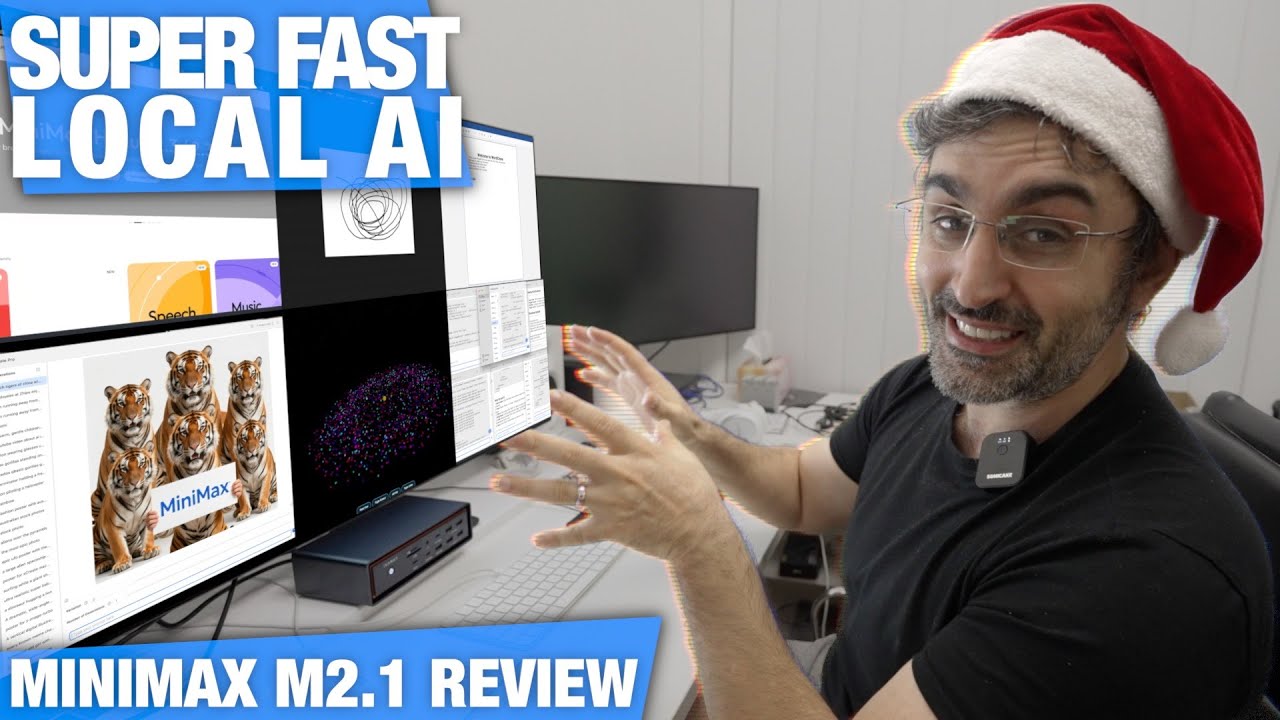
Let's Run Local AI MiniMax M2.1 - Super Fast Coding & Agentic Model | In-Depth REVIEW
Keywords
Summary
224 words
Critical Evaluation
Value of the Information & Strength of the Argument
The video provides substantial hands-on value by demonstrating real-world performance metrics (tokens per second, memory footprint) that users would find useful for hardware planning. The argumentation is structured: the reviewer systematically tests creative writing, tool calling, coding, reasoning, and batching, providing concrete examples and outputs. He also compares performance across different modes (thinking vs non-thinking) and settings (repetition penalty), offering practical advice. However, some assertions are subjective (e.g., ‘better than Claude in vibing’) and may be influenced by affiliate partnerships. The overall argument is coherent and evidence-based, though it relies on a single hardware configuration and lacks statistical rigor.
Scientific Rigor, Source Quality, Title Accuracy
The video references specific sources: the HuggingFace repository for the quantized model (inferencerlabs/MiniMax-M2.1-MLX-6.5bit), the Inferencer app, and companion videos for comparison (GLM 4.6, Kimi K2, etc.). These sources are legitimate for the claims made, though affiliate links in the description could be perceived as conflicts of interest. The title accurately reflects the content, focusing on the local run, speed, and coding capabilities. The reviewer does not cite any external studies or official model papers, relying instead on first-hand testing and subjective comparisons. Overall, the scientific rigor is moderate: it’s a practical review rather than a formal benchmark, but the methodology is transparent and reproducible on similar hardware.
221 words
Title / Content Match
The title accurately reflects the content: focus on running MiniMax M2.1 locally, emphasizing speed, coding, and agentic capabilities.
Quality & Reliability
6/10
Thorough hands-on review with quantitative metrics, but includes subjective assessments, affiliate links that may bias recommendations, and tests on a single high-end Mac Studio limiting generalizability.
Key Moments
Markers derived by PSI from the transcript: the creator did not define chapters.
- First creative writing test: 43 tokens/s, 173GB memory usage
- Tool calling test: fetching webpage and Wikipedia content, correctly using parameters
- Python argument passing question answered correctly with thinking disabled
- Regex challenge: solved after 8,933 thinking tokens, with speed comparison to GLM
- Logical reasoning puzzles: surgeon paradox solved, trolley problem failed on a twist
- Batching test: six concurrent inferences at ~67 tokens/s aggregate, building HTML apps
- Review of generated apps: Word, Photoshop, 3D universe; thinking vs non-thinking comparison
- Final speed test with repetition penalty disabled, demonstrating faster batching
Cited Sources
- MiniMax-M2.1-MLX-6.5bit on HuggingFace — Quantized model used for local inference testing
- Inferencer App — Application used to run the model and perform tests
Concurring Sources
- Companion video: GLM 4.6 review — Comparison of reasoning and coding performance across models
- Companion video: Kimi K2 Thinking — Comparison of agentic and thinking capabilities
External References
Contribution & Novelties
The video offers a practical, performance-focused review of MiniMax M2.1, highlighting its speed advantages for local coding tasks and effective tool use, while also revealing limitations in deep reasoning. It provides quantitative data on tokens per second and memory footprint under various configurations (thinking, batching, repetition penalty), useful for practitioners. The comparison between thinking and non-thinking modes for code generation offers actionable insights.
Pour aller plus loin :
- MLX - Apple’s array framework — Relevant for understanding the MLX quantization and deployment of the model.
- MiniMax official website — Official page for model announcements and technical details, though not directly linked in the video.
- Large language model (Wikipedia) — Background on the technology and evaluation methods.
116 words
Radar Profile
The radar profile shows high scores in quantitative information and technical depth, moderate in quality and reliability. The video excels in hands-on metrics and practical guidance, but its reliability is slightly reduced by subjective judgments and potential bias from affiliate links.