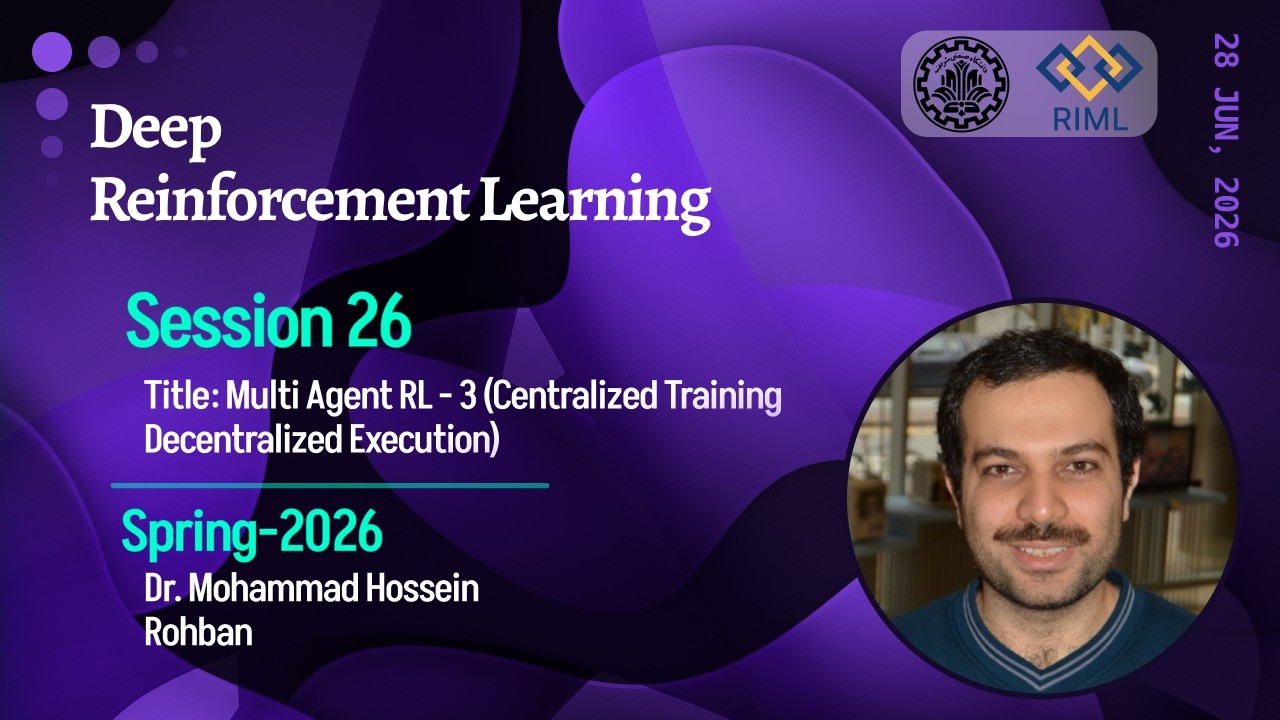
Reinforcement Learning 2026 - Session 26
Keywords
Summary
152 words
Critical Evaluation
Value of the Information & Strength of the Argument
The lecture provides substantial value by clearly explaining the CTDE paradigm and its theoretical underpinnings. The argumentation is solid: the instructor justifies why decentralized execution is necessary for scalability and why centralized training can provide better guidance. They use concrete examples and address potential pitfalls, such as non-stationarity in independent learning. The interactive Q&A adds depth, clarifying misconceptions and exploring edge cases. The reasoning is logical and well-structured, building from basic concepts to more advanced ideas.
Scientific Rigor, Source Quality, Title Accuracy
The scientific rigor is high, as the lecture is based on a well-known textbook (Albrecht et al.) and the instructor demonstrates deep understanding. The sources are clearly referenced (the textbook and slides), though no external papers are cited. The title accurately reflects the content. The lecture is well-organized, with clear explanations and mathematical formulations. The instructor also acknowledges limitations and open questions, which enhances credibility.
156 words
Title / Content Match
The title accurately reflects the content: a session on reinforcement learning, specifically covering multi-agent methods.
Quality & Reliability
8/10
The content is a lecture based on a recognized textbook (Albrecht et al.), with rigorous theoretical explanations and interactive Q&A. The instructor demonstrates deep expertise and provides references, though the video is a recording of a live session with some informal interactions.
Key Moments
Markers derived by PSI from the transcript: the creator did not define chapters.
- Introduction and recap of previous session on game theory and Nash equilibrium.
- Discussion of training and execution modes, and the spectrum from independent to joint learning.
- Introduction of centralized training with decentralized execution (CTDE) and its motivation.
- Explanation of actor-critic architecture for CTDE, with centralized critic and decentralized actor.
- Q&A on marginalization and equilibrium selection in multi-agent learning.
- Discussion of independent deep Q-networks and their limitations.
- Introduction to value decomposition methods for cooperative games.
- Further Q&A on scalability and practical considerations.
- Summary and conclusion of the session.
Cited Sources
- Albrecht et al., 'Multi-Agent Reinforcement Learning: Foundations and Modern Approaches' (Chapter 9) — The lecture is based on this textbook, specifically Chapter 9, which covers CTDE and related methods.
Concurring Sources
- Lowe et al., 'Multi-Agent Actor-Critic for Mixed Cooperative-Competitive Environments' (MADDPG) — This paper introduces a CTDE algorithm with centralized critic, aligning with the lecture's focus.
Contribution & Novelties
The lecture provides a clear and rigorous exposition of CTDE, bridging the gap between independent and joint learning. It emphasizes the actor-critic framework as a natural way to achieve CTDE, and introduces value decomposition as a key technique for value-based methods. The interactive format allows for deep exploration of nuances, such as the impact of equilibrium selection and the challenges of non-stationarity.
Pour aller plus loin :
- Multi-agent reinforcement learning — Overview of the field.
- Actor-critic algorithm — Background on actor-critic methods.
- Value decomposition networks — Original paper on VDN, a value decomposition method.
- QMIX — A popular value decomposition algorithm.
101 words
Radar Profile
The radar profile shows high scores in information quality and technical level, indicating a dense and rigorous lecture. The quantity of information is also high, but the fiabilite_globale is slightly lower due to the informal nature of a live session. Overall, the lecture is well-balanced and suitable for an advanced audience.
💬 No comments were provided for analysis.