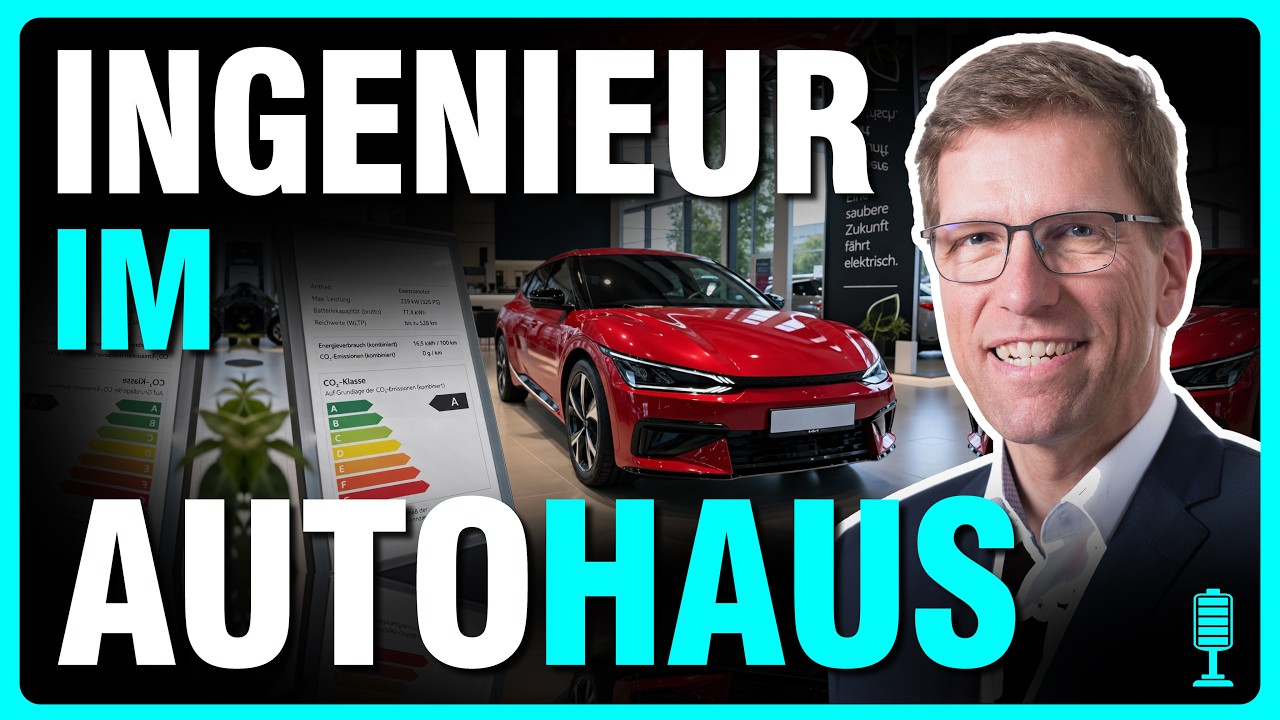
Autohäuser hassen DIESE E-Auto-Fragen!⚡ Prof. Doppelbauer | Geladen Podcast
Car dealerships HATE these EV questions!⚡ Prof. Doppelbauer | Geladen Podcast
Keywords
Summary
156 words
Critical Evaluation
Value of the Information & Strength of the Argument
The value of the information is high, as it provides practical, expert-driven insights for potential EV buyers. Doppelbauer’s arguments are well-structured and supported by data, such as the KBA statistics on average fuel consumption and the comparison of CO2 emissions over a vehicle’s lifetime. He effectively debunks common myths, such as the idea that plug-in hybrids are always efficient or that EV batteries are worse for the environment than oil extraction. The argumentation is solid, though some points rely on general estimates rather than specific studies, which slightly reduces the rigor.
Scientific Rigor, Source Quality, Title Accuracy
The scientific rigor is good, with references to official statistics (KBA) and general research on EV emissions. However, specific sources are not cited in the episode, and the discussion is based on the professor’s expertise rather than a literature review. The title accurately reflects the content, and the episode stays on topic. The comments section shows a generally positive reception, with viewers sharing personal experiences that align with the discussed points.
177 words
Title / Content Match
The title accurately reflects the content: a professor of electric drives answers critical questions about EVs in a car dealership setting, challenging common dealer narratives.
Quality & Reliability
8/10
The episode features Prof. Martin Doppelbauer, a recognized expert in electric drives from KIT, providing detailed technical explanations grounded in data (e.g., KBA statistics, WLTP discrepancies). The discussion is balanced, addressing both pros and cons of EVs, and avoids sensationalism. However, some claims (e.g., average CO2 savings) are presented as general estimates without specific citations, and the podcast format includes personal opinions.
Key Moments
Markers derived by PSI from the transcript: the creator did not define chapters.
- Introduction and first question: what to ask a car dealer about EVs.
- Discussion on plug-in hybrids: real-world consumption vs. advertised values.
- Value retention of EVs vs. combustion engines.
- CO2 footprint of EVs: battery production vs. oil extraction.
- Range anxiety: why charging speed matters more than range.
- Battery size and chemistry: LFP vs. NMC.
- Charging infrastructure and practical advice for buyers.
- Safety aspects of EV batteries and crash performance.
- Final recommendations and summary.
Cited Sources
- FlexiSpot C7 Morpher chair (sponsorship) — Sponsorship segment, not a scientific source.
- FlexiSpot deals — Sponsorship segment, not a scientific source.
- Geladen LinkedIn — Channel social media link.
Concurring Sources
- KBA statistics on average fuel consumption — Referenced in the episode to show real-world consumption trends.
Contribution & Novelties
The episode provides a unique perspective by having an expert simulate a car dealership visit, offering practical advice that is often missing from typical reviews. It emphasizes the importance of charging speed over range, a nuanced view that challenges common consumer priorities. The discussion on CO2 emissions includes a compelling comparison between battery production and oil extraction, which is not often presented in such a balanced way.
Pour aller plus loin :
- WLTP test procedure — Relevant for understanding official consumption figures.
- Lithium-ion battery — Background on battery technology and chemistry.
- Plug-in hybrid — Further reading on the technology and its real-world efficiency.
103 words
Radar Profile
The radar profile shows high scores in quantity of information and technical level, reflecting the expert depth of the discussion. Quality and reliability are also strong, though slightly lower due to the reliance on expert opinion rather than cited studies. The overall balance indicates a highly informative and trustworthy episode.
💬 positif — Sur les 30 commentaires analysés, le climat est très positif, avec de nombreux auditeurs partageant leurs expériences personnelles en accord avec les propos du professeur, et exprimant leur gratitude pour la clarté des explications.