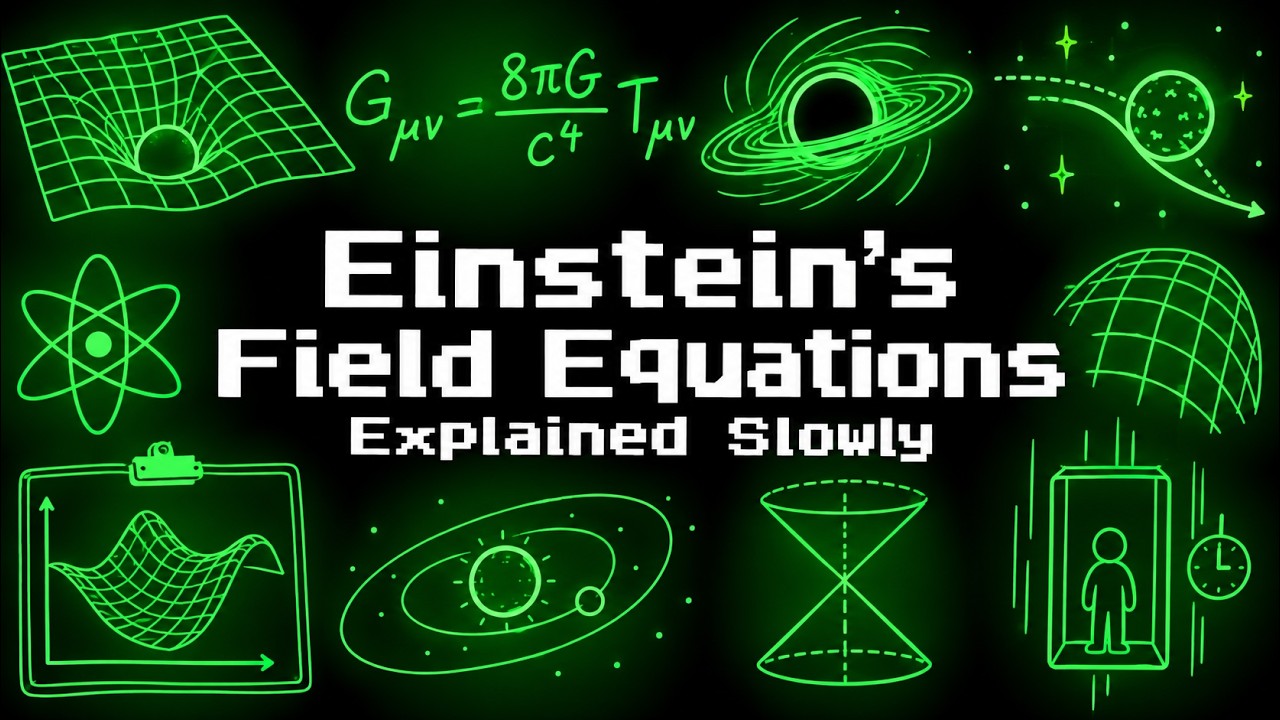
Every Confusing Thing About Einstein's Field Equations Explained Slowly (For Sleep)
Keywords
Summary
167 words
Critical Evaluation
Value of the Information & Strength of the Argument
The video provides substantial value by demystifying a notoriously complex topic. It excels in building an intuitive understanding of abstract concepts like curved spacetime and the metric tensor through analogies (e.g., the rubber sheet) and historical storytelling. The argumentation is solid, following a logical progression from Newton to Einstein, and it correctly emphasizes the conceptual shift from gravity as a force to gravity as geometry. However, it stops short of presenting the actual equations or their mathematical derivation, which might leave some viewers wanting more technical depth. The narrative is engaging and well-structured, making it a valuable educational resource for beginners and those seeking a conceptual overview.
Scientific Rigor, Source Quality, Title Accuracy
The video demonstrates strong scientific rigor in its historical and conceptual accuracy. It correctly attributes key developments and ideas, such as the equivalence principle and the role of Riemannian geometry. The sources cited in the description are reputable and directly relevant, including NASA, LIGO, the American Physical Society, and Einstein Online. The title is an accurate reflection of the content: it is a slow, explanatory journey through the concepts surrounding Einstein’s field equations, explicitly designed for sleep. The video does not overstate its claims and appropriately notes the limitations of general relativity. The public comments, if any, are not provided, so no analysis of audience reception is possible.
230 words
Title / Content Match
The title accurately reflects the content: the video systematically explains the conceptual and historical aspects of Einstein's field equations in a slow, soothing manner, suitable for sleep.
Quality & Reliability
8/10
The video provides a historically and scientifically accurate overview of general relativity, correctly explaining key concepts such as the equivalence principle, tensor calculus, and the Einstein field equations. It cites reputable sources (NASA, LIGO, APS, Einstein Online) and avoids major errors. However, it is a popularization and does not delve into the mathematical derivations, which limits its depth for advanced audiences.
Key Moments
Markers derived by PSI from the transcript: the creator did not define chapters.
- Introduction: The video promises a slow, step-by-step explanation of Einstein's field equations, starting from the beginning.
- Newton's law of gravity and the problem of action at a distance.
- Introduction to special relativity and its two postulates, including the constancy of the speed of light.
- The equivalence principle: Einstein's 'happiest thought' and the equivalence of gravity and acceleration.
- Bernhard Riemann and the development of non-Euclidean geometry, leading to the concept of the metric tensor.
- Einstein's collaboration with Marcel Grossmann and his struggle to learn tensor calculus.
- The final formulation of the field equations in November 1915, including the rivalry with David Hilbert.
- Predictions of general relativity: black holes, gravitational waves, and the expanding universe.
- The mysteries that general relativity cannot solve, such as its incompatibility with quantum mechanics.
Cited Sources
- LIGO Scientific Collaboration – GW150914: First Direct Detection of Gravitational Waves — Referenced in the video description as a resource for the first direct detection of gravitational waves.
- American Physical Society – One Hundred Years of General Relativity — Referenced in the video description as a resource for the history and impact of general relativity.
- NASA – General Relativity and the Nature of Spacetime — Referenced in the video description as a resource for understanding general relativity and spacetime.
- Einstein Online – Gravity: From Weightlessness to Curvature — Referenced in the video description as a resource for the equivalence principle and curvature.
Concurring Sources
- NASA – General Relativity and the Nature of Spacetime — Supports the video's explanation of spacetime curvature and its effects.
- Einstein Online – Gravity: From Weightlessness to Curvature — Aligns with the video's discussion of the equivalence principle and the geometric nature of gravity.
- LIGO Scientific Collaboration – GW150914: First Direct Detection of Gravitational Waves — Confirms the video's mention of gravitational waves as a prediction of general relativity.
External References
Contribution & Novelties
The video’s original contribution lies in its pedagogical approach: it presents the history and conceptual foundations of general relativity in a slow, narrative-driven format explicitly designed for relaxation or sleep. It effectively bridges the gap between popular science and textbook explanations by focusing on the ‘why’ behind the mathematics, making the subject accessible to a broad audience. The video does not present new scientific findings but rather synthesizes existing knowledge in an engaging and digestible manner.
Pour aller plus loin :
- General relativity — Comprehensive overview of the theory, its history, and its experimental tests.
- Einstein field equations — Detailed mathematical formulation and derivation of the field equations.
- Metric tensor — Explanation of the mathematical object that encodes spacetime geometry.
- Equivalence principle — The foundational principle linking gravity and acceleration.
- Gravitational wave — Ripples in spacetime predicted by general relativity, first detected by LIGO.
144 words
Radar Profile
The radar profile shows a balanced performance across all dimensions, with slightly lower scores in technical depth and information quantity, reflecting the video's focus on conceptual explanation rather than mathematical rigor. The high scores in quality and reliability indicate a trustworthy and well-structured presentation.