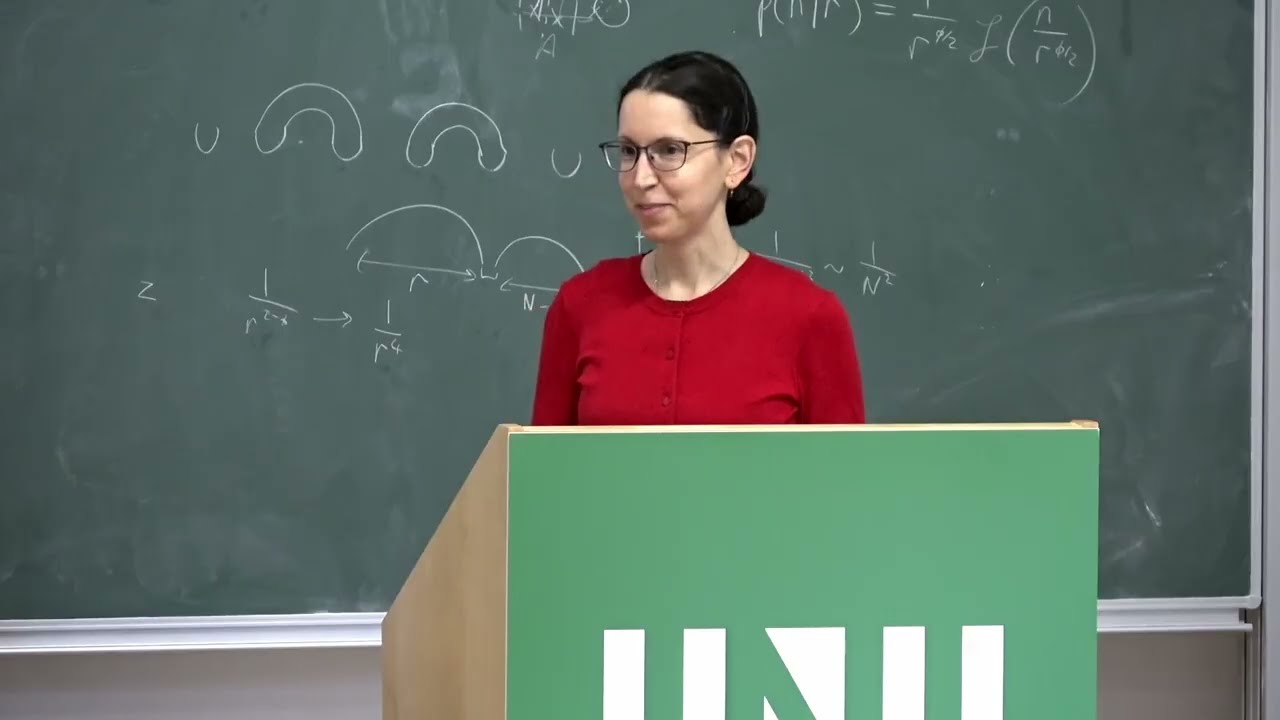
Prof. Nicole Yunger Halpern | Thermalization and its non-Abelian discontents
Keywords
Summary
164 words
Critical Evaluation
Value of the Information & Strength of the Argument
The talk provides a clear and rigorous exposition of a cutting-edge topic, synthesizing recent research on non-Abelian thermodynamics. The argumentation is logically structured: it identifies a gap in standard statistical mechanics, explains why the ETH fails, proposes a modified framework (NAETH), and derives concrete predictions. The speaker supports claims with references to published papers and numerical evidence, and she is transparent about the conjectural nature of the ETH. The discussion of the Wigner-Eckart theorem and its implications is particularly illuminating. The talk also highlights potential applications, such as quantum memory, which adds to its value.
Scientific Rigor, Source Quality, Title Accuracy
The talk is scientifically rigorous, grounded in established physics (ETH, Wigner-Eckart theorem, KMS relation) and recent literature. The speaker cites specific papers and collaborators, and the numerical checks provide support for the NAETH. The title accurately reflects the content, and the talk is well-organized. The audience questions are addressed thoughtfully, indicating depth of understanding. The description provides links to the institute and the specific seminar page, which are relevant sources.
180 words
Title / Content Match
The title accurately reflects the content, which discusses thermalization and the impact of non-Abelian symmetries, echoing the 'discontents' theme.
Quality & Reliability
8/10
Talk by a recognized expert (NIST) at a prestigious institute (INI), based on published peer-reviewed work, with clear logical structure and mathematical rigor. Some claims are presented as conjectures (ETH) but are supported by numerical evidence.
Key Moments
Markers derived by PSI from the transcript: the creator did not define chapters.
- Introduction and motivation: non-commuting charges in thermodynamics.
- Review of the eigenstate thermalization hypothesis (ETH).
- Explanation of why non-Abelian symmetries break ETH premises.
- Introduction of the Wigner-Eckart theorem and its clash with ETH.
- Presentation of the non-Abelian ETH (NAETH) ansatz.
- Numerical support for NAETH and discussion of thermal states.
- Implication 1: Thermalization of time-averaged expectation values.
- Implication 2: KMS relation and its modification.
- Discussion of finite-size corrections and potential for quantum memory.
- Open questions and future work.
Cited Sources
- Isaac Newton Institute for Mathematical Sciences — Host institution and organizer of the workshop.
- Seminar page for the talk — Official page for the seminar, providing details and possibly slides.
Concurring Sources
- Isaac Newton Institute for Mathematical Sciences — The institute's website provides context on the workshop and the speaker's affiliation.
Contribution & Novelties
The talk presents a novel framework (NAETH) that extends the standard ETH to systems with non-Abelian symmetries, addressing a gap in quantum statistical mechanics. It provides concrete predictions for how thermodynamic expectations are modified, such as polynomially larger finite-size corrections in certain regimes, which could have implications for quantum information processing. The talk also highlights the role of the Wigner-Eckart theorem in constraining matrix elements, offering a deeper understanding of thermalization in the presence of non-commuting charges.
Pour aller plus loin :
- Eigenstate thermalization hypothesis — Background on the standard ETH.
- Wigner–Eckart theorem — The theorem that underpins the NAETH.
- Kubo–Martin–Schwinger relation — The KMS relation discussed in the talk.
- Generalized Gibbs ensemble — Related concept for integrable systems.
119 words
Radar Profile
The radar profile shows high scores in information quality and technical level, reflecting the advanced and rigorous nature of the talk. The quantity of information is also high, but the global reliability is slightly lower due to the conjectural nature of the ETH and the limited time for detailed derivations.
💬 Sur les 0 commentaires analysés, aucune tendance n'est disponible.