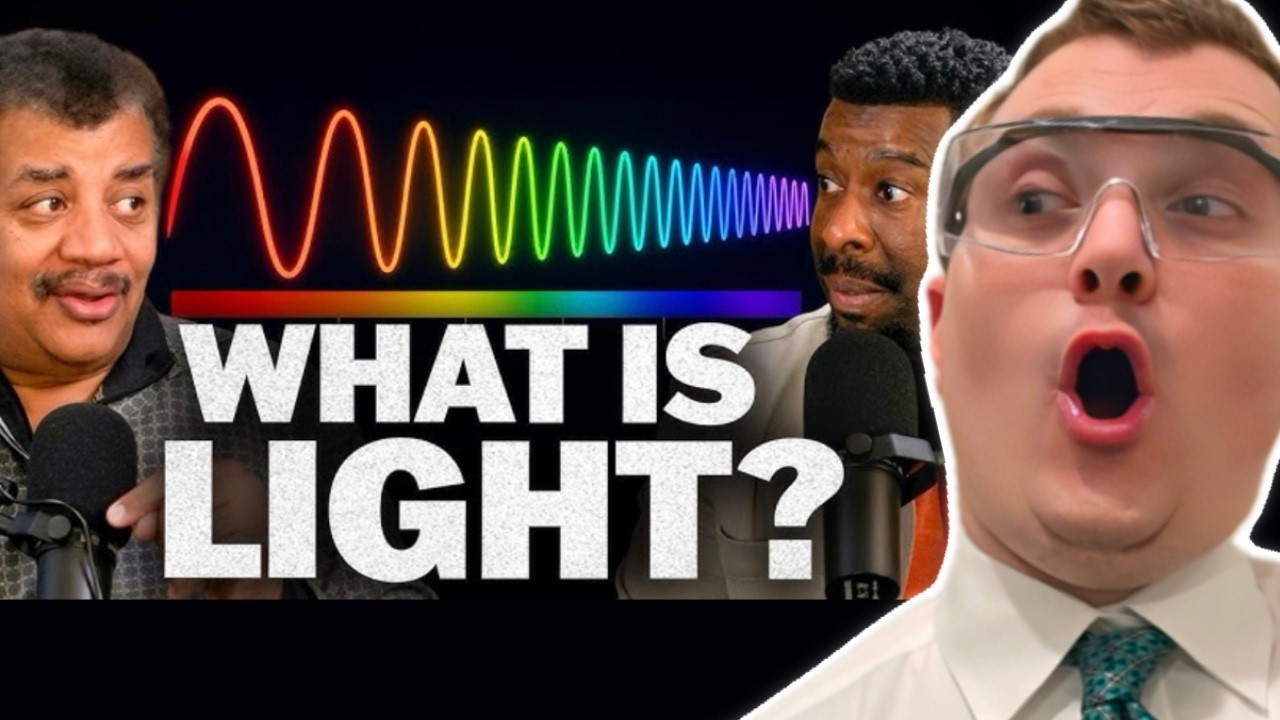
Neil's Most Important Explanation Ever? - Nuclear Engineer Reacts to Startalk
Keywords
Summary
122 words
Critical Evaluation
Value of the Information & Strength of the Argument
The video provides valuable insights by bridging theoretical physics with practical engineering. The nuclear engineer’s perspective adds depth, particularly in explaining radiation detection, the operation of nuclear reactors, and the importance of measurement. The argumentation is solid, relying on established scientific principles and historical anecdotes. The engineer effectively uses analogies to clarify concepts like wave-particle duality and the electromagnetic spectrum. However, the conversational format sometimes leads to tangents, and the argumentation could be more structured. The value lies in the unique combination of astrophysics and nuclear engineering, offering a fresh angle on a fundamental topic.
Scientific Rigor, Source Quality, Title Accuracy
The scientific rigor is high; the content is accurate and well-explained. The engineer references historical figures like Faraday, Maxwell, and Herschel, and the explanations align with textbook physics. The primary source is the StarTalk video, which is a reputable science communication channel. The title is slightly sensationalist but not misleading. The engineer’s personal anecdotes, while not formally sourced, are consistent with known facts. The video does not cite specific academic papers, but the information is reliable. The title accurately reflects the content, though the ‘most important explanation ever’ is hyperbolic.
200 words
Title / Content Match
The title is somewhat clickbait ('Most Important Explanation Ever?') but accurately reflects the content: Neil deGrasse Tyson's explanation of light, with the nuclear engineer's reactions and additions.
Quality & Reliability
8/10
The video is a reaction by a nuclear engineer to a StarTalk episode featuring Neil deGrasse Tyson. The content is scientifically accurate, with the reactor adding practical engineering context. The information is well-explained and aligns with established physics. However, the format is conversational and not peer-reviewed, and the reactor's personal anecdotes, while relevant, are not systematically sourced.
Key Moments
Markers derived by PSI from the transcript: the creator did not define chapters.
- Introduction: Neil deGrasse Tyson sets up the topic of light as electromagnetic radiation.
- Discussion on the importance of measurement in science, with the engineer adding examples from nuclear engineering.
- Explanation of wave-particle duality and the concept of photons.
- Historical context: Ben Franklin and the study of electricity, and Faraday's field concept.
- Unification of electricity and magnetism into electromagnetism, leading to the electromagnetic spectrum.
- Explanation of how color perception works, with the engineer comparing the eye to a radiation detector.
- Discovery of infrared by William Herschel, and the expansion of the known spectrum.
- Discussion on radio waves, microwaves, and their practical applications, including microwave ovens.
Cited Sources
- StarTalk: Neil deGrasse Tyson Explains Light — Original video that the nuclear engineer is reacting to.
Concurring Sources
- Electromagnetic spectrum — Confirms the range of wavelengths and frequencies discussed.
- Wave–particle duality — Supports the explanation of light's dual nature.
Contribution & Novelties
The video adds a unique engineering perspective to a popular science explanation of light. The nuclear engineer’s insights into radiation detection, measurement, and practical applications of electromagnetic waves provide added value beyond the original StarTalk content. The comparison between the human eye and radiation detectors is particularly insightful.
Pour aller plus loin :
- Electromagnetic spectrum — Provides a comprehensive overview of the different types of electromagnetic radiation.
- Wave–particle duality — Explains the fundamental concept that light behaves as both a wave and a particle.
- Infrared — Details the discovery and applications of infrared radiation.
- Microwave oven — Explains the physics behind microwave heating, including dielectric heating.
106 words
Radar Profile
The radar profile shows high scores in information quantity, quality, and reliability, with a slightly lower technical level. This indicates a video that is informative and trustworthy, but not overly technical, making it accessible to a broad audience.
💬 No comments were provided for analysis.