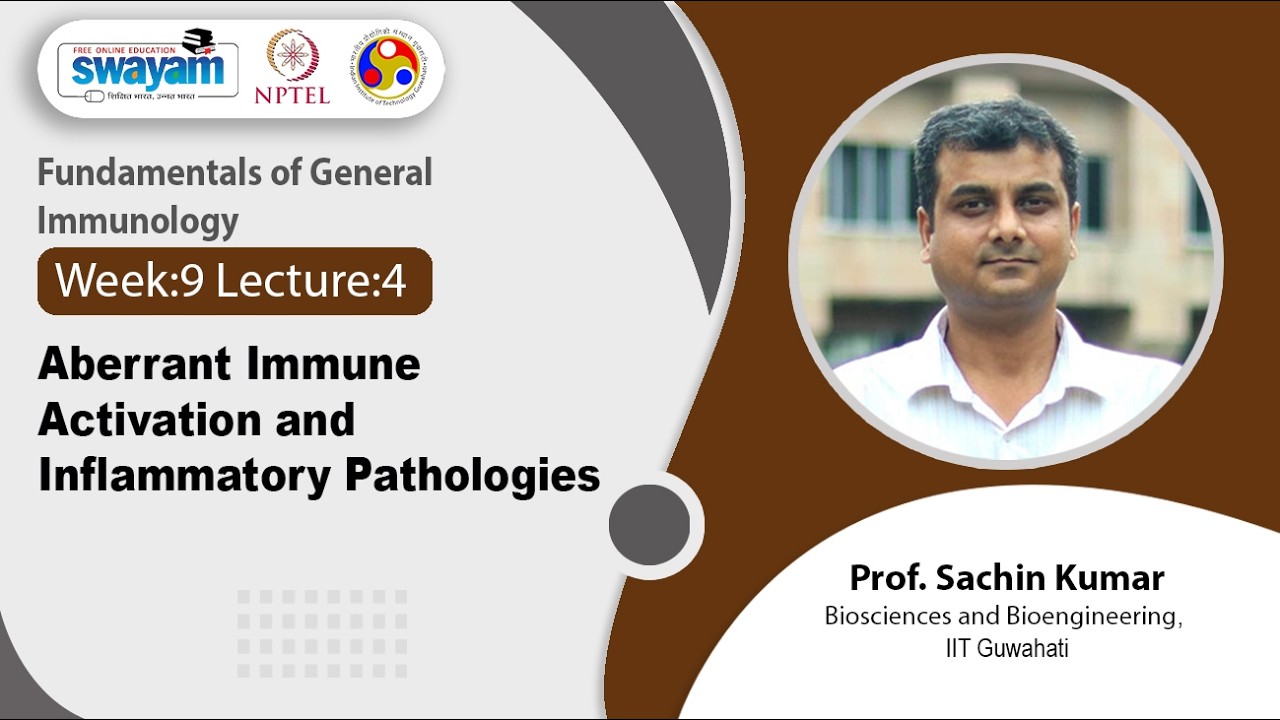
Lec 38: Aberrant Immune Activation and Inflammatory Pathologies
Keywords
Summary
126 words
Critical Evaluation
Value of the Information & Strength of the Argument
The lecture provides a clear and structured overview of immune dysregulation, effectively differentiating between autoimmunity and autoinflammation. The argumentation is logical, building from basic concepts to specific examples. The use of examples like antibiotic-induced gut dysbiosis and the detailed explanation of celiac disease enhances understanding. However, the lecture remains at an introductory level, with limited depth on molecular mechanisms. The discussion on the gut-brain axis is brief and could be more substantiated. Overall, the information is valuable for foundational knowledge but lacks advanced detail.
Scientific Rigor, Source Quality, Title Accuracy
The lecture is scientifically rigorous, delivered by an academic expert, and aligns with established immunology principles. The content is consistent with current understanding, though some simplifications are made for clarity. The title accurately reflects the content. The lecture does not cite specific research papers, but it is part of a formal educational course (NPTEL), which provides a reliable framework. The description includes links to the course and playlist, but no direct references to primary literature.
174 words
Title / Content Match
The title accurately reflects the content, which focuses on aberrant immune activation leading to inflammatory pathologies, including autoimmunity, autoinflammation, allergy, and gut-related disorders.
Quality & Reliability
7/10
The lecture is delivered by an academic expert (Prof. Sachin Kumar, IIT Guwahati) and covers established concepts in immunology. The content is accurate but presented at an introductory level, with some oversimplifications and a few minor inaccuracies (e.g., 'hypothermia' instead of 'hyperthermia'). The lecture is part of a structured NPTEL course, lending credibility.
Key Moments
Markers derived by PSI from the transcript: the creator did not define chapters.
- Introduction to the module on immune dysregulation and pathological responses.
- Definition of immune dysregulation and distinction between autoimmunity and autoinflammation.
- Overview of innate immune cells and their role in autoinflammation.
- Explanation of gut dysbiosis and its consequences, including the gut-brain axis.
- Discussion on factors responsible for immune dysregulation: genetics, microbiome, environmental stressors.
- Introduction to allergic reactions: sensitization and elicitation phases.
- Examples of common allergies: hay fever, pet dander, dust, food allergies.
- Detailed explanation of celiac disease: gluten, TG2, HLA-DQ2/8, and immune response.
- Introduction to inflammatory bowel disease (IBD), including Crohn's disease and ulcerative colitis.
Cited Sources
- Fundamentals of General Immunology - Course Page — Official NPTEL course page providing context and syllabus for the lecture series.
- Playlist: Fundamentals of General Immunology — YouTube playlist containing all lectures of the course.
Concurring Sources
- Autoimmunity (Wikipedia) — Supports the distinction between autoimmunity and autoinflammation.
- Gut–brain axis (Wikipedia) — Corroborates the concept of gut-brain axis mentioned in the lecture.
- Celiac disease (Wikipedia) — Confirms the role of gluten, TG2, and HLA-DQ2/8 in celiac disease.
Contribution & Novelties
The lecture provides a comprehensive introduction to immune dysregulation, effectively bridging basic immunology with clinical pathologies. It offers a clear framework for understanding autoimmunity vs. autoinflammation and highlights the emerging role of the gut microbiome in systemic health. The detailed walkthrough of celiac disease serves as a concrete example of how genetic and environmental factors converge to cause autoimmune conditions.
Pour aller plus loin :
- Autoimmunity — Overview of autoimmune diseases and mechanisms.
- Gut–brain axis — Explores the bidirectional communication between the gut and the brain.
- Celiac disease — Detailed information on celiac disease, including pathogenesis and genetics.
- Inflammatory bowel disease — Covers IBD, including Crohn’s disease and ulcerative colitis.
110 words
Radar Profile
The radar profile shows a balanced performance across all dimensions, with slightly higher scores in information quality and reliability, reflecting the academic nature of the lecture. The technical level is moderate, suitable for an introductory course. The overall profile indicates a solid educational resource.