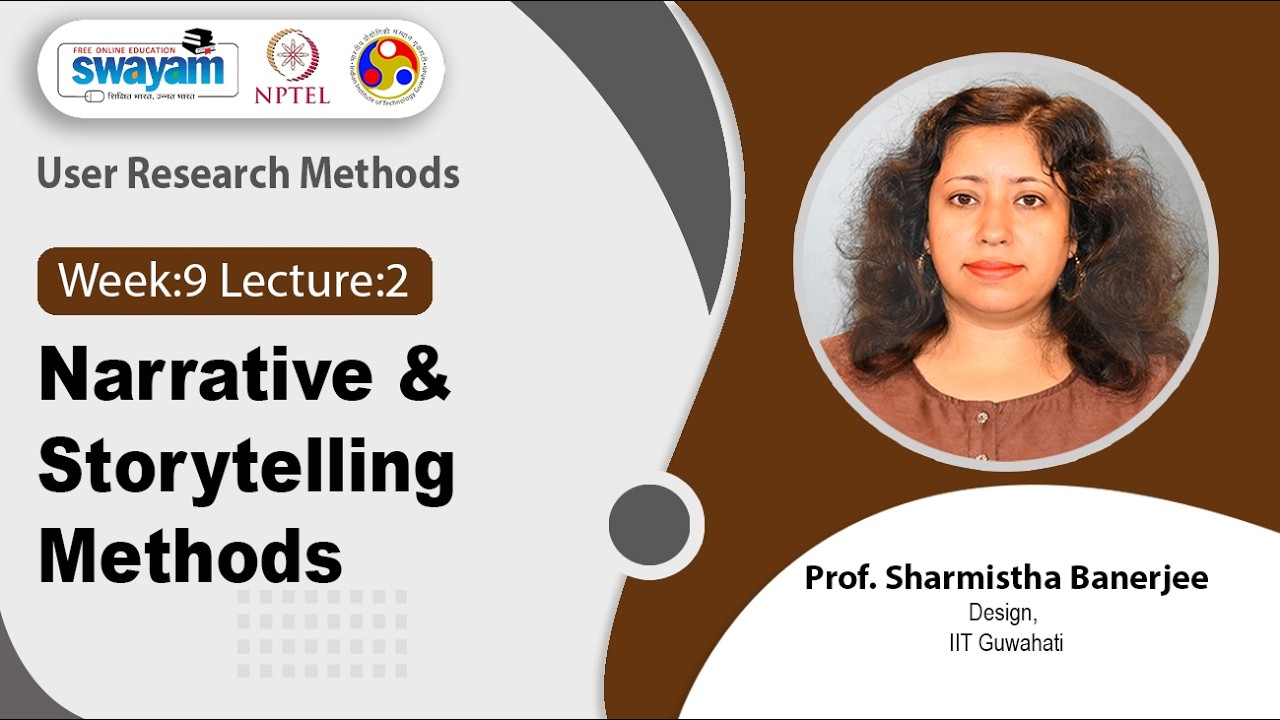
Lec 43: Narrative & Storytelling Methods
Keywords
Summary
137 words
Critical Evaluation
Value of the Information & Strength of the Argument
The lecture provides a comprehensive and practical overview of narrative inquiry methods, with clear step-by-step guidance. The argumentation is solid, built on the premise that stories are a rich source of user data, and it effectively demonstrates how to elicit, analyze, and apply narratives. The use of concrete examples (e.g., the diabetes app, library catalog) strengthens the argument and makes the methods tangible. The instructor also addresses important considerations such as letting the story run and guarding against bias, showing a balanced understanding of the method’s strengths and limitations.
Scientific Rigor, Source Quality, Title Accuracy
The lecture is scientifically rigorous, presenting a well-established qualitative research method. The instructor, a professor at IIT Guwahati, provides a structured and coherent presentation. However, the video does not cite specific external sources or studies; it relies on the instructor’s expertise and illustrative examples. The title accurately reflects the content. The description provides links to the course and playlist, which are relevant for further context but not direct sources for the claims made.
177 words
Title / Content Match
The title accurately reflects the content, which focuses on narrative and storytelling methods for user research.
Quality & Reliability
8/10
The lecture is a well-structured academic presentation by a professor at IIT Guwahati, part of an NPTEL course. It provides a clear framework for narrative inquiry methods, with concrete examples and practical guidance. The content is consistent with established qualitative research practices, though it lacks explicit citations to external sources within the video itself.
Key Moments
Markers derived by PSI from the transcript: the creator did not define chapters.
- Introduction to narrative and storytelling methods for user research.
- Explanation of why stories matter in research, preserving context and emotion.
- Example: patient journey narrative for a diabetes management app.
- Example: story prompts for first-time investors in a fintech app.
- Introduction to the Pixar story spine framework.
- Example: library catalog redesign using the story spine.
- Techniques for eliciting user stories: critical incident, timelines, prompts.
- Analysis of narratives: structure, turning points, voice and emotion, meaning.
- Translating insights into design: pains, personas, scenarios, journey maps.
- Key takeaways and conclusion.
Cited Sources
- NPTEL Course: User Research Methods — Course page for the lecture series.
- NPTEL IIT Guwahati Playlist — Playlist containing this lecture.
Concurring Sources
- Narrative inquiry — Wikipedia article that aligns with the lecture's description of narrative inquiry as a qualitative research method.
Contribution & Novelties
The lecture provides a structured and practical guide to using narrative inquiry in user research, with a clear framework (Pixar story spine) and analysis methods. It emphasizes the value of stories in capturing context and emotion, and offers concrete techniques for eliciting and analyzing narratives. The examples illustrate the application across different domains.
Pour aller plus loin :
- Narrative inquiry — Wikipedia article providing background on the qualitative research method.
- Critical incident technique — Wikipedia article on the technique used to elicit specific events.
- User journey map — Nielsen Norman Group article on journey mapping, a key output of narrative research.
101 words
Radar Profile
The radar profile shows high scores across all dimensions, indicating a well-rounded and reliable lecture. The strongest aspects are the quantity and quality of information, with a slightly lower but still solid technical level and global reliability.