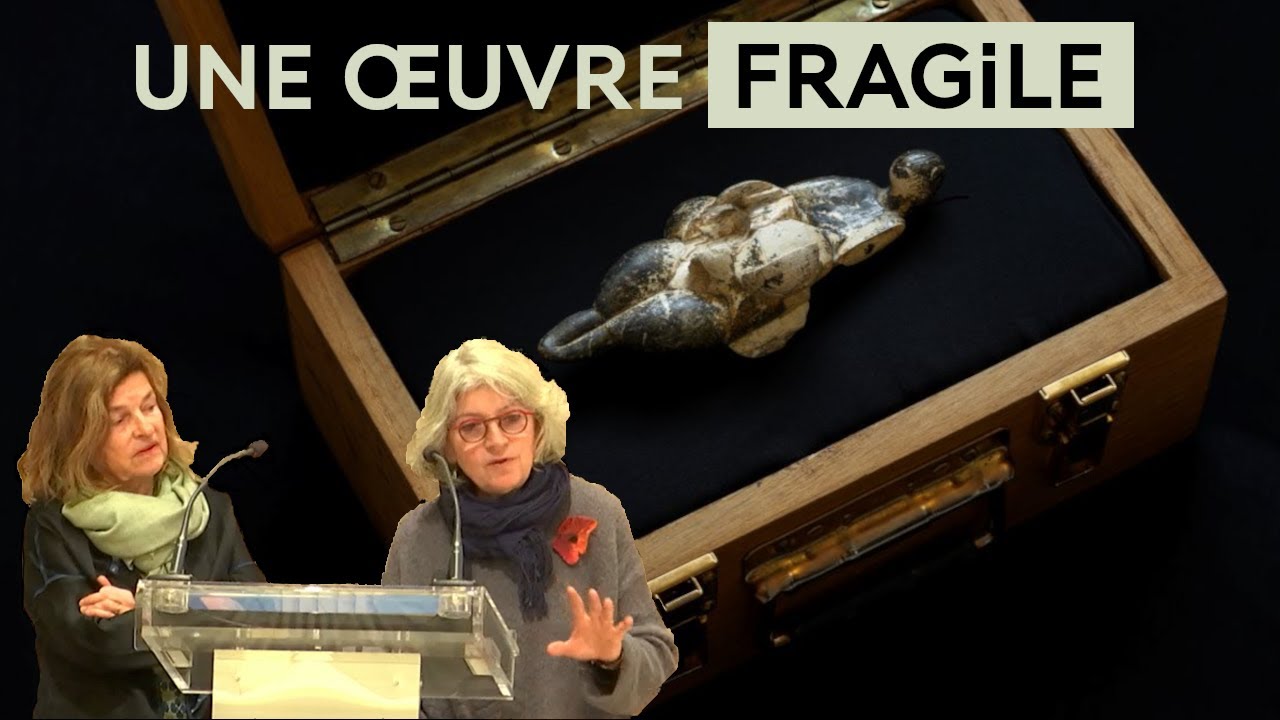
Vénus de Lespugue : une restauration sensible
Vénus de Lespugue: a sensitive restoration
Keywords
Summary
193 words
Critical Evaluation
Value of the Information & Strength of the Argument
The value of the information is high, as it provides a detailed, first-hand account of a conservation project on a major prehistoric artifact. The argumentation is solid, based on direct observation, scientific imaging, and historical documentation. The restorers carefully distinguish between what is known, what is hypothesized, and what remains uncertain, demonstrating scientific rigor. They present evidence for their conclusions, such as the identification of the impact point of the pickaxe based on fracture morphology and the presence of manganese oxide deposits on ancient breaks. The discussion of the manufacturing process is well-supported by traceological analysis and comparisons with other figurines. The talk also raises important questions about the object’s function and the meaning of certain features, acknowledging the limits of current knowledge.
Scientific Rigor, Source Quality, Title Accuracy
The scientific rigor is evident in the methodology: the restorers conducted a thorough examination using binocular microscopy, radiography, and tomography, and they consulted historical archives and publications. They cite the original excavation report by René de Saint-Périer and reference the work of researcher Carole Vercoutère. The sources are appropriate and credible. The title ‘Vénus de Lespugue : une restauration sensible’ accurately reflects the content, which focuses on the restoration process and the sensitive handling of the object. The conference is part of the museum’s public program, and the presentation is adapted for a general audience while maintaining technical depth. The comments on the video are not provided, so no analysis of public reception is possible.
253 words
Title / Content Match
The title accurately reflects the content, which focuses on the restoration process and the material study of the Venus.
Quality & Reliability
8/10
The conference is given by two accredited heritage restorers, based on direct examination of the object and scientific imaging (radiography, tomography). The methodology is rigorous and transparent, with cautious interpretation of the evidence.
Key Moments
Markers derived by PSI from the transcript: the creator did not define chapters.
- Introduction and description of the Venus of Lespugue
- Context of the intervention and the importance of preliminary study
- Material study: mammoth ivory and its properties
- Radiography and tomography: locating the ivory block in the tusk
- Analysis of tool marks and manufacturing techniques
- Alterations: cracks, fractures, and losses
- The pickaxe impact and the discovery narrative
- History of restorations: reassembly and molding
- Discussion on the function and handling of the Venus
- Conclusion and questions from the audience
Cited Sources
- Exposition 'Arts et Préhistoire' — Mentioned as the context of the conference
Concurring Sources
- Venus of Lespugue — General information about the figurine, consistent with the presentation.
Contribution & Novelties
This conference provides a unique, detailed insight into the conservation and material study of the Venus of Lespugue, a major prehistoric artifact. The restorers share their findings from scientific imaging and traceological analysis, offering new hypotheses about the manufacturing process and the object’s history. The discussion of the restoration history, including the use of filling materials and molds, adds to our understanding of conservation practices in the early 20th century.
Pour aller plus loin :
- Venus of Lespugue — Overview of the figurine and its significance.
- Gravettian — The archaeological culture associated with the Venus.
- Mammoth ivory — Properties and uses of ivory in prehistoric art.
106 words
Radar Profile
The radar profile shows high scores in information quality and reliability, with slightly lower scores in quantity and technical level. This indicates a focused, expert presentation that is accessible to a general audience while maintaining scientific depth.