Néandertaliens et humanité de l'Homme
Neanderthals and humanity of Man
Keywords
Summary
148 words
Critical Evaluation
Value of the Information & Strength of the Argument
The lecture provides valuable insights into the historiography of prehistory, demonstrating how scientific interpretations of Neanderthals have been shaped by broader intellectual and political currents. Hurel’s argument is well-structured, using specific examples like Lartet’s work at Aurignac and Mortillet’s classification system to illustrate his points. He effectively shows how scientific narratives are not purely objective but are influenced by the cultural and ideological context of their time. The argumentation is solid, though it is presented as an expert opinion rather than a systematic review, and some generalizations are made for brevity.
Scientific Rigor, Source Quality, Title Accuracy
The lecture demonstrates strong scientific rigor, drawing on historical documents and publications from the 19th century. Hurel, as a historian at the MNHN, is a credible source. The title accurately reflects the content, focusing on the human dimension of Neanderthal research. The sources cited are primarily historical, and the lecture does not rely on modern scientific studies but rather on historical analysis. The adequacy between title and content is good, as the lecture indeed explores the concept of humanity through the lens of Neanderthal studies.
191 words
Title / Content Match
The title accurately reflects the content, which focuses on how Neanderthals have been perceived and represented in the history of prehistory, and what that reveals about humanity.
Quality & Reliability
8/10
The lecture is given by a historian of prehistory at the Muséum national d'Histoire naturelle, providing a well-documented historical analysis. The content is based on archival research and historical sources, though it is an interpretive lecture rather than a peer-reviewed study.
Key Moments
Markers derived by PSI from the transcript: the creator did not define chapters.
- Introduction: the difficulty of maintaining distance from the subject of study.
- Periodization of prehistory: three major periods up to the early 20th century.
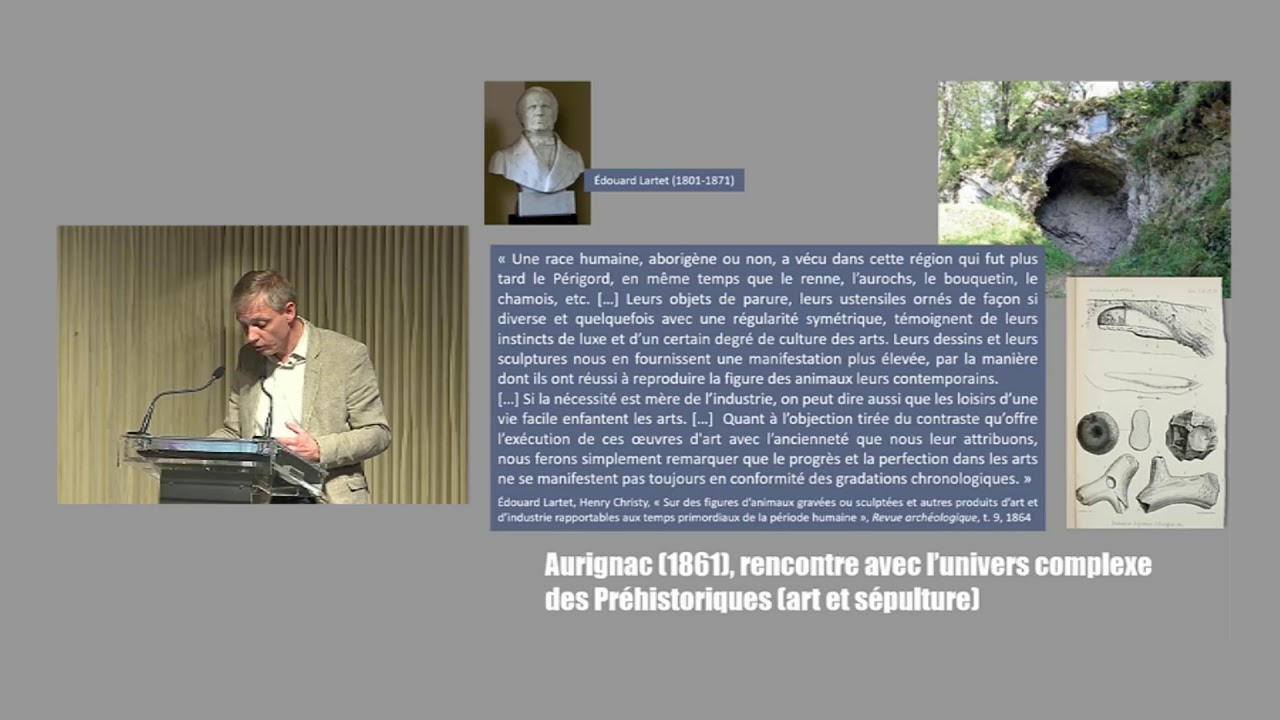
- Édouard Lartet's criteria for establishing human antiquity.
- Lartet's analysis of Aurignac and the diversity of prehistoric material culture.
- Discussion of Armand de Quatrefages and the monogenism debate.
- Gabriel de Mortillet's evolutionary classification and its constraints.
- Mortillet's denial of symbolic or religious practices among prehistoric people.
- The influence of Mortillet's political views on his scientific conclusions.
Cited Sources
- Expo Neandertal — Mentioned as an exhibition related to the topic.
- Playlist of lectures at Musée de l'Homme — Mentioned as a resource for further lectures.
Concurring Sources
- Expo Neandertal — The exhibition likely presents similar historical perspectives on Neanderthals.
Contribution & Novelties
The lecture offers a historical perspective on how Neanderthals have been perceived, emphasizing the constructed nature of scientific encounters. It highlights the contrast between Lartet’s open-minded approach and Mortillet’s rigid system, showing how ideological factors can shape scientific interpretations. This contributes to a deeper understanding of the history of paleoanthropology.
Pour aller plus loin :
- History of paleoanthropology — Provides background on the field’s development.
- Gabriel de Mortillet — Details on the scientist’s life and contributions.
- Édouard Lartet — Information on Lartet’s work and discoveries.
85 words
Radar Profile
The radar profile shows high scores in information quantity, quality, and reliability, with a slightly lower technical level, indicating a well-researched but accessible lecture.