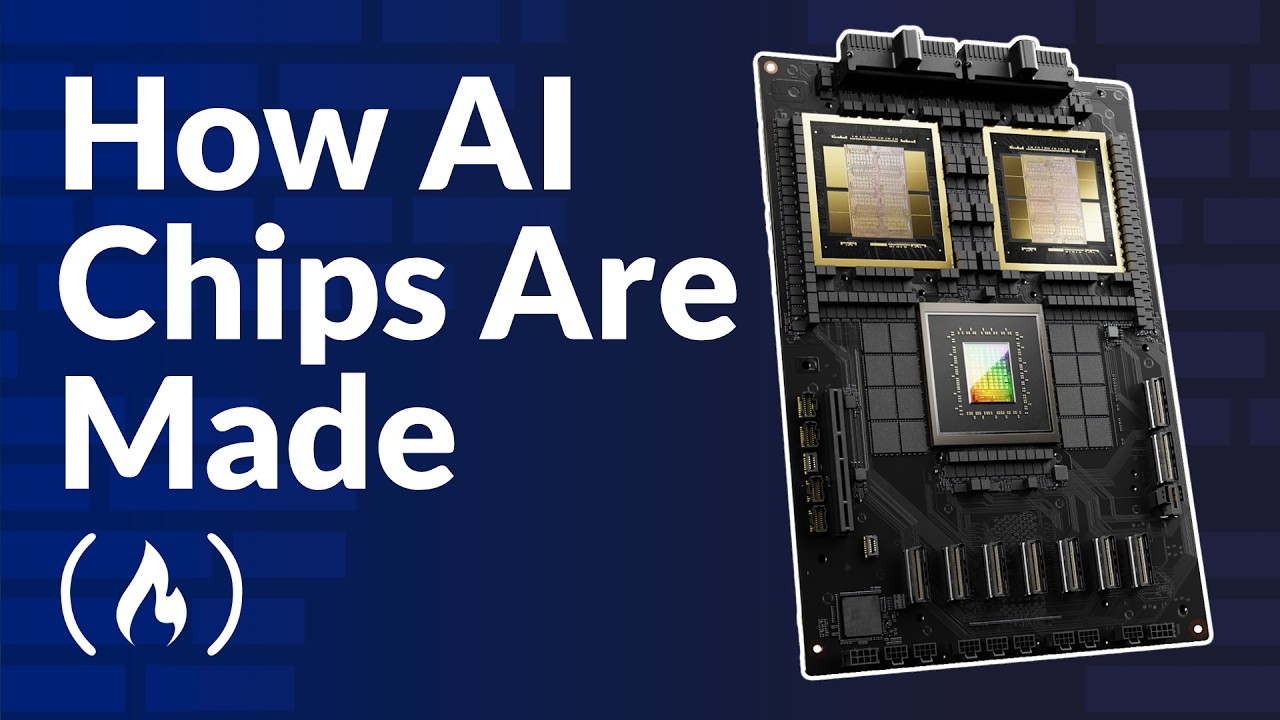
Inside the AI Hardware Engine – Full Semiconductor Supply Chain Course
Keywords
Summary
144 words
Critical Evaluation
Value of the Information & Strength of the Argument
The video provides substantial value by demystifying a complex industry, offering a clear, structured explanation of the semiconductor supply chain. The argumentation is solid, based on technical explanations and industry knowledge. The instructor effectively uses the GB300 as a concrete example to illustrate each stage, making abstract concepts tangible. The discussion of choke points and economic factors adds depth and practical relevance. However, the presentation is largely descriptive, and the instructor occasionally makes claims without providing sources or evidence, which slightly weakens the overall argumentation.
Scientific Rigor, Source Quality, Title Accuracy
The scientific rigor is high for a tutorial format, with accurate technical explanations and up-to-date information. The instructor demonstrates a strong grasp of the subject. However, the video lacks explicit citations to external sources, relying on the instructor’s expertise. The title accurately reflects the content, and the course is well-organized with clear chapters. The description provides links to freeCodeCamp and Scrimba, but these are not directly cited as sources for the technical content. The video’s credibility is enhanced by its detailed and coherent narrative, but it would benefit from referencing primary sources for key claims.
195 words
Title / Content Match
The title accurately reflects the content: a comprehensive course on the semiconductor supply chain, focusing on AI hardware.
Quality & Reliability
8/10
The course is a detailed technical tutorial covering the semiconductor supply chain from physics to data center integration. It is well-structured, with clear explanations and up-to-date information (as of 2026). The instructor demonstrates deep knowledge and uses specific examples (GB300, TSMC, ASML). However, it is a single-source presentation without external verification, and some claims (e.g., specific costs, transistor counts) are not cited to primary sources.
Chapters
- Intro & Course Overview
- GB300 Architecture & Scale-Up vs. Scale-Out
- Reticle Limits, Dual Dies & NV-HBI
- High Bandwidth Memory (HBM)
- Caches, NVLink & PCIe Routing
- Inference Walkthrough & Memory Hierarchy
- Hardware Economics & Transistor Budgets
- Vera Rubin & Next-Gen Roadmap
- Part 1: Semiconductor Physics
- Logic vs. Memory & Clock Speeds
- 1T1C DRAM Cells, SRAM & 3D TSVs
- Transistor Basics & Scaling History
- What Process Nodes Mean (PPA)
- Planar, FinFET & Gate-All-Around
- End of Dennard Scaling
- Rock’s Law & Fab Economics
- The Great Unbundling: Fabless & Foundries
- 4 Modern Semiconductor Business Models
- Part 2: Chip Design & EDA
- SMs, Tensor Cores & Parallelism
- CUDA: The Software Moat
- Nvidia Margins & Market Dominance
- The EDA Flow: RTL to Tape-Out
- Leading-Edge Design Costs
- Synopsys, Cadence & Siemens EDA
- Choke Point #1: Certified EDA Tools
- EDA Export Controls
- Semiconductor IP: ARM vs. RISC-V
- ARM's Move into Custom Silicon
- Fabless: Merchant, In-House & Custom ASICs
- Part 3: Foundries & Manufacturing
- History of TSMC & Morris Chang
- Die Size, Defect Density & Yield Models
- The Fab Scale Flywheel & Capex
- How Apple De-Risked Node Ramps
- 5 Pillars of a Dependable Foundry
- TSMC Roadmaps (N2, A16) & High-NA EUV
- Wafer Pricing Trends
- Choke Point #2: Leading-Edge Foundry Capacity
- Geographic Concentration & TSMC Global Fabs
- The Fall & Restructuring of Intel
- Intel 18A / 14A Turnaround Plan
- Rapidus, SMIC & Global Foundry Frontier
- Wafer Fab Equipment (WFE) Overview
- Silicon Ingots & Spruce Pine Quartz
- Photomasks & Reticle Costs
- Inside the Fab: Building a Wafer Layer
- Doping & Annealing
- Inline Inspection & Wafer Travel
- Why Wafer Cycles Take 3–4 Months
- Cleanroom Standards: ISO 1 Air
- ASML & High-NA EUV Colossus
- Optical Columns & Carl Zeiss Mirrors
- The Extreme Supply Chain Behind EUV
- Numerical Aperture & Resolution Limits
- 3D NAND Stacking & High Aspect Etch
- Applied Materials, Lam Research & TEL
- Metrology & Inspection: KLA’s Moat
- Choke Point #3: Japanese Materials
- Material Shocks: Neon, Quartz & Embargoes
- The Other 90%: Legacy Nodes & Auto Shortages
- Part 4: Memory Cycles & HBM
- DRAM Economics & Supplier History
- The AI Memory Wall
- HBM3E Specs & TSV Wafer Penalty
- Part 5: Advanced Packaging & Interconnect
- Anatomy of CoWoS-L
- Choke Point #4: Advanced Packaging
- NVLink, NV-Switch Trays & SuperNICs
- Part 6: Geopolitics & Policy Risk
- Escalation of US-China Export Controls
- Nvidia’s Access to China
- Collateral Impact: Automotive Mature Nodes
- China's Counter-Strategy: Yield vs. Power
- Tooling & Domestic Supply Chain Gaps
- Taiwan Conflict Scenarios & Economic Impact
- Diverging AI Hardware Stacks
- Rack-Scale Power Limits (135 kW)
- Conclusion: Core Supply Chain Choke Points
Cited Sources
- freeCodeCamp News — General resource for articles on programming and technology, linked in the description.
- Scrimba — Sponsor link, not a source for the course content.
- freeCodeCamp — Main platform hosting the course, linked in the description.
Concurring Sources
- Semiconductor supply chain — General overview of the semiconductor industry, consistent with the video's content.
- High Bandwidth Memory — Technical details on HBM, matching the video's explanation.
Contribution & Novelties
The course provides a unique, comprehensive overview of the semiconductor supply chain, specifically tailored to AI hardware. It connects technical details (transistor physics, packaging) with economic and geopolitical factors, offering a holistic view rarely found in a single resource. The use of the GB300 as a case study makes the information concrete and current.
Pour aller plus loin :
- Semiconductor supply chain — Overview of the industry and its supply chain.
- High Bandwidth Memory (HBM) — Technical details on HBM technology.
- TSMC — Information on the leading foundry.
- ASML — Details on the EUV lithography equipment maker.
- CoWoS packaging — Explanation of advanced packaging technology.
105 words
Radar Profile
The radar profile shows high scores in quantity of information, quality, and technical level, with a slightly lower score in reliability. This indicates a content-rich, technically sound tutorial, but with some limitations in source citation and verification.