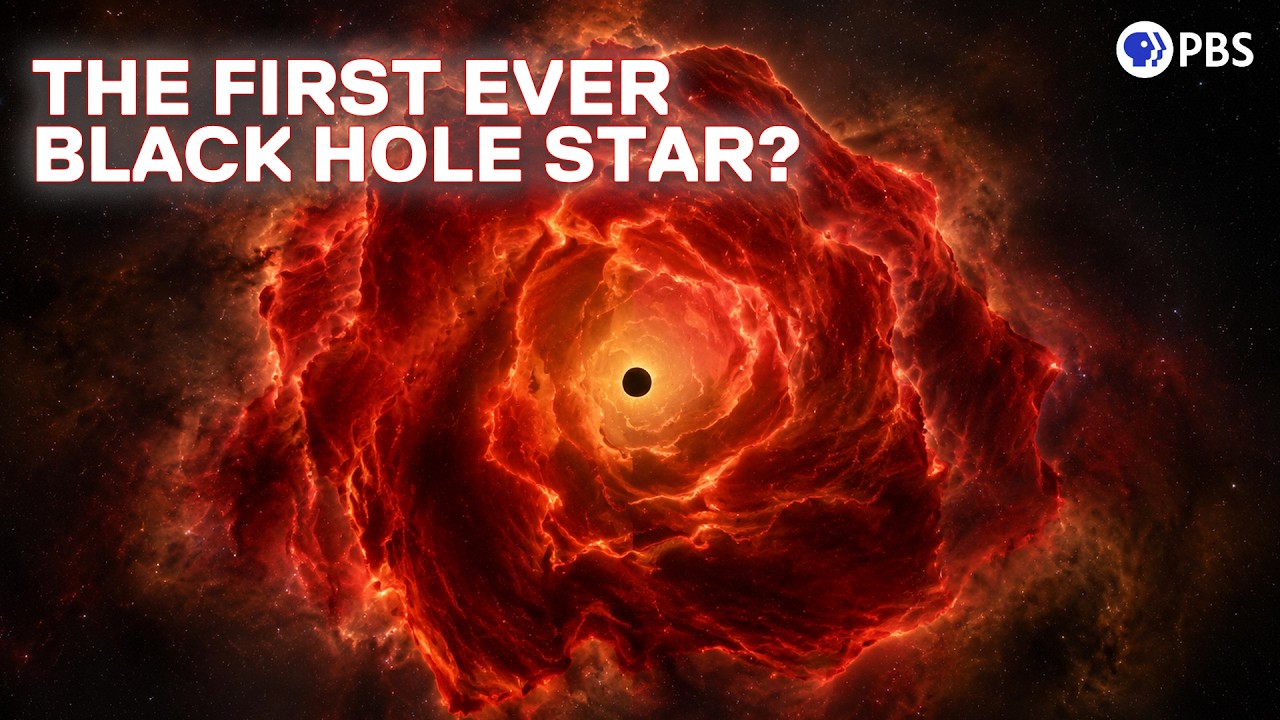
JWST May Have Discovered a New Cosmic Object: The Black Hole Star
Keywords
Summary
179 words
Critical Evaluation
Value of the Information & Strength of the Argument
The video provides high-value information by explaining a complex astrophysical problem and a potential solution in an accessible yet rigorous manner. It builds the argument step-by-step: starting with the problem, explaining the Eddington limit, introducing the little red dots, and then presenting the black hole star hypothesis. The argumentation is solid, clearly distinguishing between established facts and interpretations. It also acknowledges uncertainties and the need for more observations, which enhances its credibility.
Scientific Rigor, Source Quality, Title Accuracy
The scientific rigor is high: the host is an astrophysicist, and the content is based on a recent Nature publication. The video explains the physics behind the observations (Balmer break, emission lines, Eddington limit) accurately. However, the description lacks direct links to the original research articles, which is a minor weakness for viewers seeking primary sources. The title accurately reflects the content, and the video stays on topic throughout.
156 words
Title / Content Match
The title accurately reflects the content: the video discusses JWST's potential discovery of a black hole star as a solution to the problem of early supermassive black holes.
Quality & Reliability
8/10
The video presents a well-structured explanation of a recent scientific discovery, referencing a Nature publication and explaining the underlying physics (Eddington limit, Balmer break). The host is an astrophysicist, and the content is consistent with current scientific understanding, though it is a popularization and the interpretation is not yet confirmed.
Key Moments
Markers derived by PSI from the transcript: the creator did not define chapters.
- Introduction to the problem: early supermassive black holes and the Eddington limit.
- Explanation of little red dots and how they worsen the problem.
- Introduction of MoM-BH-1* and its peculiar spectrum with Balmer break and broad lines.
- Discussion of the dense cocoon enabling super-Eddington accretion.
- Explanation of how scattering may overestimate black hole masses, potentially solving the problem.
Cited Sources
- PBS Space Time Patreon — Support page mentioned in the video.
- Space Time Merch Store — Merchandise store mentioned in the video.
- Space Time Mailing List — Mailing list signup mentioned in the video.
- Space Time Library Search — Search tool for past episodes mentioned in the video.
- End Credits Music by J.R.S. Schattenberg — Music credit for the end credits.
Concurring Sources
- Nature publication by Rohan Naidu et al. — The study presenting the analysis of MoM-BH-1* (not directly linked in the video description).
Contribution & Novelties
The video presents a novel interpretation of JWST data that could resolve a major cosmological puzzle. It explains the concept of a ‘black hole star’—a dense cocoon around an accreting black hole—and how it might enable super-Eddington accretion and bias mass estimates. This is a significant contribution to science communication, making cutting-edge research accessible.
Pour aller plus loin :
- Eddington limit — The theoretical limit on accretion rate, central to the discussion.
- Balmer break — The spectral feature used to identify the black hole star.
- James Webb Space Telescope — The observatory that made the discovery.
96 words
Radar Profile
The radar profile shows high scores in information quantity and quality, with a slightly lower technical level, indicating a well-balanced popular science video that is both informative and accessible.
💬 Très positif. Sur les 30 commentaires analysés, la grande majorité exprime une forte appréciation de la vidéo, avec de nombreuses références humoristiques à la chanson 'Black Hole Sun' de Soundgarden, mais aussi des éloges pour la qualité de l'explication et la pédagogie de Matt O'Dowd.