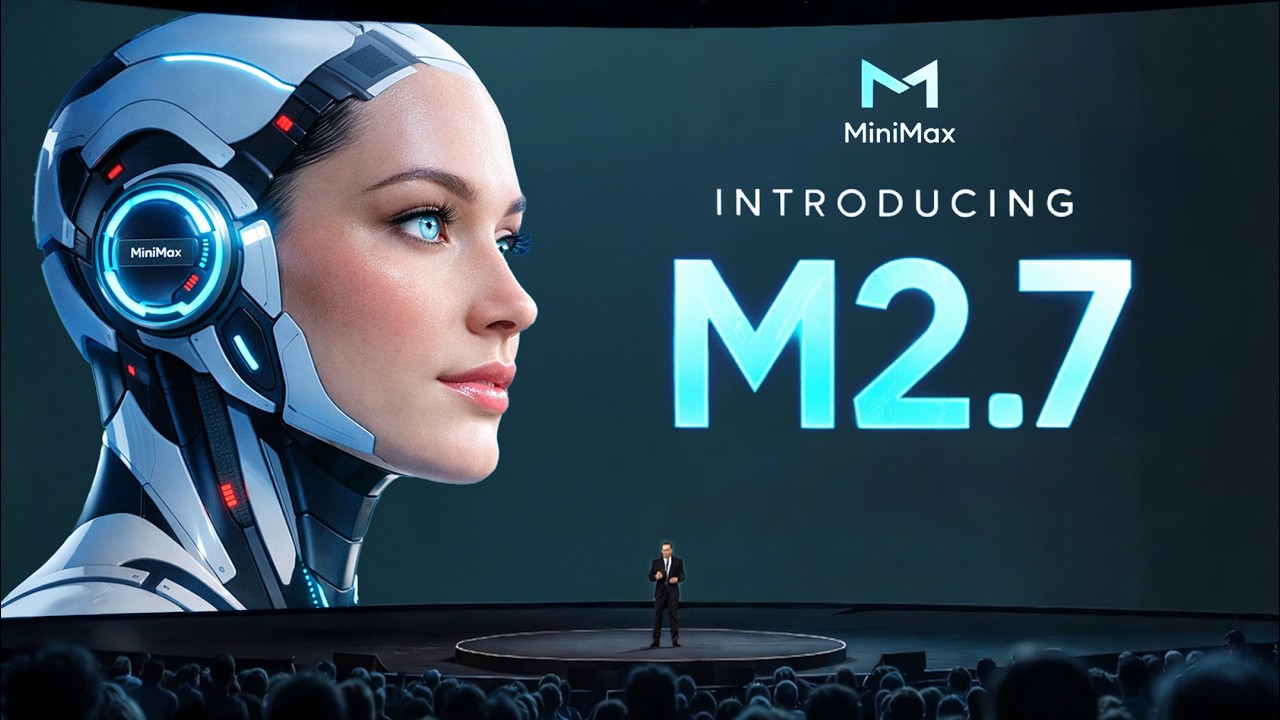
China’s New Self Improving Open AI Beats OpenAI
Keywords
Summary
150 words
Critical Evaluation
Value of the Information & Strength of the Argument
The video provides a comprehensive overview of recent AI releases, with specific benchmark numbers and technical details, which adds value for viewers tracking AI progress. The argumentation is largely based on vendor-provided data and official announcements, which are presented without critical scrutiny. The host’s enthusiasm is evident, but the lack of independent verification or discussion of limitations (e.g., potential benchmark overfitting) weakens the critical analysis. The inclusion of multiple sources and links to official pages supports the credibility of the information, but the narrative is promotional in tone.
Scientific Rigor, Source Quality, Title Accuracy
The video cites official sources for each major announcement, including Hugging Face for MiniMax M2.7, Meta’s blog for Muse Spark, and Google Labs for Mixboard. These are reputable primary sources. However, the video does not critically evaluate the benchmarks or compare them across independent studies. The title is somewhat misleading as it implies a direct comparison between MiniMax and OpenAI, but the video covers a broader range of updates. The content is generally accurate but presented with a promotional bias, typical of AI news channels.
188 words
Title / Content Match
The title is somewhat sensationalist and focuses on MiniMax M2.7, but the video covers multiple AI updates, not just the comparison with OpenAI.
Quality & Reliability
7/10
The video reports on recent AI model releases and features, citing official sources and benchmarks. However, some claims (e.g., self-improvement results) are based on vendor-provided data without independent verification, and the video includes promotional content.
Key Moments
Markers derived by PSI from the transcript: the creator did not define chapters.
- Introduction to the video's topics
- MiniMax M2.7 open-sourced on Hugging Face
- Engineering and office benchmarks for M2.7
- Self-evolving AI breakthrough: M2.7 improves its own scaffold
- Runable RunClaw AI agent launch and $2M ARR
- Google Mixboard voice mode and workspace features
- OpenAI unified Codex app and Scratchpad
- Meta Muse Spark launch and contemplating mode
Cited Sources
- MiniMax-M2.7 on Hugging Face — Official model card and weights for MiniMax M2.7
- Runable RunClaw — Product page for RunClaw AI agent
- Google Mixboard — Google Labs page for Mixboard
- OpenAI unified Codex app and Scratchpad — Article about OpenAI's Codex app development
- Meta Muse Spark — Meta AI blog post introducing Muse Spark
Concurring Sources
- MiniMax-M2.7 on Hugging Face — Official model card and weights for MiniMax M2.7
- Meta Muse Spark — Meta AI blog post introducing Muse Spark
Contribution & Novelties
The video’s main contribution is aggregating and summarizing recent AI model releases and features, providing a snapshot of the competitive landscape. It highlights MiniMax’s self-improving AI as a notable advancement, which is a relatively novel concept. The video also discusses the trend toward agentic AI systems that can execute tasks autonomously.
Pour aller plus loin :
- Self-improving artificial intelligence — Overview of the concept and its implications.
- Mixture of experts — Technical background on the architecture used in M2.7.
- AI agent — General concept of AI agents, relevant to RunClaw and Codex.
- Benchmark (computing) — Context for understanding model benchmarks.
100 words
Radar Profile
The radar profile shows high scores in quantity of information and technical level, reflecting the video's detailed coverage of benchmarks and features. The quality and reliability scores are moderate, indicating that while the information is sourced, it lacks critical analysis and independent verification. The overall profile suggests a content that is informative but not deeply analytical.
💬 Sur les 0 commentaires analysés, aucune tendance n'est disponible.