Keywords
Summary
202 words
Critical Evaluation
Value of the Information & Strength of the Argument
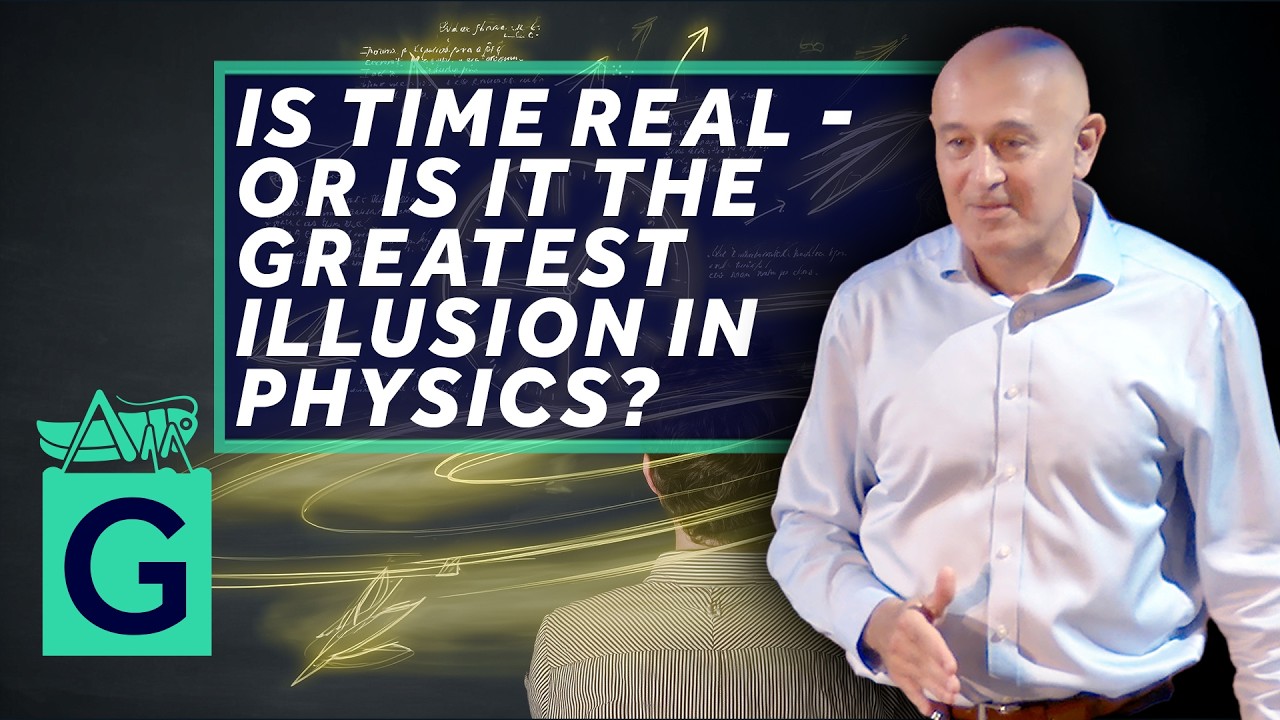
The lecture provides a high-value, comprehensive overview of the nature of time, synthesizing philosophical and physical perspectives. Al-Khalili’s argumentation is clear and logically structured, moving from ancient philosophical debates to modern physics. He effectively uses analogies (e.g., the road of time, temperature as emergent property) to make complex concepts accessible. He presents multiple viewpoints (time as illusion, emergent, or fundamental) and supports each with relevant scientific context. The discussion of Laplace’s demon is particularly strong, incorporating chaos theory and information theory to argue against determinism. The lecture is not merely descriptive; it engages with open questions and encourages critical thinking about the nature of time.
Scientific Rigor, Source Quality, Title Accuracy
The lecture demonstrates high scientific rigor. Al-Khalili, a distinguished professor of physics, accurately presents established theories such as special and general relativity, thermodynamics, and quantum mechanics. He correctly explains time dilation and its practical application in GPS, and references the work of Kip Thorne in the context of Interstellar. The discussion of the Wheeler-DeWitt equation and emergent time is presented as speculative but grounded in current research. The title accurately reflects the content, which is a broad but rigorous exploration of time in modern physics. The lecture is well-structured with clear chapters, and the content is consistent with the scientific consensus. The description provides links to the transcript and a Q&A session, enhancing the credibility of the source.
238 words
Title / Content Match
The title accurately reflects the content: a comprehensive overview of the nature of time from the perspective of modern physics, covering philosophical and physical aspects.
Quality & Reliability
9/10
Lecture by a distinguished professor of physics, with clear structure, references to established theories (relativity, thermodynamics, quantum gravity), and no obvious errors. The content is well-supported by the scientific consensus, though some speculative ideas (e.g., emergent time) are presented as such.
Chapters
- // Introduction — five chapters on the nature of time
- // The philosophical problems — Parmenides vs Heraclitus
- // Physical time — time as number, dimension and arrow
- // What does it mean for time to flow?
- // Laplace's demon and why the future is unpredictable
- // Is time fundamental, emergent or just a measuring tool?
- // The block universe — all moments coexist in spacetime
- // Time dilation — GPS satellites, black holes and Interstellar
- // Quantum gravity and the Wheeler-DeWitt equation
- // The arrow of time — entropy, shuffling cards and the second law
- // Loschmidt's paradox and the past hypothesis
- // Does time have a beginning and an end?
- // Conclusion — time is real but the deepest questions remain open
Cited Sources
- Transcript of the lecture — Official transcript of the lecture on the Gresham College website.
- Q&A session — Follow-up Q&A session related to the lecture.
- Gresham College website — Institution providing free public lectures.
Concurring Sources
- The Order of Time — Carlo Rovelli's book, which argues that time is emergent, aligning with one of the views presented in the lecture.
Contribution & Novelties
The lecture synthesizes a wide range of ideas about time from philosophy and physics, offering a clear and engaging overview. Its original contribution lies in its accessible presentation of the different ‘problems of time’ and the various ways physics defines time (as a number, dimension, and arrow). It effectively communicates the current state of knowledge and open questions, such as the emergence of time from quantum gravity.
Pour aller plus loin :
- Block universe — A key concept in relativity, central to the lecture’s discussion of time as a dimension.
- Arrow of time — The concept of time’s direction, linked to thermodynamics and entropy.
- Wheeler-DeWitt equation — A fundamental equation in quantum gravity, mentioned in the lecture as a source of the idea that time is emergent.
- Loschmidt’s paradox — A paradox related to the arrow of time, discussed in the lecture.
142 words
Radar Profile
The radar profile shows high scores across all dimensions, indicating a lecture that is both informative and reliable. The slightly lower score for technical level reflects the accessible nature of the presentation, which is appropriate for a general audience.