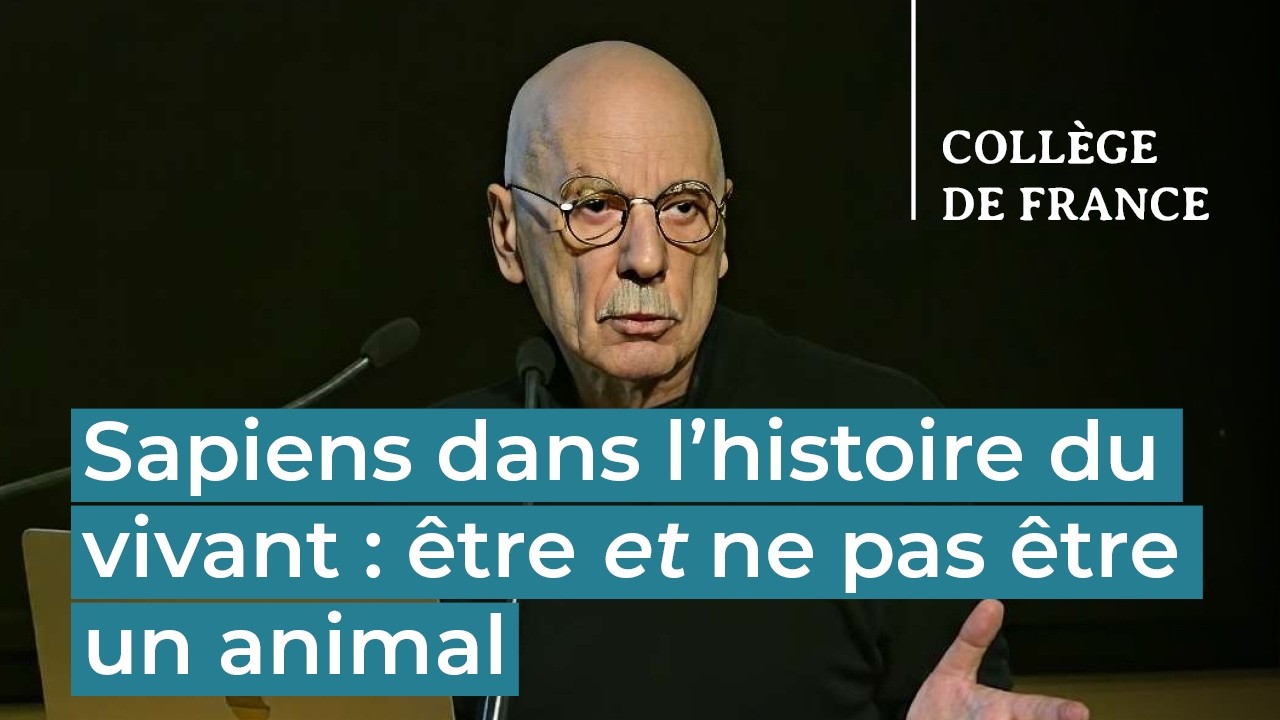
Sapiens dans l’histoire du vivant : être et ne pas être un animal - 2026-2027 (12)
Sapiens in the history of life: to be and not to be an animal - 2026-2027 (12)
Keywords
Summary
241 words
Critical Evaluation
Value of the Information & Strength of the Argument
The lecture provides a rich synthesis of current knowledge in evolutionary neurobiology, integrating molecular genetics, developmental biology, and comparative anatomy. The argumentation is solid, building from broad evolutionary concepts to specific examples of genetic changes (e.g., ARHGAP2, NOTCH2L, HARs) and their functional consequences on cortical size and connectivity. Prochiantz effectively explains complex mechanisms, such as chromatin looping and enhancer-promoter interactions, in an accessible yet precise manner. He also connects these findings to larger cognitive implications, including critical periods and the importance of inhibition in plasticity, thus offering a coherent narrative from genotype to phenotype. While some hypotheses (e.g., the role of microglia) are presented as recent and not fully confirmed, the overall reasoning is transparent and well-supported by cited research. The speaker’s expertise is evident, and the lecture is informative for both specialists and informed laypersons.
Scientific Rigor, Source Quality, Title Accuracy
The scientific rigor is high: the speaker, a renowned neurobiologist and former director of the Department of Biology at ENS, references specific studies (e.g., work on HARs, NOTCH2L duplications, and critical periods) without overclaiming certainty. He explicitly mentions the recent dating of divergence from Neanderthals/Denisovans (700,000 years) based on information from Jean-Jacques Hublin, and acknowledges when data are too recent for him to be fully certain. The sources are credible, stemming from the Collège de France colloquium on ‘The Animal,’ with links provided to the program and other official resources. The title accurately reflects the content: the lecture indeed explores being and not being an animal in the history of life, focusing on the unique features of Homo sapiens. The speaker’s style is engaging and occasionally humorous, which does not detract from the scientific substance. No commercial or promotional content was present beyond the standard institution links.
298 words
Title / Content Match
The title perfectly matches the content: the lecture explores what makes Homo sapiens unique in the living world, combining evolutionary history with brain development, while also addressing the paradox of being both animal and not.
Quality & Reliability
8/10
Lecture by a world-renowned neurobiologist at the Collège de France, presenting a coherent synthesis of evolutionary neurobiology with clear arguments and references to recent research. The talk is well-structured and scientifically grounded, though it includes some hypotheses and personal interpretations.
Key Moments
Markers derived by PSI from the transcript: the creator did not define chapters.
- Introduction by the session chair and presentation of Alain Prochiantz.
- Evolutionary tree and divergence times; emphasis on the species-specific expansion of the human brain.
- Discussion of human accelerated regions (HARs) and their role in gene regulation, including the example of HAR5 affecting FZD8 and cortical size.
- Mechanisms of neurogenesis: the outer subventricular zone and the role of NOTCH2L in amplifying neural progenitors.
- Importance of inhibitory neurons from the subpallium and their contribution to cortical function and critical periods.
- Critical periods of plasticity and the role of inhibition in opening and closing them, including social cognition windows.
- Neoteny and slowed development: the duplication of GARP2C and its effect on synaptogenesis; discussion of microglia and brain maturation.
Cited Sources
- Collège de France - Colloque de rentrée 2026 : L'animal — Page of the colloquium where this lecture was given; contains program and recordings.
- Collège de France - Main website — General resource of the institution offering lectures and courses.
- Fondation du Collège de France — Support the institution; not directly related to content but provided in description.
External References
Contribution & Novelties
This lecture provides a comprehensive and up-to-date synthesis of the genetic and developmental mechanisms underlying human brain evolution. It integrates recent findings on human-specific gene duplications, HARs, and the unique morphology of the human cortex, while emphasizing the role of neoteny in cognitive development. The original contribution lies in the clear presentation of how specific molecular changes (e.g., in ARHGAP2, NOTCH2L) might explain the extended plasticity and learning capacity of Homo sapiens, offering a bridge between genetics and cognitive neuroscience.
Pour aller plus loin :
- Neoteny — Concept central to the lecture, describing the retention of juvenile traits into adulthood, which is proposed as a key feature of human development.
- Human accelerated regions — Genomic segments with rapid changes in humans, repeatedly cited in the talk as drivers of brain expansion.
- Radial glial cells — Neural stem cells that generate neurons and guide migration, with a mention of the outer subventricular zone in primates.
- Critical period — The time windows of heightened plasticity discussed in relation to learning and social development.
171 words
Radar Profile
The radar profile shows a balanced high-level performance, with quality of information and technical level scoring highest, reflecting the depth of the lecture. Quantity of information is slightly lower, as the talk focuses on select examples rather than exhaustive coverage. Overall reliability is strong, aligning with the speaker’s expertise and the institution’s reputation.