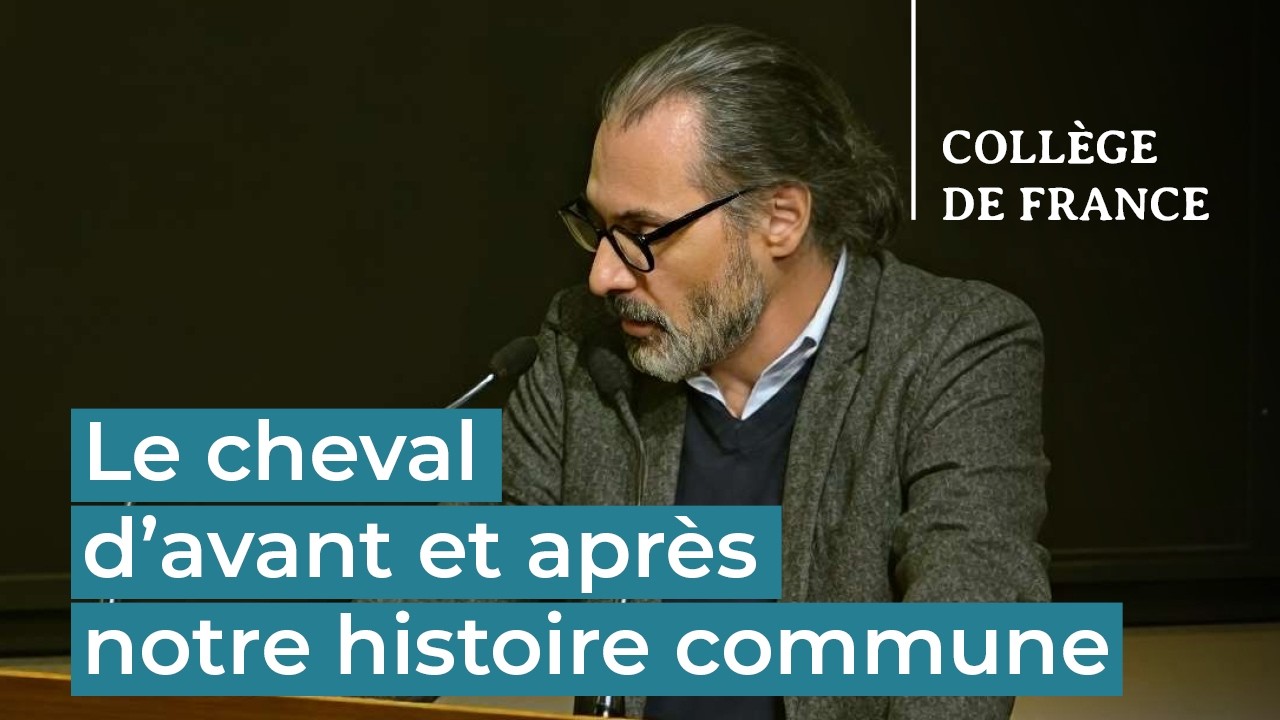
Le cheval d’avant et après notre histoire commune - 2026-2027 (7)
The horse before and after our common history - 2026-2027 (7)
Keywords
Summary
192 words
Critical Evaluation
Value of the Information & Strength of the Argument
The scientific value is exceptional: the speaker presents original research results from his own laboratory, combining genomic time-series, population genetics models and functional experiments on animal models. The argumentation is rigorous and progressive, systematically moving from observations (genetic diversity graphs) to inferences (domestication bottleneck, selection of a specific mutation) and then to experimental validation (mouse models carrying the equivalent mutation). The presentation also offers an original analytical perspective by reversing the initial question: instead of the simple passage from one wild type to multiple domestic forms, he shows that domestication led to a collapse of a much richer past diversity. Each conclusion is supported by quantifiable data (migration rates, effective population sizes, allele frequencies), and the chronological and spatial precision is high. The explanatory choices, such as the narrative of a single nucleotide change becoming nearly fixed in the population, make complex population genetics concepts accessible without sacrificing scientific exactness.
Scientific Rigor, Source Quality, Title Accuracy
The scientific rigour is beyond reproach: the conference is given at the Collège de France, an institution committed to fundamental research and open dissemination of ‘knowledge in the making’. Ludovic Orlando’s credentials are impeccable: CNRS silver medal (2023), Charles Léopold Mayer Prize of the Académie des Sciences (2024), and the Newcomb Cleveland Prize. The presentation references his own published work and clearly distinguishes between validated results (genetic graphs, mouse experiments) and interpretations. The description provides institutional links including the full colloquium programme and the Collège de France website. The title ‘Le cheval d’avant et après notre histoire commune’ perfectly encompasses the lecture’s scope, addressing both pre-domestication diversity and the co-evolution between horses and humans over 4,000 years. No sourcing weakness or contradiction with established knowledge is apparent, although the speaker does not systematically name every collaborating publication.
302 words
Title / Content Match
The title exactly matches the content: the lecture covers horse genetic diversity before domestication and the transformations induced by their shared history with humans, from the emergence of domestic types to modern breeds.
Quality & Reliability
9/10
Conference by Ludovic Orlando, CNRS research director and renowned specialist in ancient DNA, at the Collège de France, an institution of fundamental research. The presentation relies on peer-reviewed genomic studies published in leading journals. The speaker holds the CNRS silver medal and the Charles Léopold Mayer Prize. The scientific content is precise, well-documented and clearly structured, with concrete examples (genetic graphs, mutation on chromosome 9, mouse experiments).
Key Moments
Markers derived by PSI from the transcript: the creator did not define chapters.
- Presentation of Ludovic Orlando by the moderator, archaeologist and CNRS research director
- Current horse numbers: 60 million domestic horses and 3,000 Przewalski horses
- Explanation of the ancient DNA approach and its three main virtues for studying past populations
- Genetic diversity of horses over the last 50,000 years: a rich and structured diversity, mostly lost today
- Chauvet cave horses are genetically distinct from Przewalski horses, overturning a common assumption
- Domestic horses emerge in the late 3rd millennium BCE from only a few hundred breeders
- Origin of domestication identified north of the Caucasus in the western Russian steppes
- The A-to-C mutation on chromosome 9 selected by early breeders; mouse experiments show improved locomotory coordination and flatter back
- Rapid spread of domestic horses across Eurasia within a few centuries, accompanying human migrations
- Modern horse breeds only diversify from the 8th century CE; draft horses emerge in medieval Europe; seven major genetic types identified
Cited Sources
- Collège de France — L'animal (colloquium page) — Programme and audio/video recordings of the 2026 rentrée colloquium on 'L'animal', session 2 'Cohabiter avec l'animal' including this conference.
- Collège de France — institutional website — General access to courses, seminars and resources of the Collège de France.
- Fondation du Collège de France — Support page for the institution.
Concurring Sources
- Domestication of the horse — Wikipedia — Broadly agrees with the lecture's conclusions on the late 3rd millennium BCE domestication timeline and the genetic evidence from ancient DNA.
Dissenting Sources
- Aucune source discordante identifiée — The lecture presents peer-reviewed results from the speaker's own laboratory; no contradicted claims were highlighted in the transcript.
External References
Contribution & Novelties
This conference presents several significant recent advances in the understanding of horse domestication, synthesizing more than a decade of ancient DNA research by Ludovic Orlando’s team. The main original contributions include: the demonstration that pre-domestication horse populations were genetically highly structured and diverse, with distinct regional lineages; the identification of a domestication bottleneck of only a few hundred reproductive individuals; the localization of the domestication centre north of the Caucasus; and the discovery of a specific mutation on chromosome 9 selected by early breeders, functionally validated through mouse experiments. The lecture also offers a long-term perspective on horse-human co-evolution, showing that modern breeds only diversified from the 8th century CE, which is a relatively recent phenomenon.
Pour aller plus loin :
- Domestication of the horse — Wikipedia synthesis on the archaeological and genetic evidence for horse domestication, directly relevant to the lecture’s core subject.
- Przewalski’s horse — Wikipedia article on the last surviving wild horse population, which the lecture discusses as genetically distinct from the Chauvet cave horses.
- Ancient DNA — Wikipedia overview of the methodology used by the speaker to reconstruct horse population histories.
- Collège de France — L’animal — Official page of the colloquium where this conference was given, offering access to the full programme and other lectures.
- Ludovic Orlando’s publications on horse genomics (Nature, Science, 2018-2023) — Not linked here, but referenced through the speaker’s institutional profile.
230 words
Radar Profile
The profile shows an excellent balance across all dimensions, with very high reliability (9) and strong information quality (8). The technical level is solid (7) but remains accessible, reflecting the Collège de France's dual mission of fundamental research and public dissemination. This is a high-quality academic lecture with no notable weaknesses.