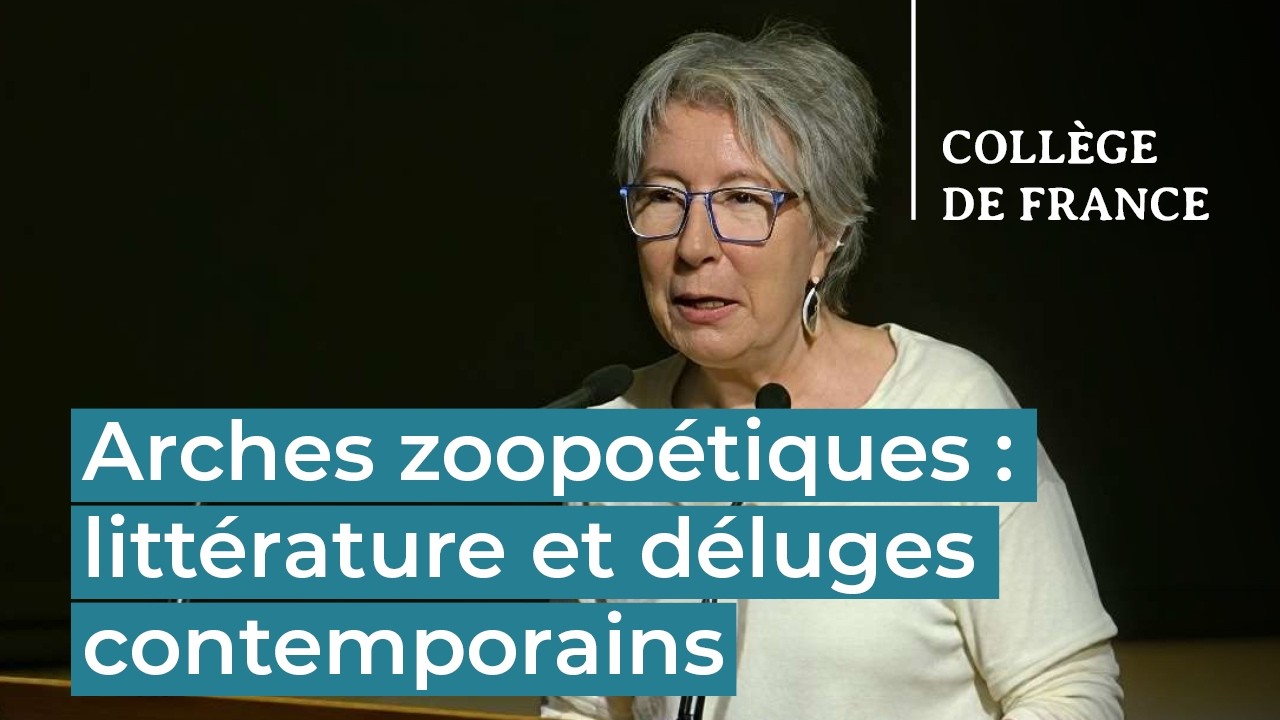
Arches zoopoétiques : littérature et déluges contemporains - 2026-2027 (6)
Zoopoetic Arches: literature and contemporary floods - 2026-2027 (6)
Keywords
Summary
178 words
Critical Evaluation
Value of the Information & Strength of the Argument
The value of the information lies in the original synthesis of a recurring literary motif (the Ark) with pressing contemporary ecological and ethical crises, grounded in the rigorous theoretical apparatus of ‘zoopoetics,’ which Simon herself has significantly defined. The argumentation is solid, built upon close readings of specific texts (notably Haller, Chevillard, and Aridjis) and a clear etymological distinction between the Hebrew teva and the Latin arca. Simon successfully connects literary analysis to philosophical traditions (Derrida, Merleau-Ponty) without succumbing to reductive analogies. The lecture offers a coherent and dense demonstration of how literature gives voice, place, and memory to non-human beings, emphasizing perception, rhythm, and syntax as vital tools for representing animality.
Scientific Rigor, Source Quality, Title Accuracy
The scientific rigor is very high, consistent with an academic lecture at a prestigious institution. Anne Simon explicitly references numerous primary sources (Bible, Gilgamesh epic, works by Supervielle, Haller, Chevillard, Aridjis) and discloses her interpretive choices, such as focusing solely on the Biblical tradition for temporal reasons. The institutional context (Collège de France, ENS-PSL) guarantees a high standard of scholarship. The title is highly accurate, directly reflecting the lecture’s subject matter—zoopoetic arks in contemporary literature concerning floods—and the description provides relevant supporting links to the Collège de France, aiding traceability. No discordant or contradictory sources were identified within the provided material.
228 words
Title / Content Match
The title accurately reflects the lecture's core focus on contemporary literary reinterpretations of the Ark and flood motif through the prism of animal presence (zoopoetics).
Quality & Reliability
9/10
Delivered at the Collège de France by a CNRS research director and ENS-PSL professor, this lecture draws on primary texts (Bible, Derrida, contemporary French poetry) and an established scholarly framework (zoopoetics). The argumentation is coherent and transparent, referencing specific works and etymologies. Institutional backing and the speaker's recognized expertise ensure a very high level of reliability, although the oral format limits full footnote-level verification.
Key Moments
Markers derived by PSI from the transcript: the creator did not define chapters.
- Introduction by William Marx presenting Anne Simon and the theme of the conference.
- Anne Simon begins her lecture, citing Rachel Carson and the concept of 'arks of life'.
- Analysis of the core biblical narrative and the Hebrew term 'teva', distinguishing it from a ship.
- Introduction of the 'zoopoetics' concept, borrowed from Jacques Derrida, and its application to literature.
- In-depth analysis of Éric Chevillard's 'L'Arche Titanic' and the Natural History Museum as a sinking ark.
- Concluding discussion of Homero Aridjis's poem 'El Arca', portraying the ark as the manifestation of vital becoming.
Cited Sources
- Collège de France - L'animal (Conference page) — Official page for the 2026 opening conference 'L'animal', providing programme details and recordings.
- Collège de France (Main website) — Institutional website of the Collège de France, hosting the video and related resources.
- Fondation du Collège de France — Foundation link supporting the institution, mentioned in the video description.
Concurring Sources
- The Animal That Therefore I Am - Wikipedia — Background on Derrida's concept of 'animot' and the philosophical critique aligned with the lecture's thesis.
- Zoopoetics - Wikipedia — Background on the field of zoopoetics, relevant context for the speaker's own theoretical contributions.
External References
Contribution & Novelties
The lecture provides novel insights by framing the Ark motif in contemporary literature as a response to ecological extinction, moving beyond a purely thematic reading to a syntactic and rhythmic one (‘zoopoetic’). The analysis of works such as Haller’s ‘M’bo’ and Chevillard’s ‘L’Arche Titanic’ as complex examples of a contemporary ‘ark’ in crisis is original. The etymological and translational focus (Teva/Arca, nid/cellule) offers a fresh dimension rarely explored in literary criticism.
Pour aller plus loin :
- Zoopoetics — Relevant background concept for the approach used by the speaker.
- The Animal That Therefore I Am — The seminal work by Jacques Derrida referenced in the lecture.
- Noah’s Ark — The biblical source text central to the lecture’s analysis of the flood narrative.
121 words
Radar Profile
The radar profile shows a very high reliability score (9) and good quality of information (8), reflecting the authoritative academic context. The technical level (7) is appropriate for a specialized lecture, while the quantity of information (7) is moderately limited by the short duration and focused thematic scope. This indicates a highly trustworthy, dense academic source rather than a broad overview.