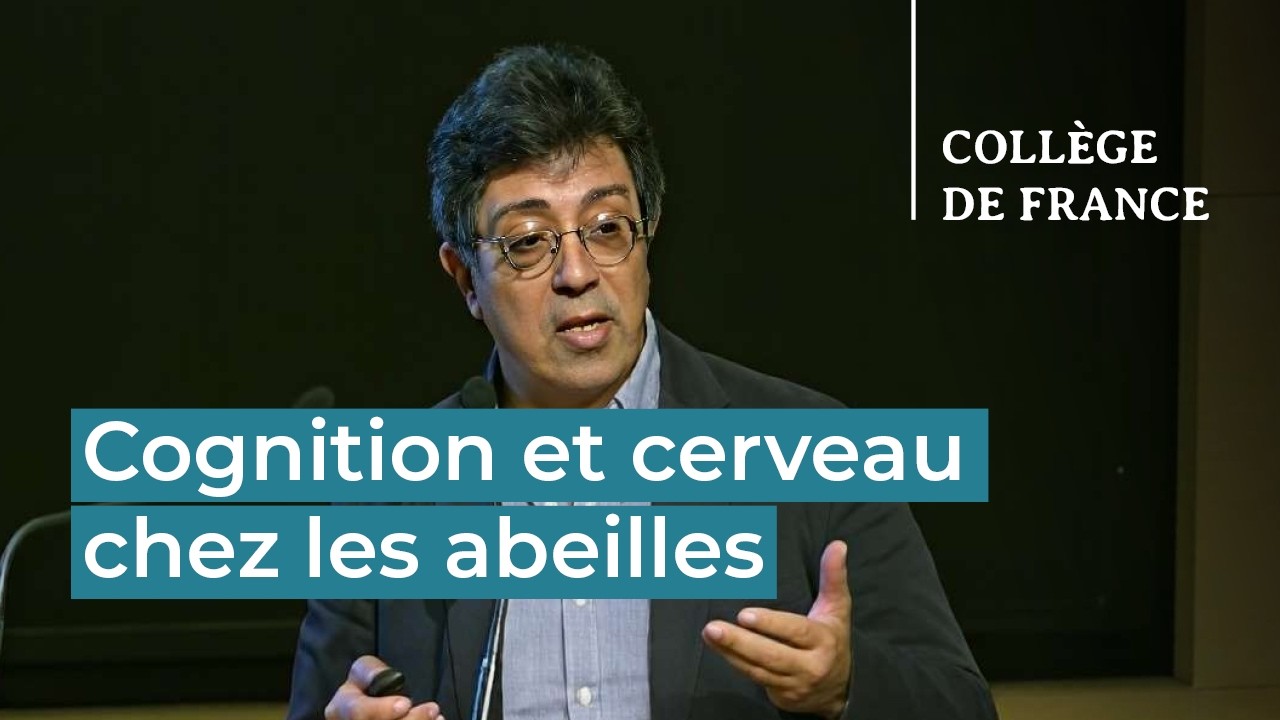
La complexité cognitive d’un cerveau miniaturisé... - 2026-2027 (14)
The cognitive complexity of a miniaturized brain... - 2026-2027 (14)
Keywords
Summary
182 words
Critical Evaluation
Value of the Information & Strength of the Argument
The lecture’s primary value lies in demonstrating that complex cognitive abilities once thought exclusive to large-brained vertebrates are present in insects. The argumentation is methodologically solid: Giurfa systematically controls for low-level perceptual confounds (e.g., cumulative area, contour, color, spatial arrangement) in his numerosity and rule-learning experiments. The use of transfer tests (e.g., testing color-trained bees on luminance patterns) compellingly proves the abstraction of relational rules rather than simple stimulus-response associations. The progression from rule learning to counting to the number line builds a coherent narrative about the evolutionary origins of core numerical cognition. He also mentions collaborative studies with renowned researchers (Rosa Rugani, Catherine Thevenot) and previous work by Stanislas Dehaene, anchoring the findings within a broader scientific context.
Scientific Rigor, Source Quality, Title Accuracy
Scientific rigor is high. The presentation describes peer-reviewed experimental paradigms (delayed matching to sample, extensive training sessions, randomization of correct side), and specifically highlights the control of confounding variables. The institutional affiliation of the Collège de France and the speaker’s recognized expertise lend strong credibility. The description provides links to the official colloquium program. The title is highly accurate, precisely capturing the content about cognitive complexity in a miniaturized brain. No conflicting evidence or alternative interpretations are presented in the lecture, though the speaker implicitly notes the ongoing debate on the neural basis of these abilities.
230 words
Title / Content Match
The title perfectly mirrors the lecture's content: it explores the cognitive complexity achievable by a miniature brain (the honeybee), focusing on higher-order learning, numerical sense, and the underlying neural mechanisms.
Quality & Reliability
9/10
Lecture delivered by a leading expert (Martin Giurfa, Professor at Sorbonne Université) at the prestigious Collège de France. The experimental designs are meticulously described, including rigorous controls for low-level confounds (e.g., area, contour, color, spatial arrangement) in numerosity and rule-learning tasks. The use of transfer tests powerfully demonstrates abstract rule learning, and the logical progression from simple association to high-order cognition is scientifically robust.
Key Moments
Markers derived by PSI from the transcript: the creator did not define chapters.
- Introduction of Martin Giurfa and his academic background.
- Comparison of human and bee brain volumes and neuron counts (1350 cm³ vs 1 mm³, 90 billion vs 950,000 neurons).
- Presentation of floral constancy and why bees are ideal models for studying learning and memory.
- Introduction of the abstract relational rule 'sameness' (delayed matching to sample).
- Description of the Y-maze experimental protocol with bees and the training procedure.
- Results of the transfer test showing bees apply the 'sameness' rule to novel stimuli (colors to patterns).
- Evidence for numerosity in bees, showing they can count up to five.
- Discussion of the mental number line in newborn humans (Dehaene's work) and its cultural vs innate origin.
- Experimental design and results showing bees exhibit a left-to-right mental number line.
Cited Sources
- Colloque de rentrée 2026 : L'animal - Collège de France — Official program and recordings of the colloquium where this lecture took place.
- Collège de France official website — General institutional resource for resources and support.
External References
Contribution & Novelties
This lecture synthesizes a significant body of original research from Giurfa’s laboratory, with a notable new highlight being the adaptation of the mental number line paradigm to honeybees, suggesting that this cognitive trait is not uniquely human or even culturally derived, but may be a fundamental property of nervous systems. It provides a strong argument for the relevance of tiny brains in uncovering fundamental cognitive principles.
Pour aller plus loin :
- Insect cognition — Broad overview of current research on cognitive abilities in insects, placing bees within a larger context.
- Mental number line — The spatial representation of numbers, detailed here with the debate on its innate vs cultural origins.
- Numerical cognition — The process by which animals, including insects, represent and manipulate quantities.
- Delayed matching to sample — The experimental protocol used to test the abstraction of relational rules.
140 words
Radar Profile
The radar profile shows high scores across all dimensions, with notably strong 'quantite_information' and 'fiabilite_globale'. The 'niveau_technique' is substantial but accessible, reflecting the speaker's ability to articulate complex methodologies clearly to a general academic audience.