EMBL Forum Science and Society Seminar: Robbert Dijkgraaf - Usefulness of Useless Knowledge
Title history
- EMBL Forum Science and Society Seminar: Robbert Dijkgraaf - Usefulness of Useless Knowledge — observed on 20261030-1104 UTC (YouTube)
Keywords
Summary
196 words
Critical Evaluation
Value of the Information & Strength of the Argument
The talk provides significant value by framing basic research as a crucial driver of innovation and societal progress. Dijkgraaf’s argumentation is strong and compelling, built on a rich narrative of historical cases where abstract scientific inquiries led to unforeseen technological revolutions. He effectively uses examples like electromagnetism, quantum mechanics, and superconductivity to demonstrate that the long-tail of curiosity-driven research often yields the most transformative outcomes. However, the argument is largely based on anecdotal evidence and personal interpretation rather than systematic data or a structured framework. While persuasive, it would benefit from more quantitative citations or a more rigorous analysis of the causal links between basic research and innovation.
Scientific Rigor, Source Quality, Title Accuracy
The scientific rigor is high in terms of factual accuracy regarding historical events and scientific discoveries, but the presentation is a personal essay rather than a peer-reviewed analysis. Dijkgraaf references important figures and works, such as Flexner’s essay, Einstein’s speech, and von Neumann’s contributions, but without formal citations. The quality of sources is good, relying on well-documented history, but the lack of direct references makes it difficult to verify specific claims. The title accurately reflects the content, and the talk is well-aligned with the stated theme of the EMBL Science and Society Forum.
216 words
Title / Content Match
The title accurately reflects the content, as the lecture explores Flexner's essay and the value of basic research through historical and contemporary examples.
Quality & Reliability
8/10
The talk is delivered by a leading expert (director of the Institute for Advanced Study) and references numerous well-documented historical examples. However, it is primarily an opinionated lecture without formal citations or peer-reviewed sources.
Key Moments
Markers derived by PSI from the transcript: the creator did not define chapters.
- Introduction to Flexner's essay and its historical context.
- Discussion of the 1939 World's Fair and Einstein's failed speech.
- The role of the Institute for Advanced Study in nuclear physics and computing.
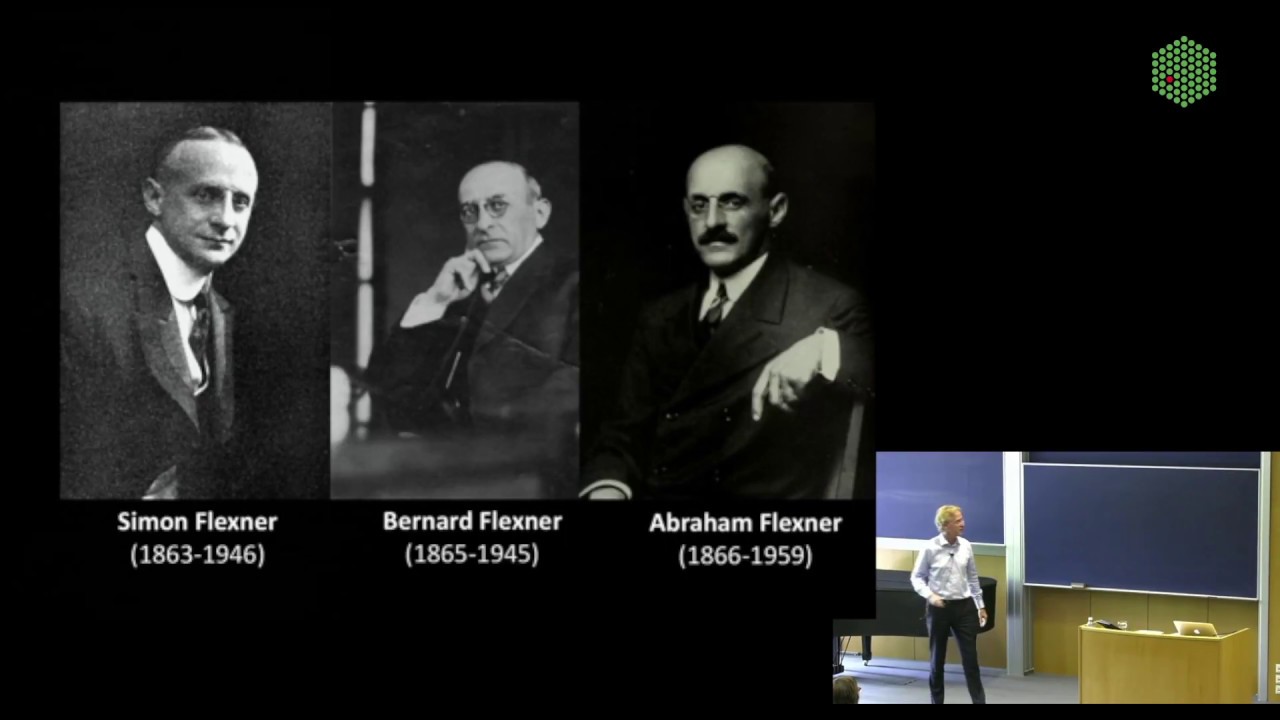
- Flexner's background and his reform of medical education.
- The 'long tail' argument and the importance of high-risk, curiosity-driven research.
- Superconductivity as an example of basic research with revolutionary applications.
- GPS and the reliance on Einstein's theories of relativity.
- Conclusion about the expanding frontier of knowledge and design.
Cited Sources
- EMBL Science and Society Forum — Official page of the forum where this talk was hosted, providing context for the seminar series.
Contribution & Novelties
The talk offers a contemporary perspective on Flexner’s 1939 essay, applying its arguments to the 21st century where the ability to design new materials, organisms, and intelligent systems expands the unknown. Dijkgraaf’s unique contribution is to frame basic research as a necessary foundation for navigating the vast space of ‘what can be made’ from the building blocks of matter, life, and information. He also draws attention to the squeezed middle of incremental research, arguing that the long tail of ambitious, curiosity-driven questions is where transformative discoveries reside.
Pour aller plus loin :
- The Usefulness of Useless Knowledge — Wikipedia entry on Flexner’s original essay, providing background and historical context.
- Institute for Advanced Study — Overview of the institution Dijkgraaf directs, its history, and its impact on science and scholarship.
- Von Neumann architecture — Description of the computing design conceived by John von Neumann, which arose from foundational mathematical logic and now underpins most digital computers.
- Superconductivity — Phenomenon discovered through low-temperature physics, with applications like MRI and particle accelerators.
169 words
Radar Profile
The radar profile shows high scores in quality and reliability, with moderate levels in quantity and technical depth, reflecting a well-informed but accessible lecture that relies on historical narrative rather than dense technical detail.