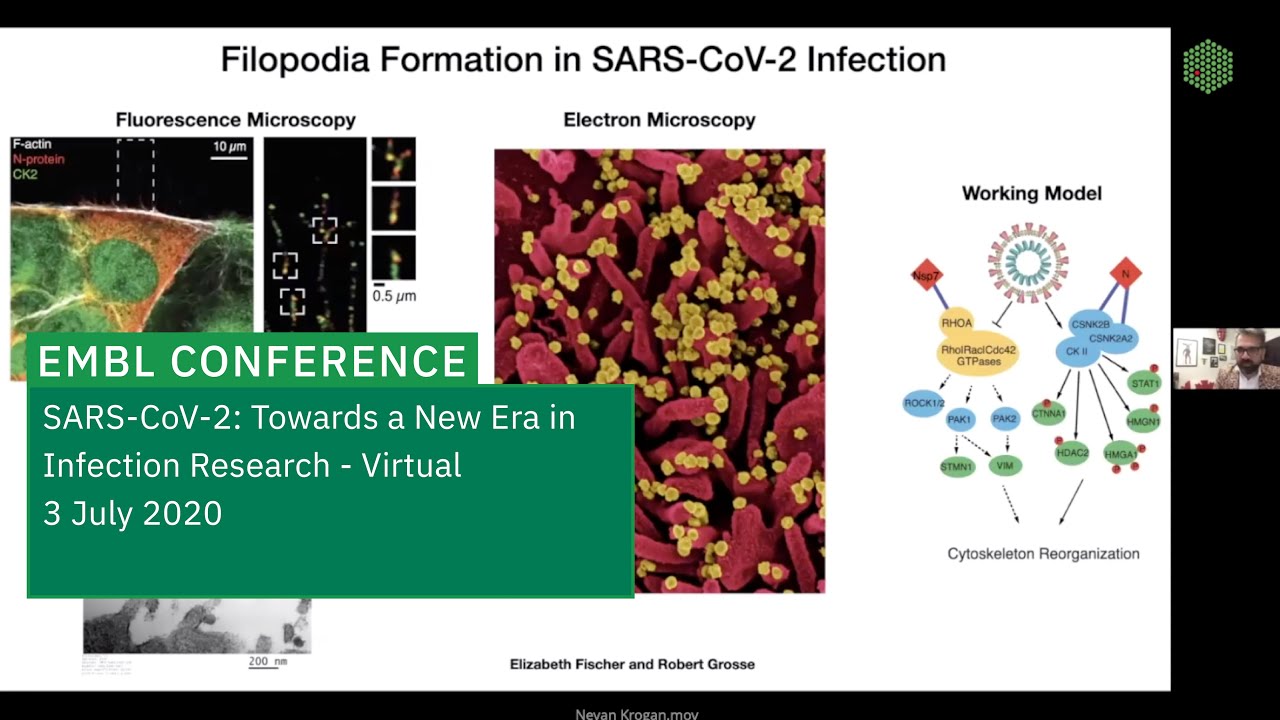
Nevan Krogan - A SARS-CoV-2 protein interaction map reveals targets for drug repurposing
Title history
- Nevan Krogan - A SARS-CoV-2 protein interaction map reveals targets for drug repurposing — observed on 20261026-1536 UTC (YouTube)
Keywords
Summary
184 words
Critical Evaluation
Value of the Information & Strength of the Argument
The value of this work lies in its innovative host-directed approach, which expands therapeutic options beyond direct viral inhibition and may offer resilience against viral mutation. The argumentation is solid, grounded in comprehensive experimental data (PPI mapping, phosphoproteomics, and functional assays) and supported by orthogonal validation in multiple cell lines and animal models. Krogan logically contrasts the benefits (reduced resistance, potential broad-spectrum activity) and drawbacks (toxicity) of targeting host factors, and mitigates concerns by prioritizing drugs already in clinical use. The collaborative framework, combining systems biology, chemical biology, and virology, strengthens the credibility of the conclusions. However, the findings are preliminary in terms of clinical efficacy; most data are from in vitro and early animal studies, and the speaker acknowledges the need for further validation in humans.
Scientific Rigor, Source Quality, Title Accuracy
The scientific rigor is high, as the research was published in reputable journals and the methodology follows established protocols with appropriate controls. Krogan transparently discusses the limits of the assays, such as the use of Vero E6 cells initially, and notes that results are being confirmed in human cell lines and animal models. He references collaborations with multiple labs, including the Pasteur Institute and Mount Sinai, which adds credibility. The title accurately matches the main content, though the talk also describes the phosphorylation study, which is not mentioned in the title. The absence of explicit citations or links in the description limits immediate verification, but the speaker names specific colleagues and institutions, and the work is part of a well-documented research effort. Overall, the presentation is scientifically sound and the title is appropriate, with a minor mismatch due to the broader scope.
284 words
Title / Content Match
The title accurately reflects the primary focus of the talk, which centers on the protein interaction map and its implications for drug repurposing. The talk also includes additional data on phosphorylation, but the main thrust is well captured.
Quality & Reliability
9/10
Presentation by a leading expert in systems biology, based on peer-reviewed research with experimental validation, from a prestigious institution (UCSF/EMBL). The methodology is rigorous and the claims are supported by data.
Key Moments
Markers derived by PSI from the transcript: the creator did not define chapters.
- Introduction of Nevan Krogan and the QBI Coronavirus Research Group (QCRG), and overview of the host-directed therapy approach.
- Description of the affinity purification mass spectrometry method to generate a protein-protein interaction map; identification of 332 interactions and 69 candidate drugs.
- Validation of drugs in cellular assays: zotatifin, plitidepsin, and sigma receptor modulators show antiviral effects; collaborative testing with Pasteur Institute and Mount Sinai.
- Presentation of the global phosphorylation analysis: identification of misregulated kinases, including CK2, CDKs, and MAP kinases, and their link to antiviral compounds.
- Detailed discussion of kinase inhibitors, including CK2 inhibitors and CDK inhibitors, with experimental evidence of reduced infection via RNAi knockdown.
- Discovery that the N protein co-localizes with CK2 in filopodia; electron microscopy images show viral particles budding from filopodia, suggesting a potential cell-to-cell spread mechanism.
- Future directions: ongoing clinical trials, combination therapy with remdesivir, comparative interactomics with SARS-CoV-1 and MERS, and a call for sustaining collaborative science.
Contribution & Novelties
This presentation delivers an original and timely contribution by systematically mapping the SARS-CoV-2 interactome and kinome, offering a data-driven approach to drug repurposing. The integration of proteomics, phosphoproteomics, and functional virology provides a comprehensive resource that goes beyond gene lists, linking specific viral proteins to druggable host factors. The notable discovery of filopodia formation driven by the N protein-CK2 interaction is a novel mechanistic insight into viral spread. The open distribution of reagents (plasmids) to hundreds of labs exemplifies an unprecedented collaborative spirit, accelerating research globally.
Pour aller plus loin :
- Affinity purification — The technique used to isolate viral-host protein complexes for mass spectrometry analysis.
- Mass spectrometry — The method for identifying and quantifying proteins in the interactome and phosphoproteome studies.
- Kinase inhibitor — The class of drugs screened against misregulated kinases, including CK2 and CDKs.
- Filopodia — Actin-rich cellular protrusions implicated in the proposed cell-to-cell spread mechanism.
- Drug repurposing — The strategy of testing existing drugs for new therapeutic indications, central to this work.
166 words
Radar Profile
The radar profile shows uniformly high scores across all four dimensions—quantity, quality, technical level, and reliability—reflecting a comprehensive, well-executed scientific presentation. The particularly high technicality and reliability scores emphasize the expert nature and the robustness of the experimental data.