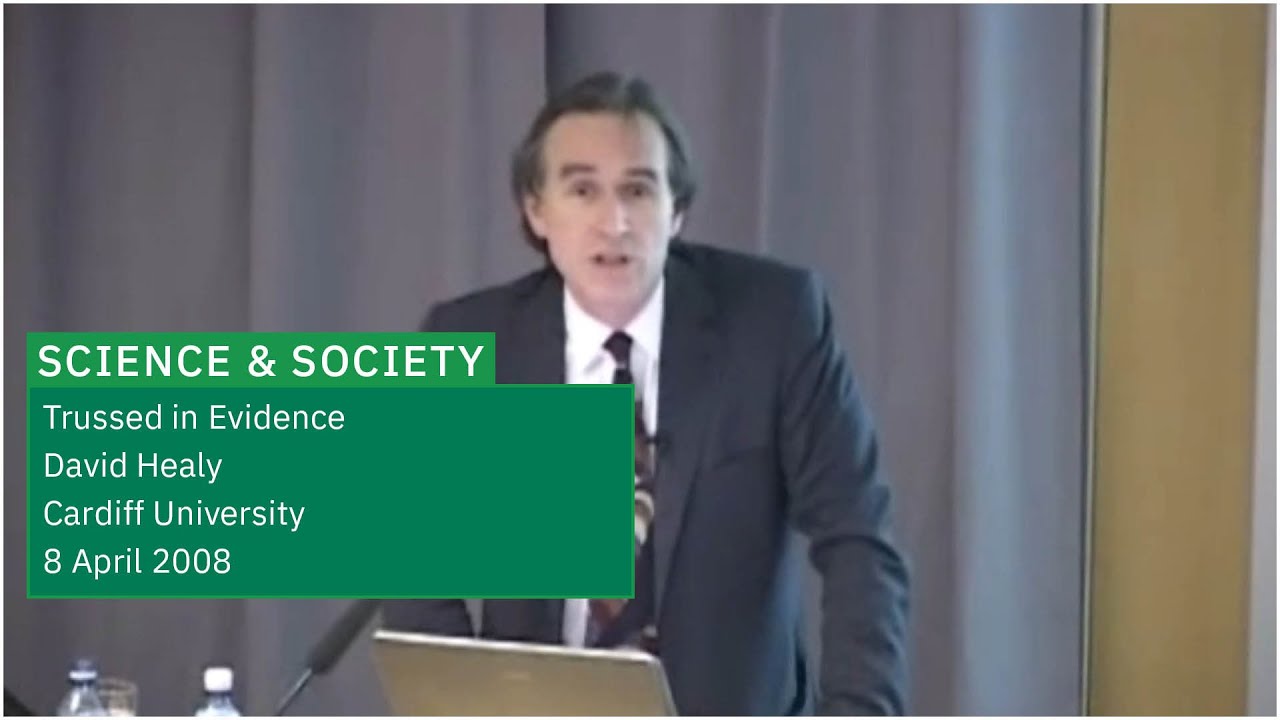
EMBL Forum Science and Society Seminar: David Healy - Trussed in Evidence
Title history
- EMBL Forum Science and Society Seminar: David Healy - Trussed in Evidence — observed on 20261030-1713 UTC (YouTube)
Keywords
Summary
187 words
Critical Evaluation
Value of the Information & Strength of the Argument
The value of the information lies in its vivid, concrete examples—such as the Zoloft ghostwriting brochure and the manipulation of study 329—that illustrate systemic flaws in the production and dissemination of psychiatric evidence. Healy’s argumentation is logically structured and historically grounded, tracing the evolution of patent laws and branding from 19th-century Germany to modern marketing. He effectively demonstrates how the trial system, intended to regulate drugs, ironically creates incentives for splitting illnesses to expand markets. The causal chain from clinical trial outsourcing to ghostwritten articles and guideline capture is well-supported with internal evidence, such as citation rates and impact factor comparisons. However, the argument is one-sided; Healy does not acknowledge potential benefits of industry involvement or provide counterexamples, and his advocacy for data transparency, while plausible, is not fully developed.
Scientific Rigor, Source Quality, Title Accuracy
The rigor of the talk is based on primary historical documents, trial data, and corporate communications, though specific citations are not formally presented. Healy references specific trials, companies, and publications, and the underlying data are consistent with known public controversies, such as the reanalysis of study 329. The reliance on personal experience and anecdotal evidence in some segments (e.g., the hospital guideline forms) is balanced by his academic credentials and previous work. The title ‘Trussed in Evidence’ is highly appropriate, capturing the central theme of how evidence is constrained and manipulated. The talk is part of EMBL’s Science and Society forum, which provides institutional credibility. No comments are provided, so public reception cannot be assessed.
260 words
Title / Content Match
The title 'Trussed in Evidence' aptly reflects the talk's critical examination of how evidence is constrained and manipulated in psychopharmacology.
Quality & Reliability
8/10
Detailed historical analysis with specific examples, but represents a single expert viewpoint and lacks systematic peer review.
Key Moments
Markers derived by PSI from the transcript: the creator did not define chapters.
- Introduction to the problem: drugs for mental health and the collapse of depression subtypes.
- Discussion of schizophrenia and antipsychotics, illustrating poor response and shortened lifespan.
- Historical branding: aspirin and heroin, and the creation of 'mood stabilizer' concept.
- Outsourcing of clinical trials and medical writing; the Zoloft ghostwriting portfolio.
- Study 329 and the 2002 World Mental Health Day; the gap between published literature and raw data.
Cited Sources
- EMBL Science and Society Forum — Seminar series where this talk was given; provides institutional context.
Contribution & Novelties
This talk provides a comprehensive, historical synthesis of how the pharmaceutical industry manipulates scientific evidence, merging marketing, patent law, and medical literature into a coherent critique. It exposes specific mechanisms—such as the deliberate creation of illness categories and the use of ghostwritten articles—that are not widely known outside medical sociology. The discussion of guideline capture and the impact on clinical practice adds practical urgency.
Pour aller plus loin :
- Medical ghostwriting — Directly relevant to the Zoloft and study 329 examples; details well-documented cases.
- Study 329 — The infamous trial on paroxetine in adolescents; a key illustration of data distortion and ghostwriting.
- Pharmaceutical marketing — Broader context on branding and marketing strategies in the industry, including disease mongering.
118 words
Radar Profile
The scores suggest a high quantity and quality of information, with moderate technical level and reliability. The profile indicates a well-researched, dense presentation that nonetheless lacks in formal sourcing and balance, fitting an expert opinion rather than a systematic review.