EMBL Forum Science and Society Seminar: Rohini Kuner
Title history
- EMBL Forum Science and Society Seminar: Rohini Kuner — observed on 20261028-0452 UTC (YouTube)
Keywords
Summary
216 words
Critical Evaluation
Value of the Information & Strength of the Argument
The value of the information is substantial: Kuner provides a rich, interdisciplinary perspective that bridges historical, molecular, and clinical aspects of pain. Her argumentation is systematic, moving from historical misconceptions to modern molecular and imaging evidence. She distinguishes clearly between nociception (sensory detection) and pain (the emotional experience), and supports her claims with references to key studies and theories. The talk is particularly valuable for its synthesis of historical and contemporary knowledge, making complex scientific concepts accessible without oversimplification.
Scientific Rigor, Source Quality, Title Accuracy
The scientific rigor is high, with the speaker citing major works (Descartes, Darwin, IASP) and current research (Tor Wager’s multivariate pain signature). The sources are mentioned verbally but not displayed, which is typical of lecture formats. The title accurately represents the content, and the talk fits the EMBL Science and Society mission of exploring the societal impact of life sciences. No comments are provided for analysis.
160 words
Title / Content Match
The title accurately reflects the content: a lecture on chronic pain by Rohini Kuner within the EMBL Science and Society forum series.
Quality & Reliability
8/10
Highly expert lecture by a professor of neuropharmacology, covering historical and molecular aspects of chronic pain. The content is well-structured and scientifically sound, but no on-screen citations are provided; the talk relies on the speaker's authority and verbal references rather than explicit source display.
Key Moments
Markers derived by PSI from the transcript: the creator did not define chapters.
- Introduction: chronic pain as a major societal and economic burden; pain as a double-edged sword (protector and tormentor).
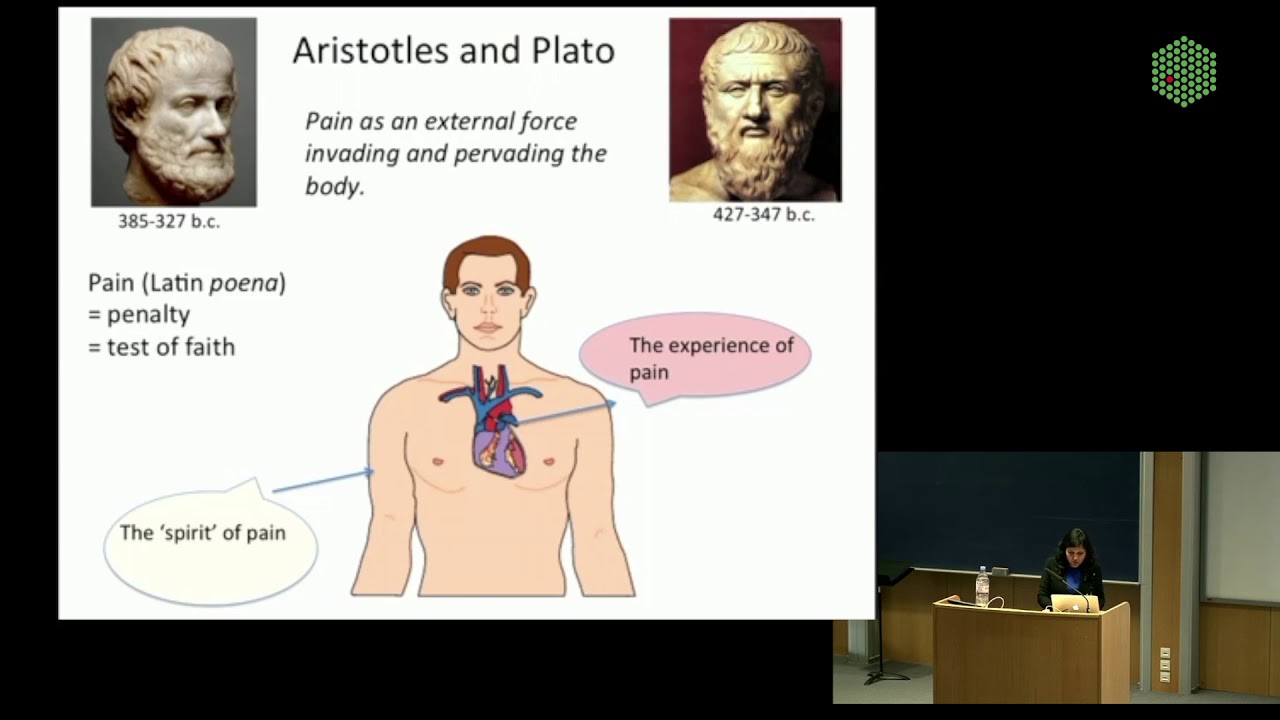
- Historical views: pain as an external force from gods, Aristotle and Plato, and the heart-centered concept.
- Descartes and the specificity theory: the mechanical model, the first pain pathway drawing, and the idea of ion channels.
- Darwin's view of pain as a homeostatic emotion; the IASP definition of pain (sensory and emotional experience).
- Molecular mechanisms: ion channels, peripheral specificity, and the combinatorial population code in the spinal cord.
- Pain matrix and neurological signature of pain; chronic pain in art (Frida Kahlo, Virginia Woolf).
Cited Sources
- EMBL Forum Science and Society Seminar page for Rohini Kuner — Official page with talk details, abstract, and related links.
Concurring Sources
- EMBL Forum Science and Society Seminar page for Rohini Kuner — The seminar page corroborates the lecture's content and context.
Contribution & Novelties
This lecture provides an integrated overview that situates current chronic pain research within historical and philosophical contexts, offering a unique perspective often missing in technical presentations. The speaker highlights how past theories (specificity, gate control) continue to inform modern molecular discoveries and the complexity of central pain processing.
Pour aller plus loin :
- Chronic pain - Wikipedia — Comprehensive overview of chronic pain, its epidemiology, mechanisms, and treatments.
- Nociception - Wikipedia — Details the sensory nervous system’s response to harmful stimuli, directly related to the lecture’s focus on molecular transducers.
- Gate control theory - Wikipedia — The theory discussed in the talk, explaining spinal cord gating of pain signals.
109 words
Radar Profile
The radar profile shows high scores in information quantity and quality, with slightly lower but still solid technical level and global reliability. This indicates a densely informative and scientifically credible lecture, though it may require moderate background knowledge in neuroscience.