Can humanitarian aid still deliver in a fractured world - Dr Duncan Green
Keywords
Summary
206 words
Critical Evaluation
Value of the Information & Strength of the Argument
The talk offers high value through its insider perspective and the breadth of current examples. Green’s argumentation is well structured: he identifies causes, illustrates them with vivid case studies, and weighs competing evidence. He thoughtfully distinguishes between contested figures, such as the number of deaths attributed to USAID cuts, and the undisputed direction of travel. His use of personal anecdotes and published research strengthens trust, while his candid admission that he was ‘part of the problem’ adds credibility. The logical flow from crisis to causation to possible remedies is persuasive, and he avoids simplistic blame, instead stressing systemic pressures. The main weakness is that some claims rely on his own political interpretation (e.g., calling the actions genocide) without detailed legal analysis, and the solutions remain somewhat general.
Scientific Rigor, Source Quality, Title Accuracy
Green demonstrates solid rigour by citing UN appeals, a Lancet study, and named experts like Atul Gawande. He also references specific events and past reports, and distinguishes between well-established facts and areas of debate. The title accurately frames the lecture’s scope and is directly addressed in the conclusion. He does not overclaim; he explicitly acknowledges when data are disputed or when attribution is uncertain. However, he does not provide a written reference list, and some references (e.g., the Al Hussein Khan paper) are given without full bibliographic detail, which could hinder verification. The overall coherence between title and content is high.
243 words
Title / Content Match
The title poses a central question that is directly addressed throughout the lecture, with a clear, nuanced conclusion on whether aid can still deliver.
Quality & Reliability
8/10
The speaker is a recognised expert with decades of field and research experience. The talk uses concrete data (UN figures, The Lancet study) and personal observations, but some statistics are contested, and the speaker clearly positions a critical perspective.
Key Moments
Markers derived by PSI from the transcript: the creator did not define chapters.
- Introduction to the two concurrent famines in Gaza and Sudan, linked to genocide and human rights violations.
- Presentation of UN 2025 appeal numbers: 250 million in need, only $12 billion raised—lowest in a decade.
- Discussion of the USAID dismantlement and its catastrophic impact, including estimated deaths and pushback from the State Department.
- First strain: the shift from altruistic aid to 'aid as national interest', illustrated by the DfID lobby example and growing donor self-interest.
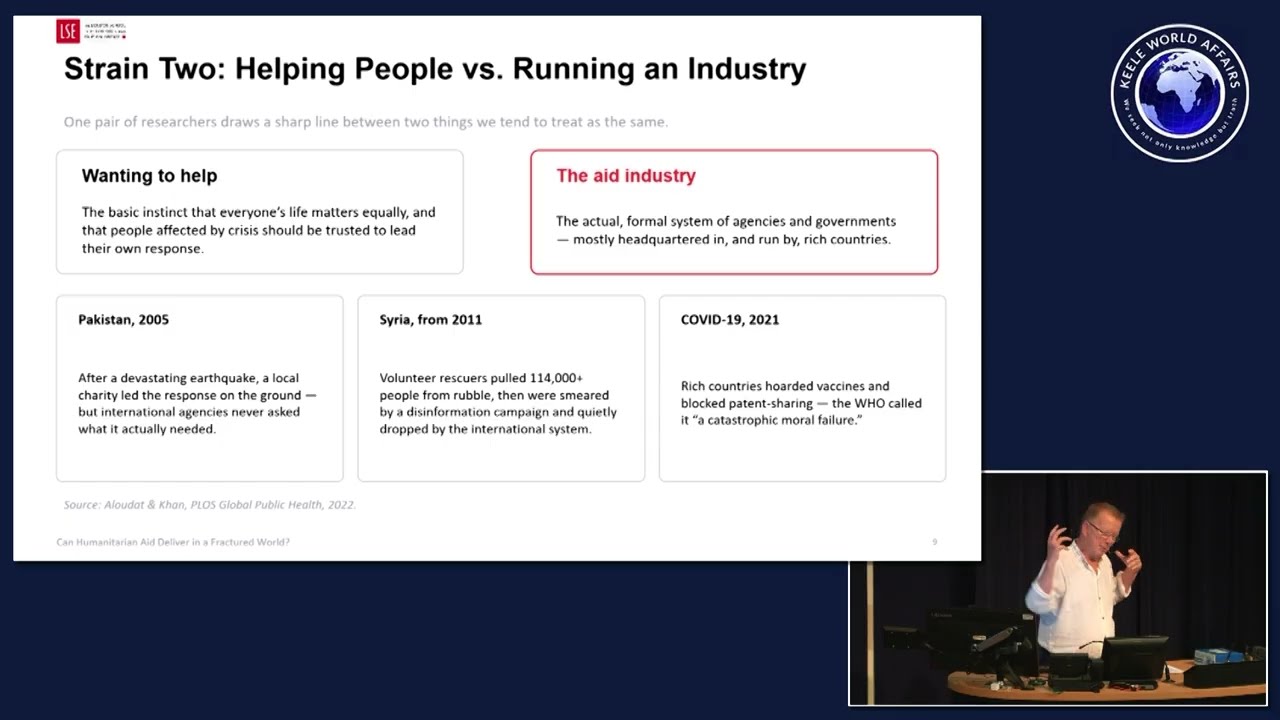
- Second strain: the industrial logic of large NGOs vs. local responders, with examples from Pakistan, Syria, COVID-19, and the Grand Bargain failure.
- Third strain: red tape, counter-terrorism rules, and risk aversion—leading to inefficiency, dangerous local aid work, and a brief good-news story about Somalia.
Cited Sources
- From Poverty to Power blog — Mentioned as Duncan Green's daily development blog, a hub for his analysis and daily commentary.
Contribution & Novelties
The lecture contributes a practical, insider perspective on the current crisis in humanitarian aid, linking short-term political shocks (like USAID cuts) to deeper structural strains. Its main originality lies in the three-part framework (money/politics, organisational logic, and red tape) and in the emphasis on ‘follow the money’ as a diagnostic tool. Green also offers a rare hopeful outlook grounded in youth activism and emerging regional rebalancing, which contrasts with the dominant doom narrative.
Pour aller plus loin :
- Humanitarian aid — Overview of the sector and its principles.
- The Grand Bargain — International agreement on localisation, directly relevant to the talk’s critique.
- Famine — Definitions and historical context, closely tied to the two famines cited.
115 words
Radar Profile
The radar profile shows a talk extremely rich in information and qualitative analysis, with moderate technical depth. The speaker's expertise and the breadth of examples push the 'quality' score high, while the reliance on personal interpretation rather than peer-reviewed synthesis keeps the reliability slightly lower.