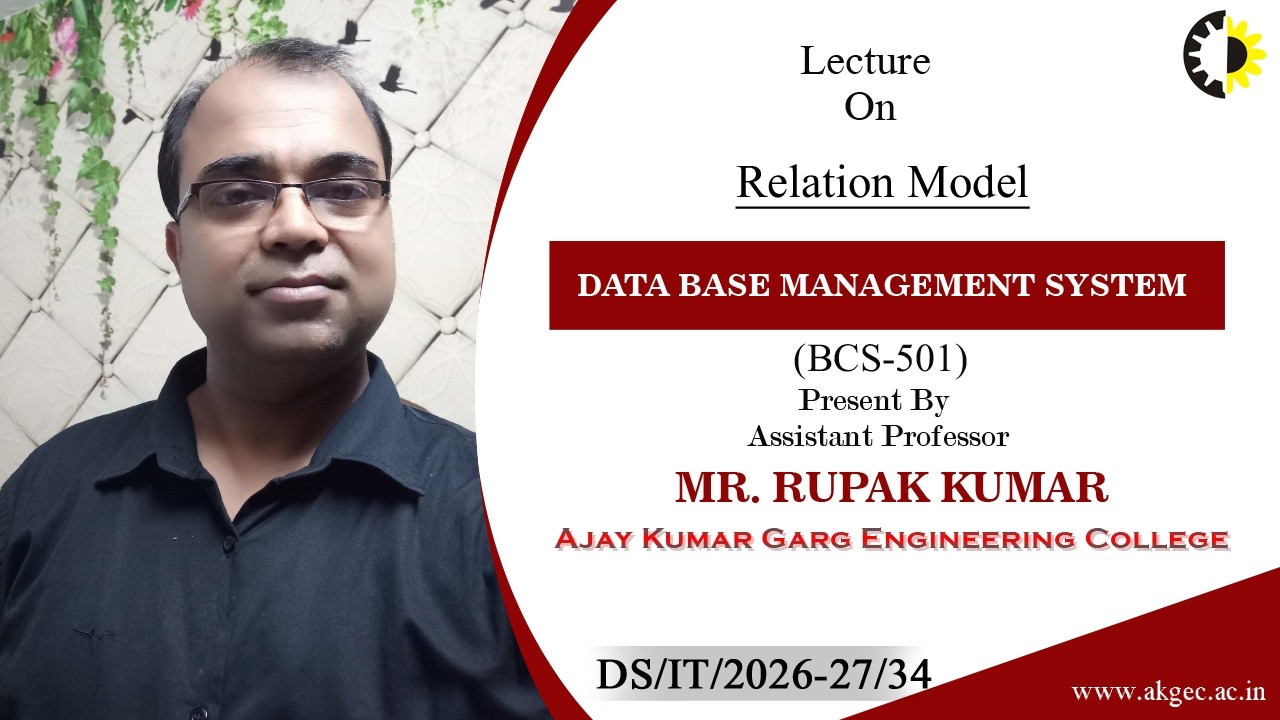
RELATIONAL MODEL | DATABASE MANAGEMENT SYSTEM | LECTURE 03 BY MR. RUPAK KUMAR | AKGEC
Keywords
Summary
150 words
Critical Evaluation
Value of the Information & Strength of the Argument
The lecture provides a solid introduction to the relational model, covering essential terminology and concepts in a clear and structured manner. The explanations are supported by simple examples, such as a student table, which help illustrate abstract ideas like tuples, attributes, and keys. The argumentation is coherent, moving logically from basic definitions to advanced topics like integrity constraints. However, the presentation occasionally repeats points, and the lack of external references weakens the scientific rigor. The emphasis on practical applications, such as avoiding duplicate rows and maintaining atomicity, demonstrates the value of the concepts in real database design. Overall, the content is informative for beginners and serves as a good foundation for further study.
Scientific Rigor, Source Quality, Title Accuracy
The lecture is delivered by a faculty member from AKGEC and is part of a course on DBMS. While no external sources are cited in the video, the content aligns with standard database textbooks. The title is accurate and specifies the lecture number and institution, which is appropriate. However, the lack of citations means the information cannot be independently verified from the video itself. The presentation is internally consistent and reflects common knowledge in the field. The adequacy between title and content is high, as the lecture fully addresses the relational model as promised. No comments or viewer feedback were provided, so public reception is unknown.
234 words
Title / Content Match
The title accurately reflects the content: a lecture on the relational model in database management systems, as part of a series.
Quality & Reliability
7/10
The lecture is delivered by a faculty member from an engineering college and covers standard textbook material accurately. However, it lacks external citations and relies on common knowledge, making it reliable but not rigorously sourced.
Key Moments
Markers derived by PSI from the transcript: the creator did not define chapters.
- Introduction to the relational model and its significance in DBMS, referencing E.F. Codd.
- Explanation of RDBMS and popular software like DB2, Oracle, and SQL Server.
- Definition of key concepts: relation, attribute, tuple, domain, and relational schema.
- Discussion of relational keys, primary keys, and properties of relations.
- Overview of integrity constraints: domain, entity, referential, and key constraints.
Cited Sources
- AKGEC Official Website — College website referenced in video description for more information.
Concurring Sources
- Relational model - Wikipedia — Wikipedia article on the relational model, which aligns with the lecture's content on tables, tuples, and attributes.
Contribution & Novelties
The lecture provides a foundational overview of the relational model, serving as an introductory tutorial for students. It systematically explains core terminology and constraints, using clear examples. While not original research, it effectively consolidates standard knowledge for educational purposes. The contribution lies in its pedagogical clarity and organization.
Pour aller plus loin :
- Relational model — Overview of the relational model and its mathematical foundation.
- Edgar F. Codd — Biography of the inventor of the relational model and his contributions.
- Integrity constraints — Detailed explanation of various integrity constraints in databases.
91 words
Radar Profile
The lecture performs well in information quantity and quality, with a moderate technical level suitable for beginners. Reliability is slightly lower due to absence of citations, but the content is practical and accurate. The balance suggests a comprehensive introduction to the relational model, ideal for foundational learning.