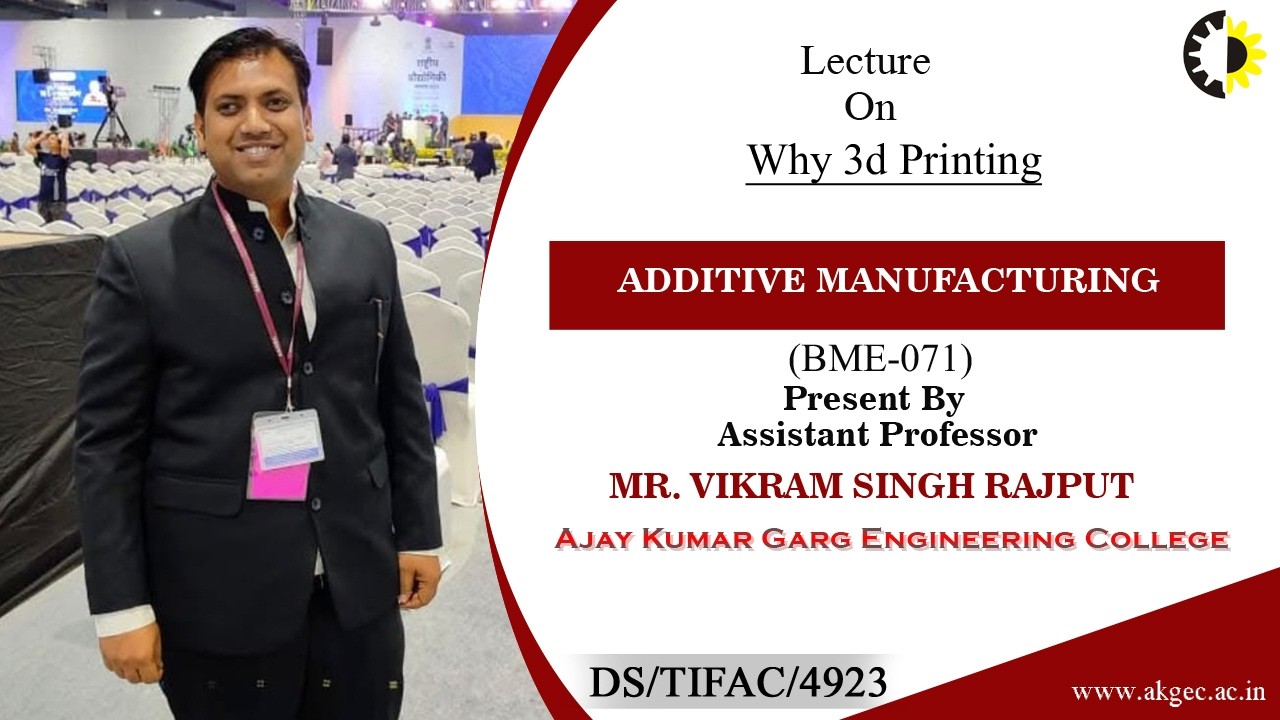
WHY 3D PRINTING | ADDITIVE MANUFACTURING | LECTURE 03 BY MR. VIKRAM SINGH RAJPUT | AKGEC
Title history
- WHY 3D PRINTING | ADDITIVE MANUFACTURING | LECTURE 03 BY MR. VIKRAM SINGH RAJPUT | AKGEC — observed on 20261030-1707 UTC (YouTube)
- vikram 03 — observed on 20261029-0907 UTC (YouTube)
Keywords
Summary
144 words
Critical Evaluation
Value of the Information & Strength of the Argument
The lecture provides a broad yet coherent argument for why 3D printing is valuable. It clearly links benefits to cost, environmental impact, and design possibilities, using relatable examples like custom shoes and dental implants. The argumentation is logical and builds on earlier lectures, but it relies heavily on anecdotal examples and generic claims without citing quantitative data or specific studies. The instructor’s emphasis on mass customization as a future trend is compelling, though the discussion remains at a conceptual level. The historical timeline is accurate and helps contextualise the technology. Overall, the value lies in its educational clarity and structured presentation, but the argumentation would benefit from more concrete evidence or references to industry reports.
Scientific Rigor, Source Quality, Title Accuracy
The scientific rigor is moderate. The lecture does not cite external sources directly; it mentions Siemens’ gas turbine blades and companies like Tooth Fairy and Adidas, but without specific references. The only sources provided in the description are the AKGEC website and a YouTube playlist, which are not peer-reviewed or primary literature. The title accurately matches the content, focusing on the ‘why’ rather than the ‘how’, and the lecture stays on that topic. The video has extremely low viewership and no likes, but this does not necessarily reflect content quality; however, it suggests limited peer validation. There are no comments to analyse, so no public feedback is available.
238 words
Title / Content Match
The title accurately reflects the content: the lecture explains why 3D printing is important, covering economics, environment, design freedom, and applications.
Quality & Reliability
6/10
The lecture is from an academic engineering college, presented by a faculty member. It provides a structured overview of additive manufacturing concepts, but lacks direct citations to primary sources and has limited production quality and audience engagement.
Key Moments
Markers derived by PSI from the transcript: the creator did not define chapters.
- Discussion of three main reasons for 3D printing: economics, environment, and design freedom.
- Explanation of lightweighting using infill structures and examples from aerospace.
- Overview of mass customization, with examples of custom shoes and implants.
- Showcase of complex structures like honeycomb, gas turbine blades with internal cooling channels, and topology-optimised brackets.
- Historical timeline of additive manufacturing: SLA, FDM, DMLS, EBM.
Cited Sources
- AKGEC Official Website — College's official website; course information and contact details.
- Additive Manufacturing Playlist — Full lecture series on additive manufacturing, of which this video is part.
Concurring Sources
- Additive Manufacturing Playlist — This playlist includes the entire series of lectures, which collectively provide a more comprehensive coverage of additive manufacturing topics.
Contribution & Novelties
The lecture offers a clear pedagogical summary of additive manufacturing’s benefits, focusing on economic, environmental, and design advantages. It introduces the concept of mass customization as a key differentiator, which is a timely topic. The use of real-world examples (possibly from industry) adds practical context, though specific case studies are not deeply explored.
Pour aller plus loin :
- Topology optimization — Explanation of a mathematical approach used to reduce material in parts, directly relevant to the bracket example.
- Selective laser sintering — An additive manufacturing process related to metal powder fusion, mentioned in the historical context.
- Mass customization — Key concept highlighted in the lecture; provides background on its industrial role.
111 words
Radar Profile
The radar profile shows moderate scores across all dimensions, with quantity of information slightly higher than quality and reliability. This suggests a lecture that covers many topics but lacks depth and rigorous sourcing. The technical level is adequate for an introductory course, but not advanced.