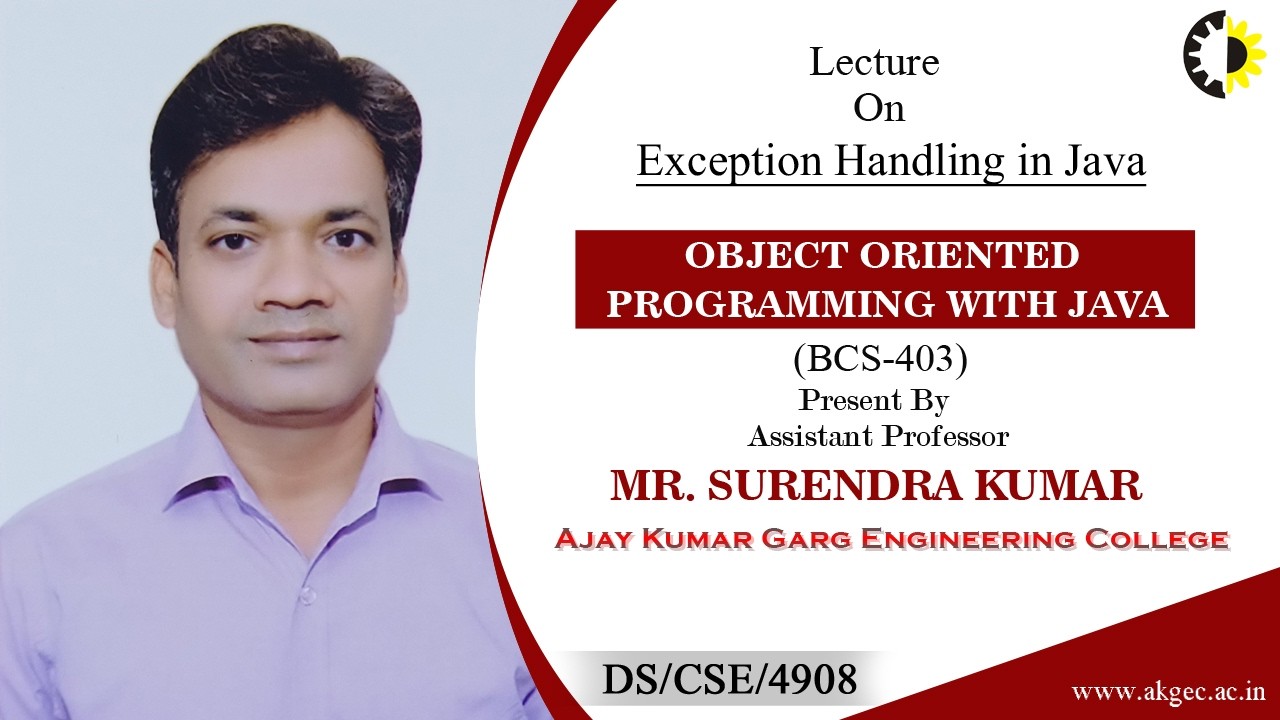
EXCEPTION HANDLING IN JAVA | OOP WITH JAVA | LECTURE 02 BY MR. SURENDRA KUMAR | AKGEC
Keywords
Summary
150 words
Critical Evaluation
Value of the Information & Strength of the Argument
The video offers an accessible introduction to a crucial programming concept. The explanation is logically structured, beginning with error types, then moving to specific exceptions, and finally to handling mechanisms. The use of simple examples (e.g., division by zero, string conversion) aids comprehension. However, the argumentation is somewhat repetitive, and the lecture lacks code demonstrations or real-world scenarios. The strength lies in clarifying the distinction between errors and exceptions and the purpose of try-catch-finally blocks, which is essential for beginners.
Scientific Rigor, Source Quality, Title Accuracy
The lecture is scientifically sound as it presents standard Java exception handling concepts without errors. No external sources are cited, but the material is based on well-established Java documentation and best practices. The title accurately reflects the content. The lecture is part of a structured course, which adds credibility. However, the absence of references or further reading suggestions limits its scientific rigor, though this is common for introductory tutorials.
164 words
Title / Content Match
The title accurately describes the content: a lecture on exception handling in Java as part of an OOP course.
Quality & Reliability
6/10
The lecture provides a correct but introductory overview of exception handling in Java. It covers key concepts and common exceptions without deep technical detail. The presentation is clear but lacks advanced examples or practical demonstrations.
Key Moments
Markers derived by PSI from the transcript: the creator did not define chapters.
- Introduction to the lecture and definition of exception handling.
- Types of errors: syntax, semantic, and runtime errors with examples.
- Common runtime exceptions: arithmetic, null pointer, number format, and array index out of bounds.
- Introduction to try-catch-finally blocks and flow diagram of exception handling.
- Summary and closing remarks.
Cited Sources
- Object Oriented Programming with Java Playlist — Full course playlist for all five units of the OOP with Java course.
- Ajay Kumar Garg Engineering College (AKGEC) Official Website — Institution website providing information about the college and its programs.
Concurring Sources
- Oracle Java Tutorials: Exceptions — Official documentation that agrees with the video's explanation of try-catch-finally and exception types.
- Wikipedia: Exception handling (Java) — Comprehensive article supporting the concepts covered in the lecture.
Contribution & Novelties
The video serves as a fundamental educational resource for beginners learning Java exception handling. It consolidates basic concepts in a clear, accessible manner, making it suitable for university students. Its novelty is limited to its pedagogical delivery rather than new technical insights. To deepen understanding, viewers can explore the following:
Pour aller plus loin :
- Oracle Java Tutorials: Exceptions — Official tutorial covering exception handling in Java with detailed examples.
- Wikipedia: Exception handling (Java) — Overview of exception handling concepts and Java-specific implementation.
- Java Language Specification: Exceptions — Formal specification of exceptions in the Java language.
96 words
Radar Profile
The radar profile shows a balanced but modest performance: quantity and quality are moderate, technical depth is low, and reliability is relatively high. This reflects an introductory lecture that is accurate but not advanced, making it suitable for beginners rather than experienced programmers.