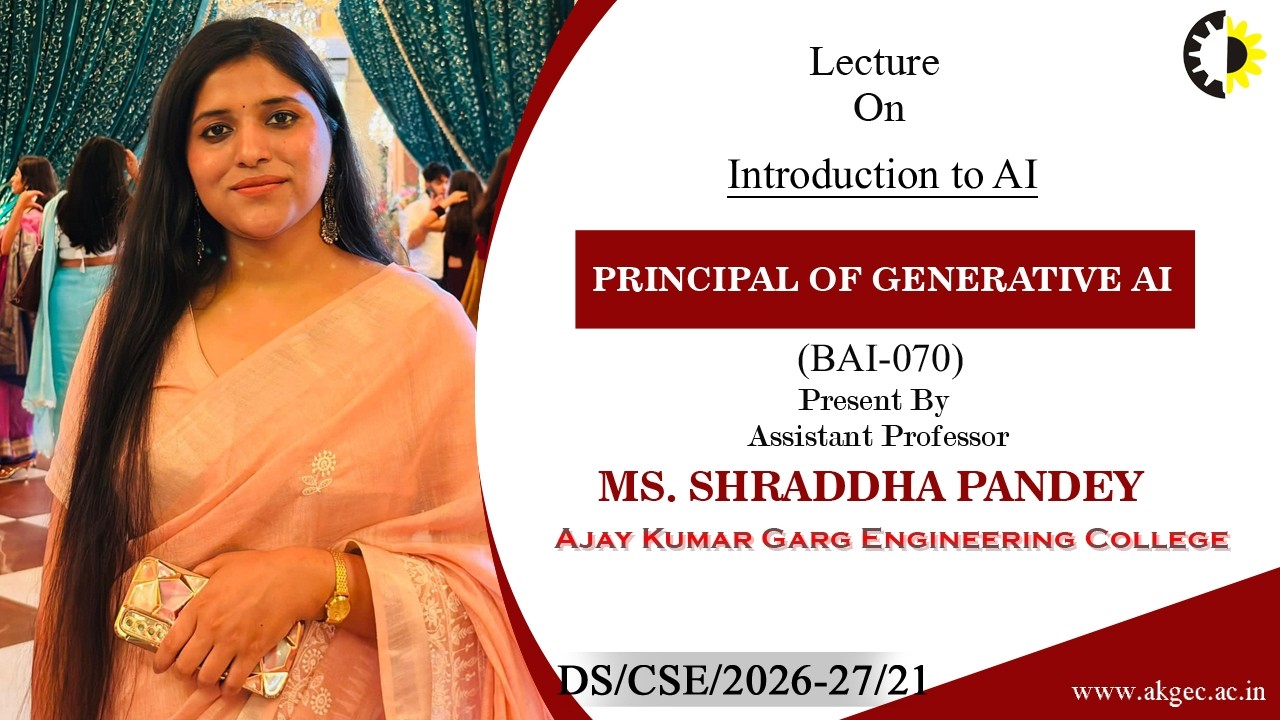
INTRODUCTION TO AI | PRINCIPLES OF GENERATIVE AI | LECTURE 01 BY MS. SHRADDHA PANDEY | AKGEC
Title history
- INTRODUCTION TO AI | PRINCIPLES OF GENERATIVE AI | LECTURE 01 BY MS. SHRADDHA PANDEY | AKGEC — observed on 20261103-1138 UTC (YouTube)
Keywords
Summary
198 words
Critical Evaluation
Value of the Information & Strength of the Argument
The lecture provides a broad, accessible overview of AI and generative AI, making it suitable for beginners. It systematically introduces key concepts and uses relatable examples to illustrate applications, which helps viewers grasp the material. However, the argumentation is descriptive rather than analytical, with few technical details or critical evaluation. The explanations are sometimes repetitive and could be more precise, but the overall structure is logical and the content is coherent. The value lies in its pedagogical clarity, though it lacks depth and original insight.
Scientific Rigor, Source Quality, Title Accuracy
The video does not cite external sources beyond the institution’s website, and the content is presented as the instructor’s own interpretation. While the information aligns with mainstream AI principles, it lacks references to specific literature or research. The title accurately reflects the content, as the lecture indeed serves as an introduction to AI and generative AI. No user comments were provided for analysis, so public reception could not be assessed.
170 words
Title / Content Match
Title accurately reflects the lecture's content covering AI and generative AI fundamentals.
Quality & Reliability
6/10
Content is basic but generally accurate; lacks references and depth.
Key Moments
Markers derived by PSI from the transcript: the creator did not define chapters.
- Introduction to the course and topic of generative AI.
- Discussion of key concepts: training data, neural networks, large language models, prompts, and outputs.
- Explanation of types of generative AI (generators, re-imaginators, synthesizers, assistants, enablers) and how models work.
- Examples of generative AI across text, image, audio, and video generation.
- Fundamentals of AI: comparison between rule-based AI and machine learning, introduction to large language models.
- AI technology landscape, scope of AI (narrow, strong, super intelligence), limitations, and applications across industries.
Cited Sources
- AKGEC Official Website — Institution website providing information about the college and course.
Contribution & Novelties
The lecture provides a systematic introduction to generative AI, clarifying the hierarchy from AI to machine learning to generative AI to large language models. It emphasizes the importance of prompts and gives practical examples. However, it does not offer novel research or unique perspectives; it is a pedagogical overview.
Pour aller plus loin :
- Artificial Intelligence — Foundational overview of AI concepts.
- Generative artificial intelligence — Detailed explanation of generative models.
- Large language model — Insights into LLMs and their architecture.
- Prompt engineering — Techniques for crafting effective prompts.
89 words
Radar Profile
The radar profile indicates moderate scores across information quantity, quality, and reliability, with a lower technical depth score, suggesting the content is introductory and accessible but lacks advanced detail and rigorous sourcing.