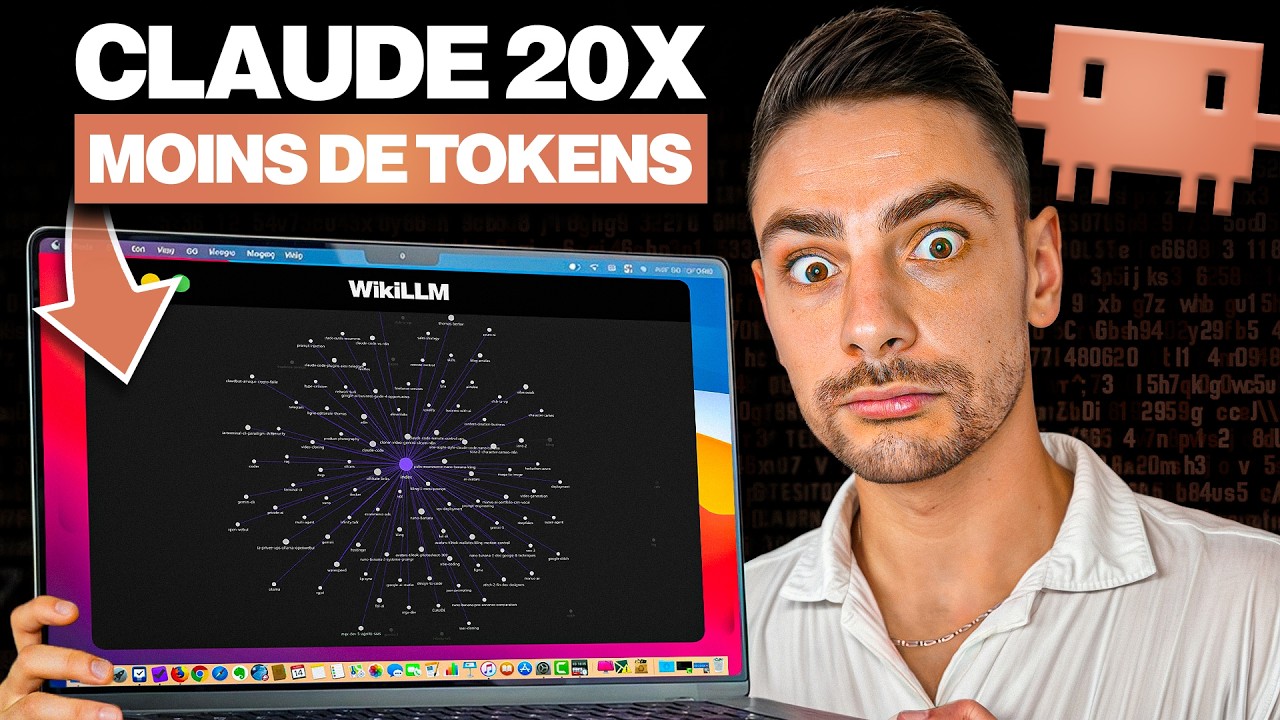
Le co-fondateur d'OpenAI vient de changer Claude Code pour toujours (LLM Wiki)
The OpenAI Co-founder Just Changed Claude Code Forever (LLM Wiki)
Title history
- Le co-fondateur d'OpenAI vient de changer Claude Code pour toujours (LLM Wiki) — observed on 20261112-0057 UTC (YouTube)
Keywords
Summary
163 words
Critical Evaluation
Value of the Information & Strength of the Argument
The video offers a clear, step-by-step tutorial that is highly practical and easy to follow. The argumentation for the value of LLM Wiki is based on a live demonstration: the system is set up from scratch, automatically populates with real data, and successfully answers specific questions in a blank Claude Code session, proving its functionality. The creator also compares it to RAG, highlighting its simplicity and lower cost. However, the argumentation is largely anecdotal and based on a single use case (his own business). While the method seems promising, the video does not provide rigorous benchmarks or comparative analysis against RAG systems, and the claimed ‘95% token savings’ is mentioned without evidence.
Scientific Rigor, Source Quality, Title Accuracy
The tutorial is structured logically, with clear chapters and timestamps. The main source is the official LLM Wiki gist by Andrej Karpathy (linked in the description), which adds credibility. The creator also uses and shows actual tools (Obsidian, Claude Code) in action. The title accurately reflects the content. However, there is a commercial aspect: the creator promotes his own services, but this is not intrusive and does not affect the technical explanation. The public reaction (not provided) could not be analyzed here, but the content is reproducible and transparent.
216 words
Title / Content Match
The title accurately reflects the content: it focuses on Karpathy's concept and its impact on Claude Code, and the video delivers a practical implementation. Minor caveat: the title says 'co-founder of OpenAI' while Karpathy is often described as co-founder, but it's accurate.
Quality & Reliability
7/10
The video provides a hands-on tutorial based on a proposal by Andrej Karpathy (LLM Wiki), with working demonstrations and a test in a blank session. However, claims such as '95% token savings' are taken from Karpathy and not independently verified, and the evaluation is mainly anecdotal rather than systematic.
Chapters
- Intro : ton cerveau numérique en direct
- Andrey Karpathy et le concept LLM Wiki
- LLM Wiki vs RAG : pourquoi c'est 10x plus simple
- Démo du système complet dans Obsidian
- Passons à l'installation
- Étape 1 : télécharger Obsidian et créer ton coffre
- Étape 2 : ouvrir Claude Code dans le projet
- Étape 3 : récupérer la documentation Karpathy
- Envoyer la doc + le prompt à Claude Code
- Le wiki se construit automatiquement
- Les opportunités : cas d'usage infinis
- Test final en session vierge
- L'étape ultime : connecter au cloud (AIOS)
- Conclusion
Cited Sources
- LLM Wiki — Andrej Karpathy (GitHub Gist) — Source of the LLM Wiki concept and the documentation used in the tutorial.
- Obsidian — Tool used to visualize and manage the Markdown vault.
- Claude Code (referral link) — AI coding agent used to build and query the wiki.
- AIOS (aios.fr) — Referred as the 'ultimate step' to connect the wiki to the cloud; also mentioned in the wiki content.
- Formation IA complète (AZURO) — Link to creator's full AI training (promotional, not used in analysis).
- Projet IA sur-mesure — Link to custom AI project service (promotional).
- Communauté IA gratuite — Link to free AI community (promotional).
- LinkedIn profile of Thomas Berton — Personal LinkedIn profile, mentioned in description.
- YouTube channel Nate Herk — Mentioned as related channel (possibly for further viewing).
External References
Contribution & Novelties
The video introduces a novel concept (LLM Wiki) proposed by Andrej Karpathy that leverages human-friendly Markdown files instead of vector databases for AI context retrieval. This approach is simple, free, and transparent, contrasting with traditional RAG. It offers a lightweight alternative for personal knowledge management and AI agents, potentially reducing token usage and infrastructure costs. The tutorial itself is valuable as it provides a hands-on implementation in under five minutes, making the concept accessible.
Pour aller plus loin :
- Retrieval-Augmented Generation (Wikipedia) — Relevant background on RAG, the technique that LLM Wiki aims to replace.
- Knowledge graph (Wikipedia) — Explains interconnected data structures, conceptually related to the interlinked Markdown files.
- Zettelkasten method (Wikipedia) — A note-taking system using interconnected notes, which shares similarities with the LLM Wiki approach.
- Obsidian (official site) — The tool used in the video to visualize and manage the wiki, directly relevant for implementation.
148 words
Radar Profile
The radar profile shows well-balanced scores across most dimensions, with a slight dip in fiabilité_globale due to the lack of independent verification. The high scores in information quantity and quality reflect the dense practical content, while technical level is adequate for a semi-technical audience.