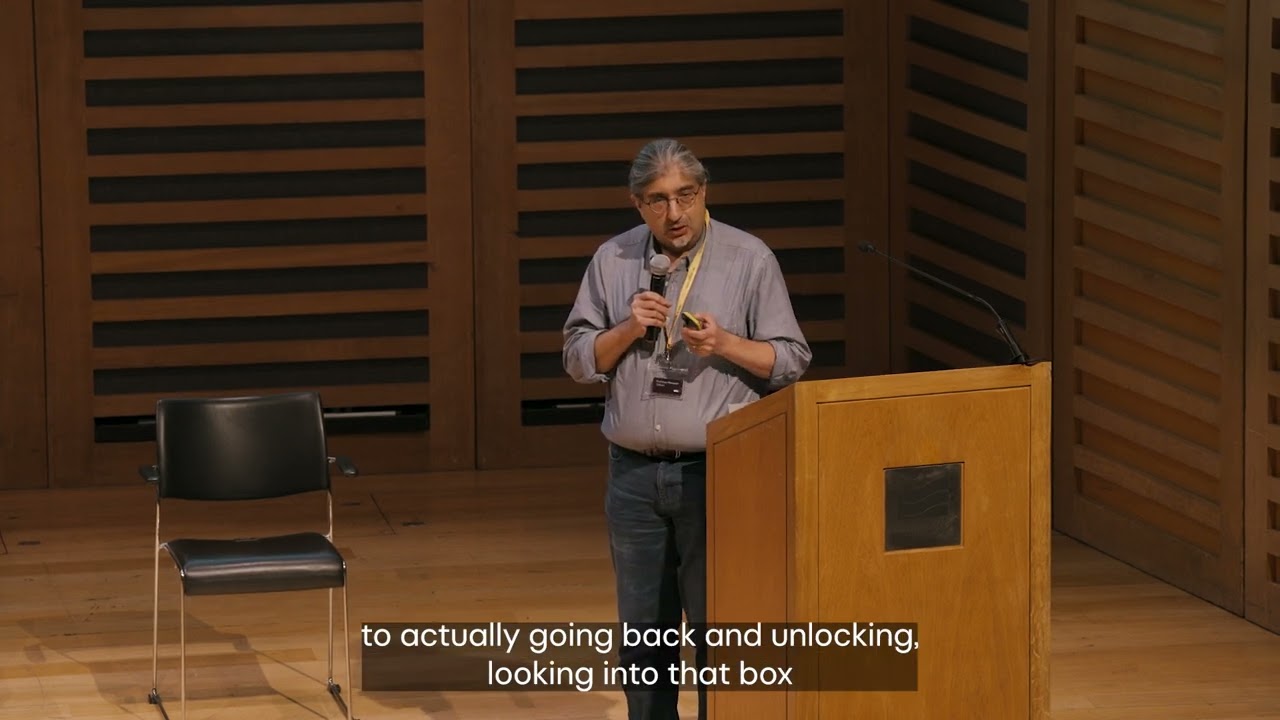
SOFAIR Launch Event. PROFESSOR MANEESH SAHANI TALK
Keywords
Summary
215 words
Critical Evaluation
Value of the Information & Strength of the Argument
The talk’s value lies in its balanced assessment of AI’s strengths and weaknesses, moving beyond sheer performance metrics. The argumentation is coherent: it starts with historical context, then presents concrete evidence of statistical biases, followed by a comparison with natural intelligence, and finally proposes a research agenda. The examples (feathers and bricks, ROT13, arithmetic with non-standard coefficients) are effective in illustrating the dependence on training data statistics. The introduction of ClockBench as a counterexample to the ‘human-level’ claim is compelling. However, the argumentation remains at a high level without deep technical detail; it serves as a persuasive call for fundamental research rather than a rigorous technical analysis.
Scientific Rigor, Source Quality, Title Accuracy
RIGOUR, SOURCES, AND TITLE: The talk is scientifically rigorous in its qualitative reasoning, but the lack of explicit citations (except for ClockBench and a passing mention of the Stanford AI Index) limits verifiability. No published papers or data sources are linked, which weakens the evidence base. The title accurately reflects the content: it is a talk by Professor Sahani at the SOFAIR launch event, and the content matches the description’s question about challenges and prospects for AGI. The omission of direct references is acceptable for a launch talk, but for a thorough analysis, one would need to consult the original studies he refers to. The title does not overpromise; it is straightforward.
234 words
Title / Content Match
The title accurately describes the content: a talk by Professor Maneesh Sahani at the SOFAIR launch event.
Quality & Reliability
7/10
The talk offers a well-argued perspective on limitations of current AI architectures, referencing specific examples and studies, but lacks direct citations or links to sources, and is primarily an opinion piece rather than a peer-reviewed review.
Key Moments
Markers derived by PSI from the transcript: the creator did not define chapters.
- Historical perceptron and 1958 expectations.
- Stanford AI Index: AI systems surpassing human baselines on many tasks.
- LLMs as sequential token prediction – statistical enterprise.
- Examples of statistical failures: GPT-3.5 and GPT-4 (feathers vs bricks, counting, ROT13).
- ClockBench benchmark: analog clock reasoning remains below human level.
- The 'jagged frontier' and the need to re-examine architecture.
- Contrast with human/animal learning: less data, interaction, uncertainty.
- Importance of active interaction and confidence calibration.
- Energy efficiency: brain vs AI systems.
- SOFAIR's four research directions and vision for scientific understanding.
Cited Sources
- ClockBench — Mentioned as a current benchmark for analog clock reading and reasoning where LLMs underperform.
- Stanford AI Index — Referenced for human baseline performance on various tasks, indicating AI has surpassed it.
- Tom Griffiths' group at Princeton — Cited for systematic studies showing statistical patterns in GPT-4's behavior.
Contribution & Novelties
This talk provides a clear articulation of why current AI architectures, despite impressive achievements, are fundamentally limited by their reliance on statistical patterns in human-generated data. It synthesizes evidence from multiple sources to argue that a paradigm shift toward neuroscience-inspired principles (interaction, uncertainty, low energy) is necessary for progress toward AGI. The presentation of the SOFAIR lab’s research agenda is a forward-looking contribution, outlining concrete directions for novel architectures.
Pour aller plus loin :
- Active inference — A theoretical framework in neuroscience that posits agents minimize free energy by acting to align predictions with the world; directly related to Sahani’s call for action-grounded learning.
- System 1 and System 2 thinking — Kahneman’s dual-process theory, referenced indirectly via discussion of confidence and deliberation in AI.
- Neural scaling laws — The empirical study of how model performance scales with data and compute; relevant to the discussion of data-hungry training and potential alternatives.
150 words
Radar Profile
The radar profile shows a balanced but moderate emphasis: high information quality (8) and fiability (7) with average technical level (6) and information quantity (7). This indicates a well-reasoned expert opinion that is accessible but not deeply technical, suitable for a broad scientific audience.