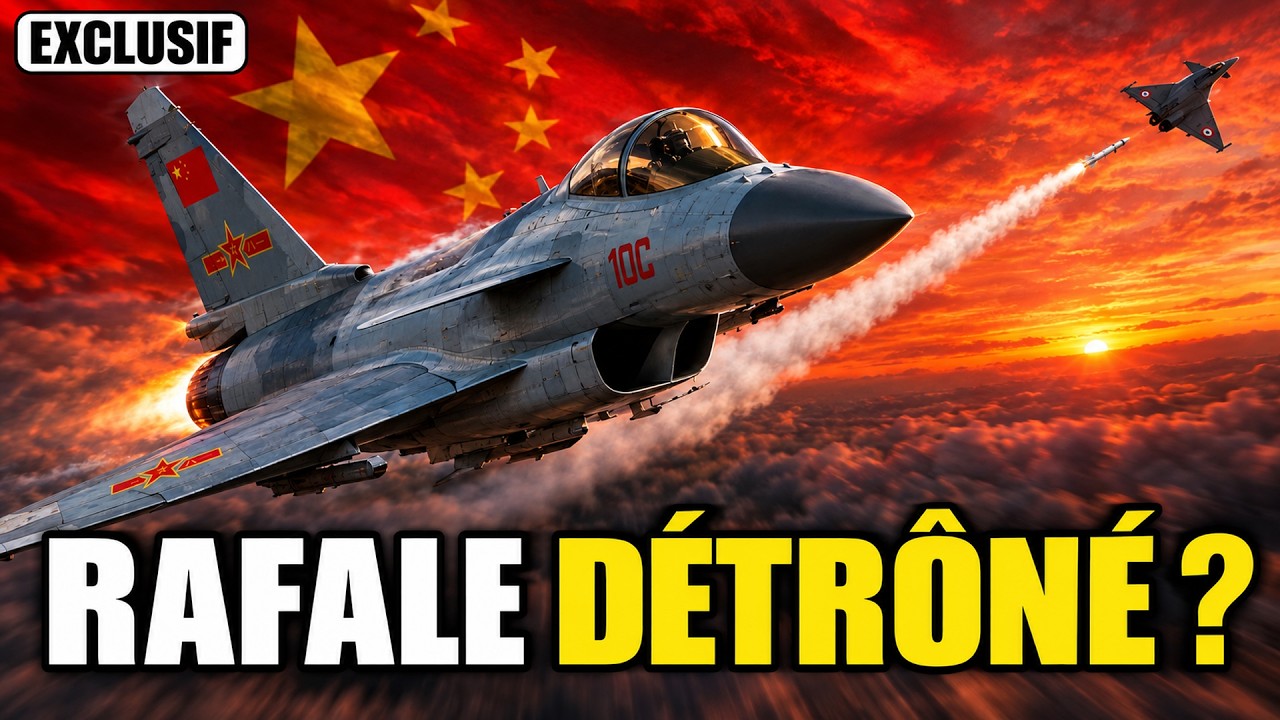
Le Chasseur Chinois Qui Fait Perdre Des Contrats Au Rafale
The Chinese Fighter Jet Costing the Rafale Contracts
Keywords
Summary
181 words
Critical Evaluation
Value of the Information & Strength of the Argument
The video provides a balanced and critical value by systematically comparing conflicting narratives from Pakistan, India, France, China, and the United States. It avoids sensationalism and exposes the evolution of an unverified hypothesis into a widely spread claim, using as an example the supposed continuous guidance of the PL-15 by an airborne radar aircraft. The argumentation is solid: it breaks down the actual event into a network-centric operation, clarifies that no verified dogfight occurred, and contextualizes the commercial impact with concrete figures. The analysis of J-10 export contracts reveals that the actual price difference, once support and infrastructure are included, is narrower than catalogue prices suggest. The video also places the J-10’s progress in the same historical trajectory as the Rafale’s own slow start, arguing that the Chinese fighter has yet to win an open competition against a Western model. The reasoning is methodical, and the conclusion that the Rafale’s principal adversary is its own production rate is well supported by delivery statistics and order backlogs.
Scientific Rigor, Source Quality, Title Accuracy
The video demonstrates scientific rigour by citing a wide range of sources: Reuters, Associated Press, The Express Tribune, South China Morning Post, The Aviationist, TWZ, The Defense Post, Asian Military Review, and French military officials. It clearly separates confirmed facts from unverified claims, noting when information comes from Pakistani, Indian, or other national sources. The handling of the Indian attaché’s statement and the French government’s disinformation campaign is cautious, acknowledging that the campaign could not be directly linked to Beijing. The title is accurate but also somewhat provocative; the video indeed examines whether the J-10 causes Rafale to lose contracts, but systematically refutes the headline scenario. The title does not mislead, as the content engages deeply with that hypothesis. The inclusion of official French statements and Dassault’s CEO adds authority, though the video acknowledges that primary data on the actual combat remains classified or disputed. Overall, the sourcing is diverse and the critical approach is commendable, though the reliance on media reports rather than primary documentation limits the absolute certainty of some claims.
354 words
Title / Content Match
The title accurately reflects the central investigation: whether the Chinese J-10 is causing the Rafale to lose export contracts, which the video examines and largely reframes.
Quality & Reliability
7/10
The video cross-references multiple national and media sources, clearly distinguishes verified facts from claims, and exposes unverified narratives. However, it relies heavily on secondary reports and official statements without independent confirmation of key combat events.
Chapters
Cited Sources
- Reuters report on claimed Pakistani kills — Cited as the origin of the claim that Pakistani J-10s downed two Indian aircraft, including a Rafale.
- Associated Press article on French intelligence allegations — Reported that French intelligence accused China of running a disinformation campaign to boost Chinese equipment.
- The Express Tribune (Pakistan) — Cited for stock market surge and analyst comments on arms attractiveness.
- The Eurasian Times — Cited for French Chief of Staff General Jérôme Bélanger's remarks and Dassault CEO's version of the Rafale loss.
- Al Jazeera — Reported Indian attaché's controversial statement about political restrictions.
- The Business Standard (Bangladesh) — Cited for Bangladesh's planned purchase of 20 J-10s.
- The Aviationist — Reported Indonesian budget approval for J-10s and minister's statements.
- TWZ (The War Zone) — Reported Uzbekistan's committee preparation for J-10 deal.
- The Defense Post — Cited for Uzbekistan's J-10CE appearance at independence parade.
- South China Morning Post — Cited for analyst commentary that J-10CE has not won open competitions against Western rivals.
- ABC Bourse — Cited for Dassault's first-half 2026 financial results and order book.
- African Military Review (likely Asian Military Review) — Cited for India's letter of request for 114 Rafales.
- QuWA (Pakistani military analysis site) — Cited for detailed analysis of the May 7 battle, indicating long-distance shots and network-centric operations.
Concurring Sources
- Reuters (2025) – Pakistani J-10s and PL-15 missiles — Supports the claim that Pakistani aircraft launched PL-15s and hit Indian aircraft, including a Rafale.
- The Express Tribune (2025) – Analysis of Chinese arms attractiveness — Aligns with the idea that the J-10's performance boosts Chinese weapons' appeal.
- Associated Press (2025) – French intelligence on Chinese disinformation — Corroborates the existence of a chinese-coordinated influence campaign.
Dissenting Sources
- Dassault CEO Éric Trappier (2025) — Claims the Rafale loss was due to technical failure, not enemy action, contradicting the narrative of a combat kill.
- Indian Air Force Chief Marshal Amar Preet Singh (2025) — Claims India shot down five Pakistani aircraft and a large aircraft at 300 km, casting doubt on Pakistan's claims of no losses.
- South China Morning Post analyst (2026) — Argues that the J-10CE has never won an open competition against Western jets, implying its export success is limited to niche markets.
Contribution & Novelties
The video offers an original synthesis by deconstructing the battle of May 7 into a network-centric engagement rather than a simple fighter duel, demonstrating that the J-10’s claimed victory is largely a narrative built on unverified assumptions. It systematically reveals the evolution of a speculative hypothesis (continuous guidance by an AEW&C) into an accepted fact through repetitive media coverage, a critical insight into information manipulation. The commercial analysis reframes the J-10’s contracts as complementary to, rather than substituting for, Western fighters, and convincingly argues that Dassault’s production rate is the key constraint, not the Chinese aircraft. This dual perspective – technical and industrial – provides a more nuanced picture than typical defence news reporting.
Pour aller plus loin :
- Chengdu J-10 — Background on the aircraft’s development and variants.
- PL-15 (missile) — Details on the air-to-air missile credited with the kills.
- Dassault Rafale — Overview of the Rafale’s capabilities and export history.
152 words
Radar Profile
The profile shows a high quantitative load of information but moderate reliability, reflecting the heavy reliance on secondary sources. Technical depth is solid, but the verification score is lower due to the unresolved nature of the combat events.