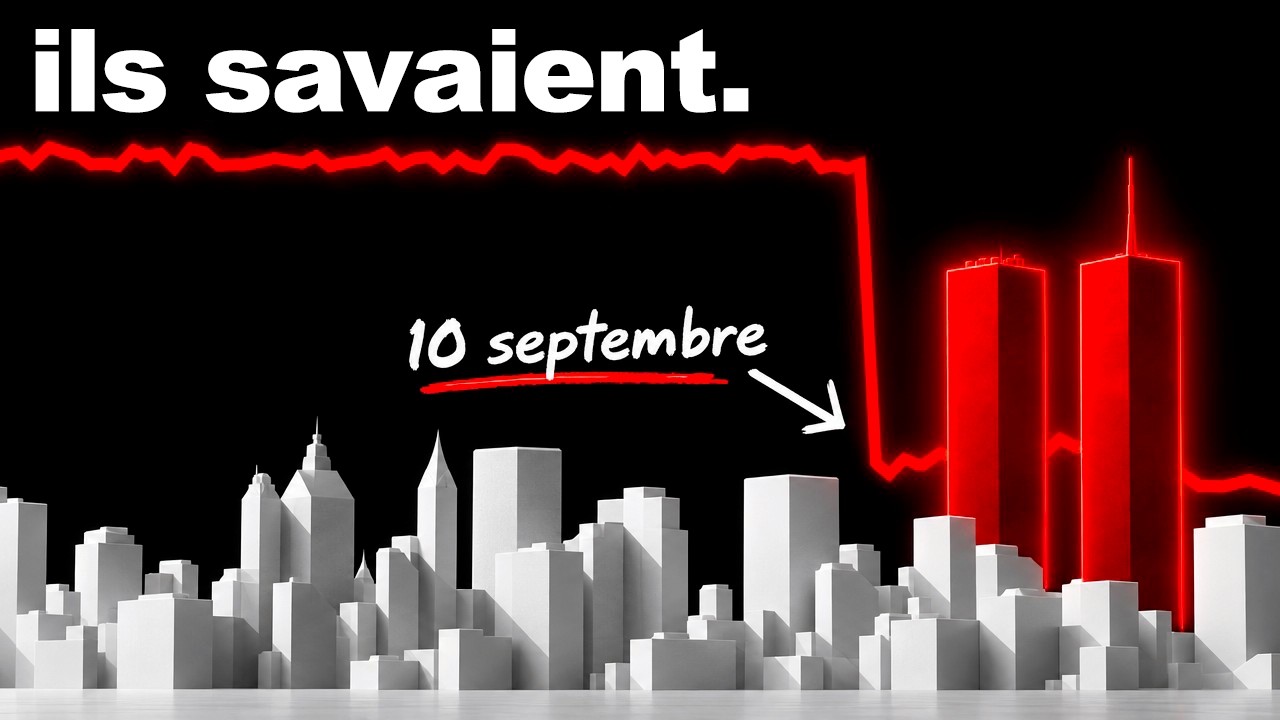
Les traders qui savaient pour le 11 septembre
The Traders Who Knew About 9/11
Keywords
Summary
224 words
Critical Evaluation
Value of the Information & Strength of the Argument
The video provides a clear and detailed explanation of put options and presents documented statistical anomalies with concrete numbers. The argumentation is structured: it starts with the anomalies, explains the instrument, then introduces academic studies that quantify the improbability, and finally examines the official explanations. The strength of the argument lies in the cited peer-reviewed research and the logical presentation of evidence. However, the narrative blends factual data with speculative interpretations, particularly when suggesting deliberate cover-ups. The creator also uses emotional language and promotional hooks, which may undermine objectivity. The argumentation is compelling but not flawless; it relies heavily on circumstantial evidence and does not offer alternative explanations beyond the official and conspiratorial extremes.
Scientific Rigor, Source Quality, Title Accuracy
The video cites specific academic papers (Poteshman, Chesney) and names the Journal of Business, lending some scientific legitimacy. The use of official reports (FBI, SEC) is mentioned but without direct references. The creator does not provide URLs for these sources, and the only link in the description is his own product (invvest.co), which is a promotional tool. The title is fully appropriate; the content indeed focuses on traders who might have had prior knowledge. However, the scientific rigor is moderate: while the quantitative anomalies are well-documented, the interpretation of the causes remains speculative. The absence of primary source links and the promotional nature of the channel (invvest) reduce reliability. The video also includes a sponsorship segment (Bricks) and the promotional hook for his own tool, which we note without penalizing the content.
261 words
Title / Content Match
The title accurately reflects the content, which investigates unusual trading patterns before 9/11.
Quality & Reliability
6/10
The video relies on documented anomalies and cites academic studies (Poteshman, Chesney), but also presents speculation and lacks primary source verification. The channel promotes its own tools, which may introduce bias.
Key Moments
Markers derived by PSI from the transcript: the creator did not define chapters.
- Introduction of the anomalies: put option volumes on United and American Airlines explode before 9/11.
- Explanation of put options with a concrete example using American Airlines contract.
- Overview of global anomalies on S&P 500, Morgan Stanley, Merrill Lynch, and Munich Re.
- Presentation of Professor Allen Poteshman's 2006 study showing the trades are in the 99th percentile and not explained by news.
- Details of FBI investigation: 96% of United Airlines put volume from a single advisor, 67% of American Airlines puts from Options Hotline.
- Theoretical conclusion: speculation about insider knowledge and possible official cover-up, followed by promotional content.
Cited Sources
- Invvest.co - outil de suivi d'investissements — Lien promotionnel du créateur dans la description, outil gratuit de suivi d'investissements.
Contribution & Novelties
The video synthesizes known statistical anomalies and academic studies into a coherent narrative for a general audience, making the case for insider trading before 9/11 more accessible. Its originality lies in assembling data from multiple sources and presenting a clear hypothesis. However, it does not provide new primary evidence; it relies on existing research and official reports. The video also introduces the perspective that official investigations may have overlooked non-Al-Qaida insider knowledge.
Pour aller plus loin :
- Put–call ratio — The indicator used to measure trading anomalies, useful for understanding the statistical basis.
- Insider trading — Legal and ethical aspects of trading on non-public information, relevant to the video’s claim.
- September 11 attacks — Historical context and the official investigation results, providing a counterpoint to the video’s theory.
128 words
Radar Profile
The radar profile shows high scores in information quantity (8) and quality (7), moderate technical level (7), and lower reliability (6). This indicates a well-developed but relatively speculative investigation, with strong factual groundwork but a need for more caution in conclusions.