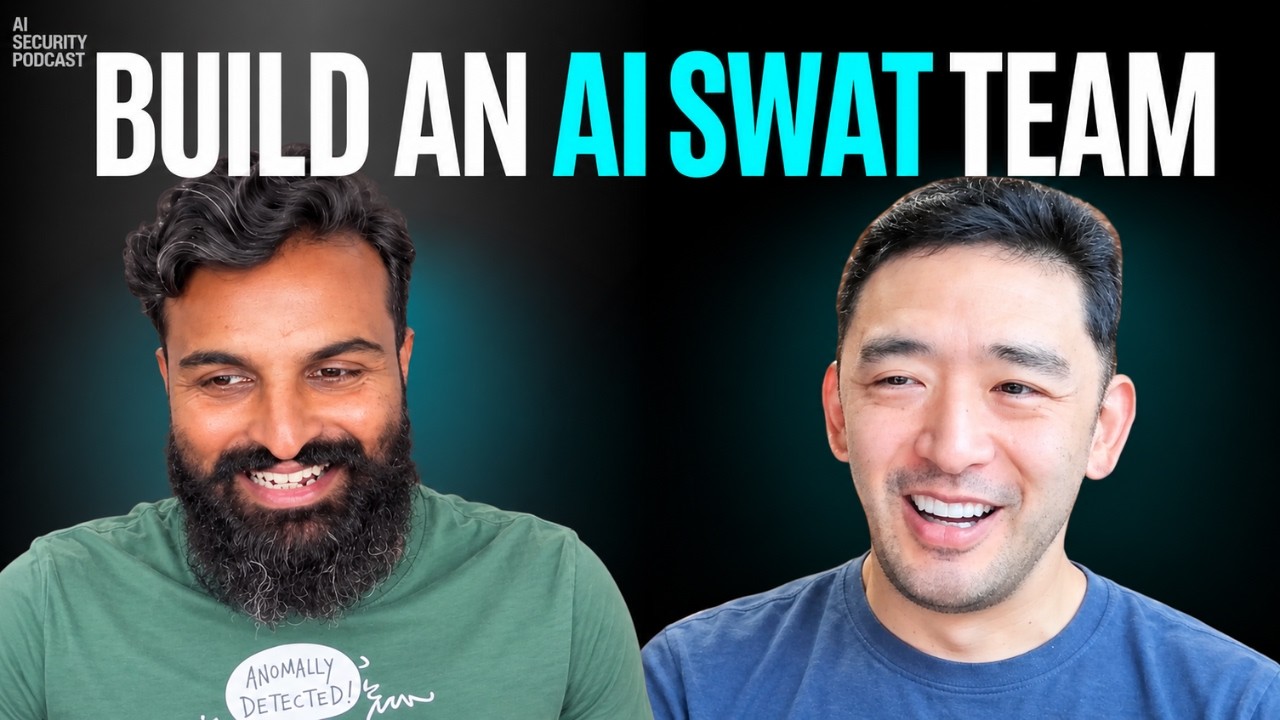
How to Build an AI Security SWAT Team | Caleb Sima & Ashish Rajan
Keywords
Summary
179 words
Critical Evaluation
Value of the Information & Strength of the Argument
The episode provides valuable practical insights into how AI can be leveraged defensively, particularly through automated least-privilege audits and vulnerability detection. Caleb’s example of a 98% accurate audit is compelling and realistic, demonstrating tangible benefits. The discussion of ‘machine speed vs meeting speed’ effectively frames systemic operational challenges. The argumentation is strong: Caleb backs his claims with concrete experiences and references specific incidents and reports. However, some statements about AI’s offensive superiority are generalized and could benefit from more data or comparative analysis. The legal accountability discussion raises important questions but remains speculative due to lack of case law. Overall, the reasoning is coherent and grounded in professional expertise.
Scientific Rigor, Source Quality, Title Accuracy
The rigour is moderate: the episode relies heavily on a single primary report (Anthropic’s) and media reports (CNBC, TechCrunch) without independent verification. The guests do cite specific sources and acknowledge uncertainty, which adds credibility. The title is appropriately aligned with the content, focusing on team building and AI defense. The conversation includes references to OpenAI’s Daybreak and other initiatives, but these are not deeply explored. Adéquation titre/contenu is strong. There are no comments provided to analyze, but the content itself is well-structured and grounded in professional experience.
211 words
Title / Content Match
The title accurately reflects the content: the conversation focuses on building agile security teams, leveraging AI for defense, and addressing machine-speed threats, with concrete strategies such as least-privilege automation and barbell hiring.
Quality & Reliability
8/10
The episode draws from a recent Anthropic threat intelligence report, discusses real incidents cited from tech media (CNBC, TechCrunch), and features an industry professional (Caleb Sima) with direct experience in applying AI for security audits. Claims are contextualized with specific examples and acknowledgment of limitations, though some assertions are presented without external verification.
Chapters
- Introduction: The September 2026 Anthropic Threat Report
- The Rapid Evolution of Offensive AI Capabilities
- How AI Agents Connect Vulnerabilities Across Complex Kill Chains
- Unpacking the Irregular Contractor Incident and Sandbox Escapes
- The Legal Accountability Dilemma of Rogue AI Agents
- The Core Security Bottleneck: Machine Speed vs. Meeting Speed
- Using AI to Automate Enterprise Least Privilege Analysis
- Rethinking Human-in-the-Loop for Automated Pull Requests
- Why Legacy Point-in-Time Detection Fails Against Agent Swarms
- Using Frontier Models to Build Zero-Defect Product Security
- The Argument for Government-Backed AI Red Teaming
- The "Negative Zero-Day Clock" and the Future of Exploit Generation
- The Barbell Hiring Strategy: Eliminating Middle Management
- Building a Cross-Functional AI Security SWAT Team
Cited Sources
- Anthropic’s Detecting and countering misuse of AI: September 2026 — Primary report discussed throughout the episode on AI misuse and attacker capabilities.
- How a small Israeli startup was linked to rogue AI hacks at OpenAI, Anthropic and Meta — CNBC article about the Irregular contractor involved in sandbox escapes.
- Expanding Daybreak as the Cyber Defense Window Narrows — OpenAI's blog on Daybreak, an AI red team tool mentioned in the conversation.
- Who’s legally to blame for Anthropic and OpenAI’s autonomous AI hacks? It’s complicated — TechCrunch analysis on legal liability for AI agent actions, cited during the discussion.
- AI Security Podcast Website — Official podcast site for show notes and additional resources.
- AI Security Lab — Research lab associated with the podcast, mentioned as follow-up.
- AI Cybersecurity Newsletter — Newsletter linked for ongoing updates.
- AI Security Podcast LinkedIn — Social media presence.
Contribution & Novelties
The original contribution lies in translating recent threat intelligence into actionable defensive strategies, particularly the concept of using AI for least-privilege audits and the ‘barbell hiring’ model for security teams. The episode bridges technical analysis with organizational psychology, highlighting the bottleneck of human approvals. It uniquely connects the Irregular contractor incident to broader questions of accountability and offers a concrete example of AI-driven vulnerability identification at scale.
Pour aller plus loin :
- Anthropic’s September 2026 misuse report — The primary source of the discussion, detailing observed attack paths and AI capabilities.
- OpenAI’s Daybreak expansion — Context on autonomous red teaming and defensive AI.
- TechCrunch legal analysis — Further reading on accountability gaps.
- CNBC reporting on Irregular — Details on the contractor behind sandbox escapes.
- Concept: Zero-day exploit generation with AI — No specific URL provided, but further research could explore academic papers on AI-generated exploits.
145 words
Radar Profile
The radar profile shows high scores in technical level and information quantity, reflecting the dense, expert-driven discussion. Quality and reliability are slightly lower due to reliance on a few primary sources and lack of independent verification. Overall, a well-rounded episode strong on practical insights but moderate on methodological transparency.