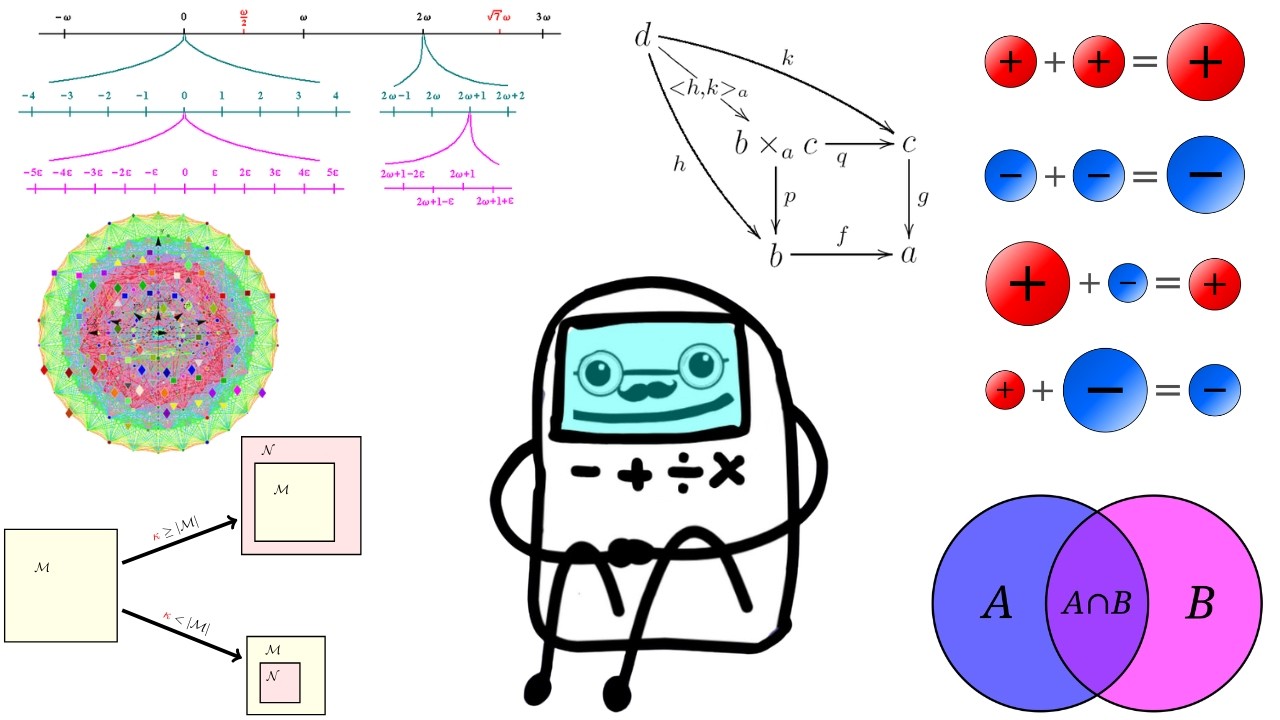
Investigating Obscure Math Theories To Help You Sleep
Title history
- Investigating Obscure Math Theories To Help You Sleep — observed on 20261024-1820 UTC (YouTube)
Keywords
Summary
138 words
Critical Evaluation
Value of the Information & Strength of the Argument
The informational value is exceptionally high, as the video successfully distills dense mathematical constructions into an intuitive narrative without losing rigor. The argumentation is structurally excellent: each new concept is presented as a logical outgrowth of the previous one, progressing from the foundational surreal numbers to their expression in game theory and then to their computational and geometric analogues. The explanation of the simplicity rule and the recursive nature of the order comparison provides a solid anchor for understanding the entire system.
Scientific Rigor, Source Quality, Title Accuracy
The scientific rigor is strong; the script consistently names primary sources, including Conway’s ‘On Numbers and Games’ (1976), Knuth’s 1974 novella, Martin Gardner’s Scientific American columns, Bouton’s 1901 work on Nim, and Whitney’s 1935 paper on matroids. The title ‘Investigating Obscure Math Theories To Help You Sleep’ is slightly playful but perfectly accurate, as the content genuinely covers obscure but foundational theories, and the calm, steady delivery matches the ‘sleep aid’ premise without compromising the factual density.
174 words
Title / Content Match
The title accurately reflects the content, which consists of a long-form exploration of several obscure and advanced mathematical theories, including surreal numbers, combinatorial game theory, tropical geometry, and matroids.
Quality & Reliability
8/10
The video presents a highly detailed and technically accurate overview of several advanced mathematical fields, correctly attributing discoveries and referencing original works by Conway, Gardner, Knuth, Bouton, Gosper, and Whitney. The explanatory framework is logically sound and avoids caricature, though it inherently simplifies certain formal proofs for a general audience.
Key Moments
Markers derived by PSI from the transcript: the creator did not define chapters.
- Introduction to surreal numbers through the analysis of Go endgames and their numerical properties.
- Construction of the first surreal numbers: zero, one, minus one, and the discovery of 1/2 via the simplicity rule.
- Extension to transfinite numbers: derivation of omega and infinitesimals as new types of numbers.
- Transition to combinatorial game theory, introduction of Nim, and Bouton's solution using the mex rule.
- Explanation of Hackenbush positions and how they directly correspond to fractional surreal numbers.
- Detailed presentation of Conway's Game of Life, including still lifes, oscillators, and the glider pattern.
- Analysis of the Gosper glider gun and the proof that the Game of Life is Turing complete via glider collisions.
- Discussion of the look-and-say sequence, audioactive decay, and Conway's constant of degree 71.
- Introduction to tropical arithmetic, defining min-plus algebra and the construction of tropical polynomials as piecewise linear functions.
- Applications of tropical geometry in auction design, international trade, neural networks, and evolutionary biology.
- Final segment on matroids, presenting Whitney's axioms and the exchange property to unify independence and forest concepts.
Cited Sources
- Visual Sources Document — The only link provided in the video description, likely containing a comprehensive list of visual references and primary sources used during production.
- Surreal_number — Mentioned in the video as the foundational topic being investigated. Provides a formal framework consistent with the construction explained.
- On Numbers and Games — Explicitly cited in the video as Conway's 1976 account of the theory of surreal numbers and combinatorial game theory.
- Combinatorial game theory — The core subject area discussed, with focus on normal play, impartial games, and the significance of Nim.
- Conway's Game of Life — Conway's cellular automaton explored in depth, including its rules, patterns like the glider, and its Turing-complete nature.
- Tropical geometry — Described as a min-plus algebra system, with applications mentioned across optimization, machine learning, and biology.
- Matroid — Whitney's 1935 introduced generalization of independence, presented as a unifying structure in the video.
- Sprague–Grundy theorem — Referenced as the key result showing every impartial game is equivalent to a nimber, a foundation stone of the video's game theory segment.
Concurring Sources
- Winning Ways for Your Mathematical Plays — Co-authored by Conway, this work corroborates the video's claims about analyzing specific partisan games with surreal number machinery.
- Look-and-say sequence — Confirms the video's description of the sequence's properties, including the limit of the length ratio and the degree of the polynomial.
Contribution & Novelties
The video’s primary contribution is its exceptional clarity in connecting disparate mathematical domains through the lens of Conway’s work. It traces a conceptual lineage from the abstract recursive construction of surreal numbers to their manifestation as concrete values in games like Hackenbush, then jumps outward to Turing-complete computational structures and purely algebraic systems like tropical geometry. By weaving these narratives together, it offers viewers a rare, cohesive perspective on how a single generative idea can permeate pure mathematics and theoretical computer science.
Pour aller plus loin :
- Surreal number — Deepens understanding of the recursive construction and comparison rules, directly extending the core topic.
- Look-and-say sequence — Provides details on Conway’s audioactive decay and the derivation of the Conway constant, mentioned near the end of the video.
- Gosper glider gun — Specifics of the mechanism that proves endless growth in the Game of Life, a key example in the computational section.
- Matroid theory — Formal axiomatic foundations for the ‘independence’ concept, connecting to Whitney’s work cited in the video.
169 words
Radar Profile
The radar profile is highly skewed toward 'quantity of information' and 'technical level', reflecting the video's dense content and pedagogic ambition. The lower score in 'quality of information' relative to quantity suggests that while vast, the breadth of topics occasionally overrides the depth of formal proof, but the overall 'reliability' remains solid.