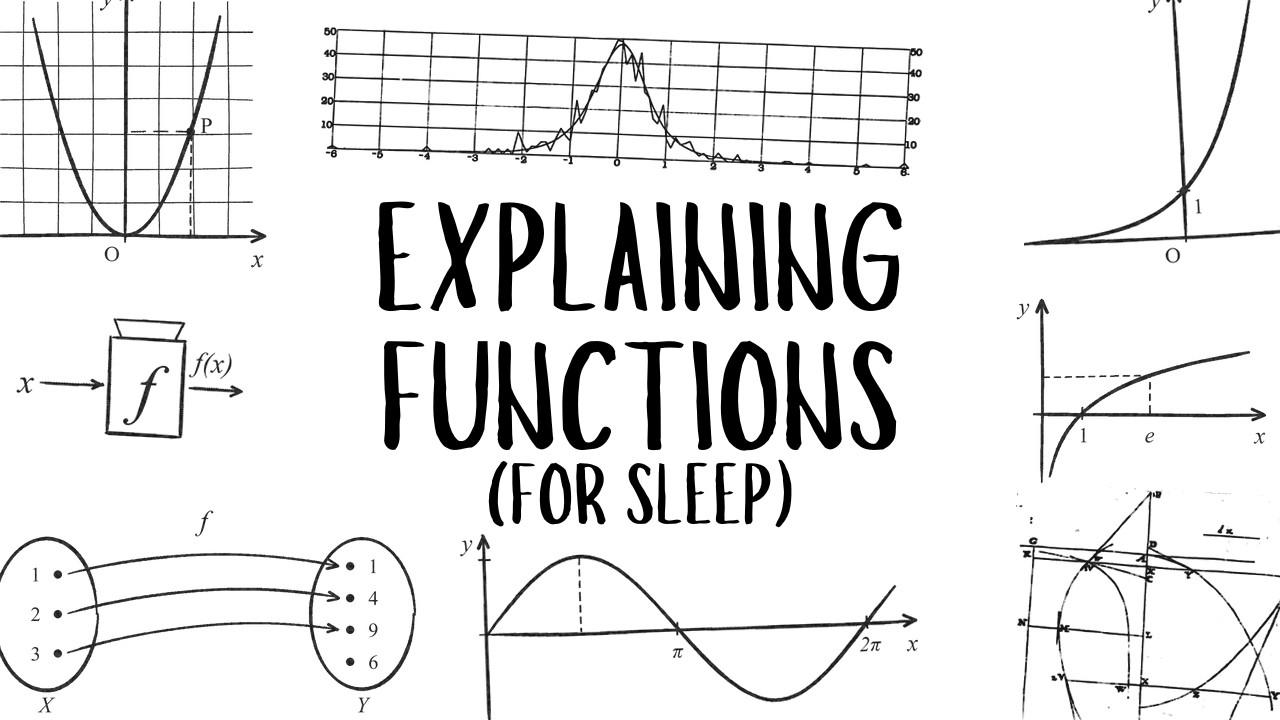
Explaining Literally Everything There Is To Know About Functions
Keywords
Summary
188 words
Critical Evaluation
Value of the Information & Strength of the Argument
The information is highly valuable for students of mathematics, as it systematically builds an understanding of functions from first principles, addressing common misconceptions such as the need for formulas or the confusion between codomain and image. The argumentation is solid: each concept is introduced with a concrete example, followed by a general definition, and then properties are derived logically. The video is careful to distinguish between a function and a relation, and between direct and inverse images, with explicit attention to why these distinctions matter. The explanations avoid oversimplification while remaining clear, and the use of multiple representations (tables, graphs, verbal rules) reinforces conceptual mastery.
Scientific Rigor, Source Quality, Title Accuracy
The scientific rigor is high: the mathematical definitions are standard and presented without errors. The video does not cite external sources beyond a linked Google Doc of visual sources, which is appropriate for a tutorial. The title is slightly overambitious, as ’everything’ would include advanced topics like bijections, inverse functions, and function spaces, which are not covered in detail. However, within an introductory scope, the treatment is thorough and accurate. No public comments were provided for analysis.
197 words
Title / Content Match
The title claims to explain everything about functions, and the video indeed covers a broad range of fundamental concepts, though advanced topics like inverse functions and surjectivity are only hinted at; still, the treatment is comprehensive for an introductory level.
Quality & Reliability
9/10
The video provides a mathematically rigorous and precise introduction to functions, accurately distinguishing domain, codomain, image, preimage, and composition, with careful attention to logical completeness and notation. The content aligns with standard mathematical definitions.
Key Moments
Markers derived by PSI from the transcript: the creator did not define chapters.
- Water bill example introduces the concept of a function as an assignment with domain and uniqueness.
- Explanation of domain and codomain, emphasizing the distinction between the declared output set and the actual image.
- Discussion of image and range, with examples showing the difference between codomain and actual outputs.
- Function notation, substitution, and the idea that functions can be expressed in multiple ways beyond formulas.
- Introduction of preimage and inverse image, with emphasis on set-based collections of inputs.
- Composition of functions, covering the requirement that intermediate outputs must fall in the domain of the outer function.
Cited Sources
- Visual sources for the video — The video's description provides a link to a Google Doc containing visual sources, likely diagrams and references used in the production.
Concurring Sources
- Function (mathematics) - Wikipedia — The video's definitions of function, domain, codomain, and image align with standard mathematical references.
- Domain of a function - Wikipedia — The video's explanation of domain as the set of permitted inputs matches this reference.
- Preimage - Wikipedia — The video's treatment of preimage as a set of inputs matching an output set is consistent with this concept.
Contribution & Novelties
The video’s original contribution lies in its pedagogical approach: it systematically builds the concept of a function from everyday examples, then formalizes each component (domain, codomain, image, preimage) with explicit attention to logical completeness. It clarifies subtle pitfalls, such as the difference between codomain and image, and the set-based nature of preimages, which are often glossed over in introductory courses. The use of multiple representations and the careful treatment of composition provide a solid foundation for further study.
Pour aller plus loin :
- Function (mathematics) — For a comprehensive overview of functions in mathematics.
- Domain of a function — Discusses the input set and its importance in defining functions.
- Image (mathematics) — Explains image and preimage for sets.
- Composition of functions — Covers the operation of composing functions, including conditions for validity.
132 words
Radar Profile
The radar profile shows high scores across information quantity, quality, technical level, and reliability, indicating a well-rounded, authoritative tutorial. The slight dip in quantity reflects the fact that not all possible topics (e.g., inverse functions in depth) are covered, but the overall balance is strong.