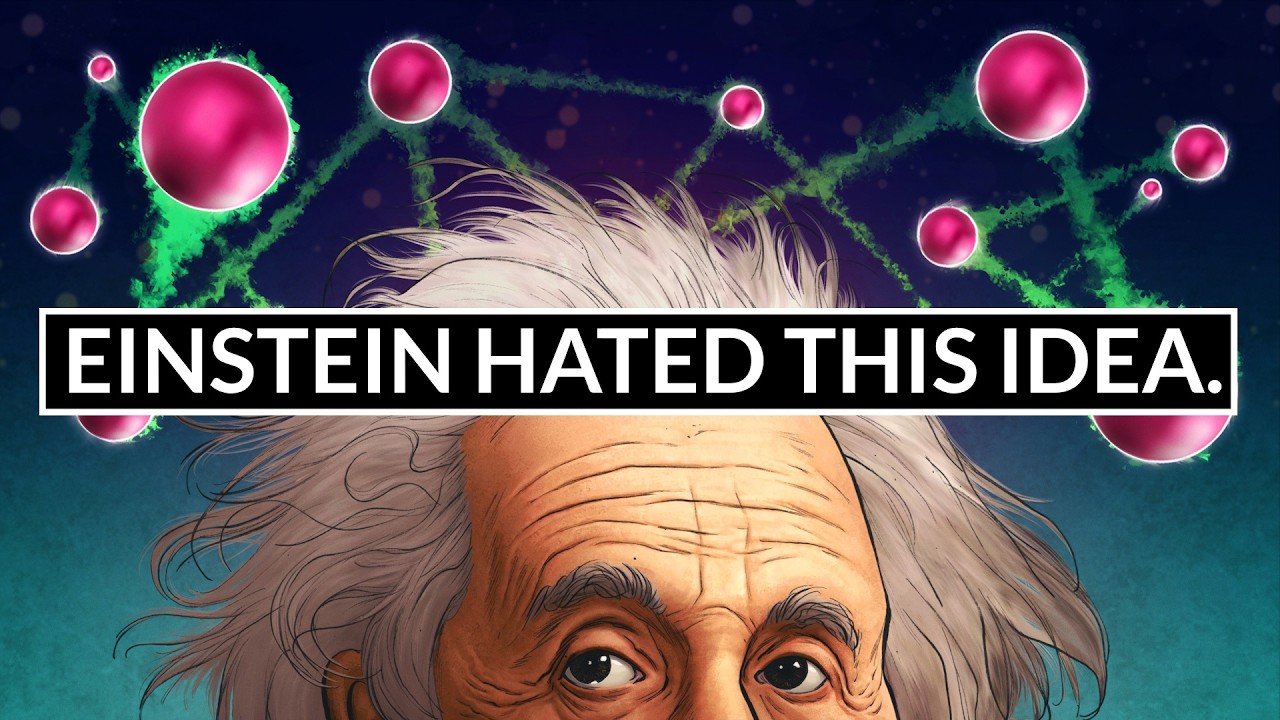
Have We Finally Proven Einstein Wrong?
Keywords
Summary
149 words
Critical Evaluation
Value of the Information & Strength of the Argument
The video provides a well-structured and engaging narrative that traces the historical and conceptual evolution of the quantum entanglement debate. It effectively explains complex ideas like wave functions, entanglement, and Bell’s inequalities using accessible analogies and clear graphics. The argumentation is solid, logically leading from the historical debate to the modern experiments, and it avoids oversimplifying the philosophical implications. The inclusion of the cosmic Bell test demonstrates how scientists have pushed the boundaries of testing, making the content valuable for understanding both the physics and the methodology. The video also correctly notes that the experiments do not prove Einstein entirely wrong but rather disprove his preference for local hidden variables, which is a nuanced and accurate stance.
Scientific Rigor, Source Quality, Title Accuracy
The video maintains a high level of scientific rigor, accurately describing historical events and experimental details. It references real experiments and theoretical results, but does not cite specific academic papers in the description. The only sources listed are the Incogni sponsorship link and the co-author’s YouTube channel; the latter is provided as a resource for further exploration but is not directly a scientific source. The title is appropriate and not misleading, though it slightly sensationalizes the nuance; the content actually discusses the subtle outcome of Bell tests. The narration is consistent with established physics, and the video includes no apparent misinformation. The sponsorship segment is clearly marked and does not compromise the scientific content. Overall, the title-content alignment is good, and the scientific quality is high.
258 words
Title / Content Match
The title asks whether Einstein has been proven wrong, and the video indeed addresses the challenge to his locality principle via quantum entanglement experiments, providing a nuanced answer. The match is good, though the conclusion is not a simple 'yes' but a nuanced acceptance of non-locality.
Quality & Reliability
8/10
The video presents a coherent historical and conceptual overview of the Einstein-Bohr debate, Bell's inequalities, and subsequent experimental tests. It accurately describes key experiments (Stern-Gerlach, EPR, Bell tests) and contextualizes the recent cosmic-scale experiments. Minor simplifications are acceptable for a general audience, and the narrative aligns with established scientific consensus.
Chapters
Cited Sources
- Alas Lewis and Barnes - YouTube Channel — The channel of Geraint Lewis, co-author of the book mentioned in the description, provided as a resource for further exploration.
External References
Contribution & Novelties
The video synthesizes a complex historical debate and recent experimental results into a digestible documentary format, highlighting the cosmic Bell test as a pinnacle of experimental ingenuity. It effectively explains the loophole-closing mechanisms and why the results are significant.
Pour aller plus loin :
- Bell’s theorem — A comprehensive overview of the mathematical result and its implications for quantum mechanics.
- EPR paradox — The original 1935 paper and its significance in the Einstein-Bohr debate.
- Cosmic Bell Test — The specific experiment using astronomical sources to close the ‘freedom of choice’ loophole.
- Copenhagen interpretation — The standard interpretation defended by Bohr, central to the video’s narrative.
105 words
Radar Profile
The radar profile shows high scores for information quantity, quality, and technical level, reflecting the video's dense but accessible content. The fiabilite_globale score is slightly lower due to the lack of explicit academic citations, but overall the profile indicates a strong educational resource.
💬 Sur les 30 commentaires analysés, le climat est très positif, avec de nombreux spectateurs exprimant leur enthousiasme et leur gratitude pour la qualité du contenu, certains mentionnant une appréciation particulière pour le travail humain sans IA.