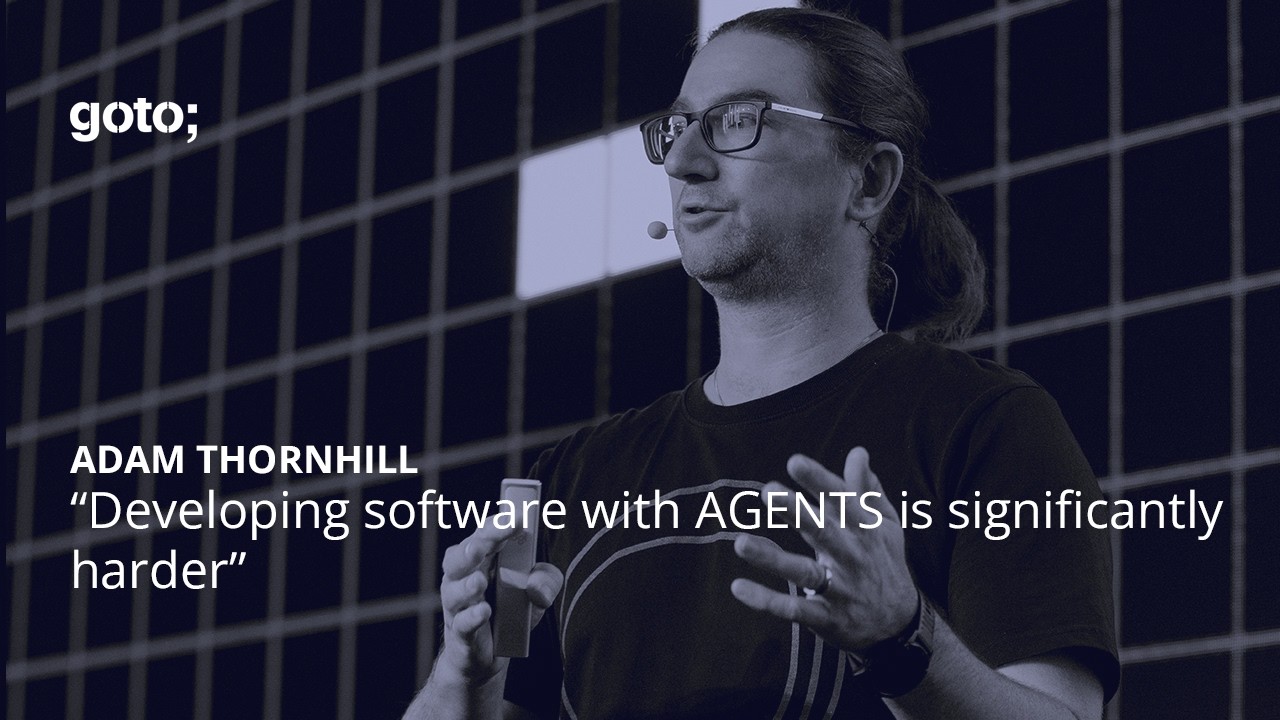
AI-Friendly Code: The Missing Link for Speed with Quality • Adam Tornhill • GOTO Copenhagen 2026
Title history
- AI-Friendly Code: The Missing Link for Speed with Quality • Adam Tornhill • GOTO Copenhagen 2026 — observed on 20261105-1106 UTC (YouTube)
Keywords
Summary
219 words
Critical Evaluation
Value of the Information & Strength of the Argument
The talk provides valuable, data-driven insights into the challenges and solutions for integrating AI agents into software development. The speaker backs his claims with references to empirical studies, including his own research on code health, which add credibility. He also presents a practical framework and a detailed case study, offering actionable advice. However, some arguments rely on anecdotal evidence from his own team and may not generalize universally. The reasoning is logical and well-structured, acknowledging both the benefits and risks of AI coding, and he supports his assertions with concrete examples and metrics.
Scientific Rigor, Source Quality, Title Accuracy
The presentation demonstrates strong scientific rigor by referencing multiple studies, including his own peer-reviewed research and industry reports like the AI Whiplash report. He is transparent about methodology, such as using replay harnesses for correctness verification. However, the description lacks explicit links to the cited research papers, limiting immediate verification. The title accurately reflects the content, and the talk stays focused on the theme of code health and AI efficiency. No external comments or audience feedback were analyzed.
186 words
Title / Content Match
The title accurately captures the talk's focus on code quality as a critical factor for achieving both speed and quality when using AI coding tools.
Quality & Reliability
8/10
The talk is based on empirical research and case studies, presented at a reputable conference by an expert. While specific citations are not provided in the description, the speaker references published studies and demonstrates data-driven insights. The arguments are coherent and well-supported, though some claims rely on the speaker's own research without external verification.
Chapters
- Intro
- The more things change - The more we realize that software engineering is hard
- Coding might be dead. Why code with a Agents?
- The core Challenges for AI Agent
- Code Health - How easy code is to understand
- Research on AI - What we have found
- Questioning The Relevance
- The Illusion of Instant Software
- Success Criteria - Safeguard any AI generated or edited code
- Success Criteria - Make Buisness critical code AI-ready
- Make code healt uplift agents
- Case Study - Refactoring at scale with agents
- The Foundation - Adapt to the local problems at hand
- Success Criteria - Software design is more important than ever
- Refactoring code - The next challenge
- Summary - Wrap up and resources
Cited Sources
- GOTO Copenhagen 2026 Session Page with Slides — Provides access to the presentation slides and full abstract.
- Adam Tornhill Official Website — Author's site with information about his books and research.
- Adam Tornhill GitHub Profile — Source code and examples related to code analysis tools.
- GOTO Expert Profile for Adam Tornhill — Background and bio of the speaker.
External References
Contribution & Novelties
This talk contributes a fresh perspective on AI coding by emphasizing the crucial role of code health as a safeguard for quality. It introduces a practical mechanism using MCP servers to provide feedback to AI agents, enabling self-correction towards healthier code. The case study of uplifting a legacy codebase (Street Fighter 3) to perfect code health demonstrates a scale-up approach that can be replicated. The talk also challenges the ‘illusion of instant software’ by highlighting long-term maintenance costs.
Pour aller plus loin :
- Technical debt — Relevant to the talk’s focus on legacy code and its impact on AI productivity.
- Code refactoring — Key process used in the case study to improve code health.
- Software design — The speaker emphasizes design as more important than ever in the AI era.
130 words
Radar Profile
The profile shows high scores in information quantity (8) and quality (8), indicating a dense, substantive talk. The technical level (7) suggests it balances accessibility with depth. Reliability (8) reflects the use of empirical research and case studies, although external verification of cited studies is limited.