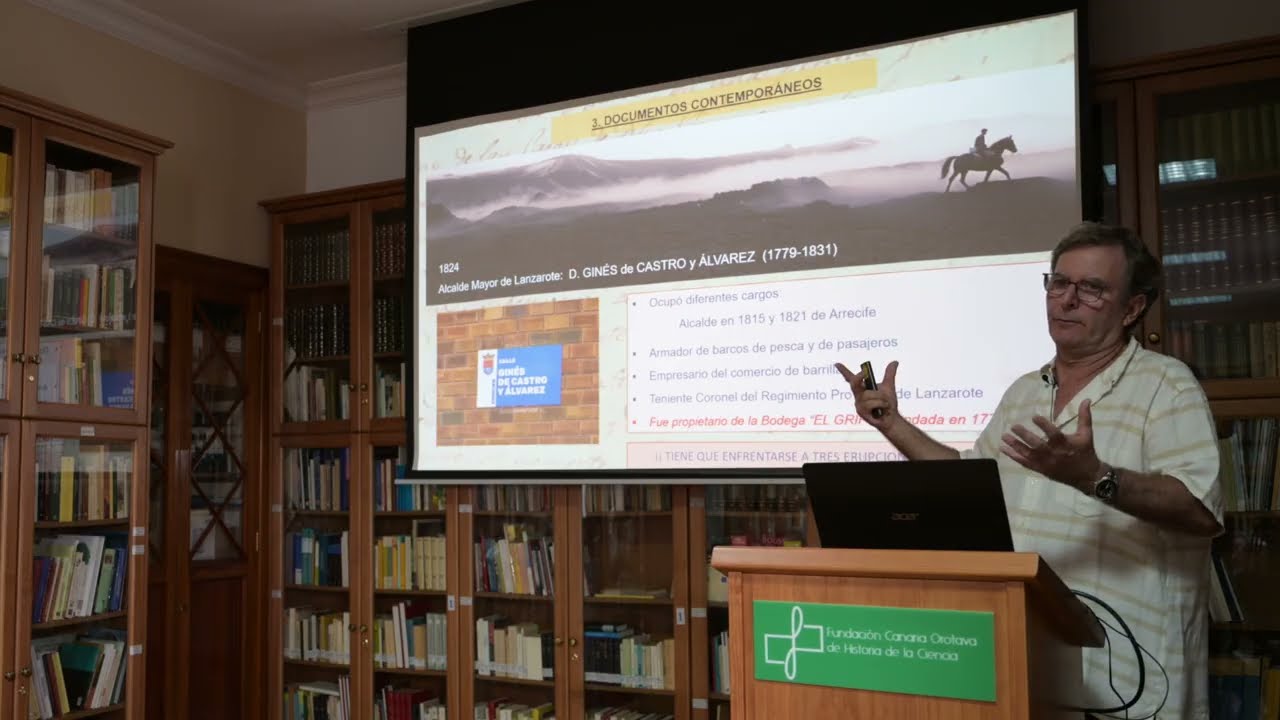
Volcanes de 1824 en Lanzarote, conferencia de Vicente D. Rodríguez Armas en la Fundación Orotava.
Volcanoes of 1824 in Lanzarote, lecture by Vicente D. Rodríguez Armas at the Orotava Foundation.
Keywords
Summary
200 words
Critical Evaluation
Value of the Information & Strength of the Argument
The value of the information is high because it presents original archival discoveries, including the recovery of municipal records and a diary, and corrects a long-standing error in attribution. The argumentation is solid: the speaker supports each claim with specific documentary evidence, demonstrates the chain of custody of the documents, and compares the observations with modern geological knowledge. The reasoning is structured logically, from historical context to detailed analysis of the eruptions and their documentation. The conference effectively argues that the 1824 documentation constitutes a pioneering systematic record of an eruption, thereby underscoring its scientific and historical significance.
Scientific Rigor, Source Quality, Title Accuracy
The presentation exhibits rigorous scientific methodology: it relies on primary sources, cross-references multiple documents, and explicitly addresses provenance and authenticity issues. The speaker cites named researchers and their assessments, while also acknowledging gaps in knowledge. The sources used are principally archival manuscripts, which are clearly described and linked to institutional repositories. The title accurately reflects the content, as the lecture is entirely devoted to the 1824 volcanoes and their historical study. The adéquation between title and content is high, with no misleading elements.
196 words
Title / Content Match
The title accurately reflects the content: a detailed account of the 1824 Lanzarote eruptions based on historical documents and scientific investigation.
Quality & Reliability
9/10
The conference presents rigorous archival research, explicitly identifying primary sources and addressing authorship controversies with evidence. The speaker is a university professor in physics, and the talk is hosted by a recognized history of science foundation.
Key Moments
Markers derived by PSI from the transcript: the creator did not define chapters.
- Introduction and motivation: the 1824 volcanoes as a unique case within world vulcanism.
- Historical and socio-political context of early 19th-century Lanzarote, including the transition from neptunism to plutonism.
- Description of the three volcanoes of 1824: Tao, Nuevo del Fuego, and Tinguatón, with emphasis on Tinguatón's accessible conduits.
- Introduction of the key documents: municipal acts and the diary of mayor Ginés de Castro y Álvarez, including their provenance and archival journey.
- Discussion of the authorship confusion and its resolution, demonstrating that the diary was written by the mayor, not a priest.
- Review of subsequent scientific investigations from the 19th century to present, emphasizing the use of these primary sources in vulcanology.
Cited Sources
- Exhibition: Del Big Bang a Tinguatón, último volcán de Lanzarote — The speaker references this exhibition as complementing the lecture and providing further information about the volcanoes.
External References
Contribution & Novelties
The principal novelty lies in the comprehensive analysis and public presentation of the 1824 documentation, particularly the clarification of the author of the volcanic diary as Ginés de Castro y Álvarez, not a parish priest. This corrects a persistent historical error and elevates the importance of the mayor as a pioneer in systematic volcanic observation. The conference also highlights the unique geological feature of Tinguatón, where magma conduits remain open, offering a rare opportunity for direct study.
Pour aller plus loin :
- Neptunism — The geological theory dominant at the time, which the speaker discusses in the context of scientific background.
- Plutonism — The opposing theory that ultimately prevailed, also mentioned in the talk.
- Timanfaya National Park — Related volcanic area in Lanzarote, relevant for understanding the island’s geology.
- Lanzarote — General information about the island where the events occurred.
140 words
Radar Profile
The radar profile shows high scores in information quantity and reliability, with a moderate technical level, reflecting a well-documented historical presentation rather than a hands-on scientific lecture. The scores indicate strong factual support and a solid argument, with lower emphasis on technical or applied aspects.