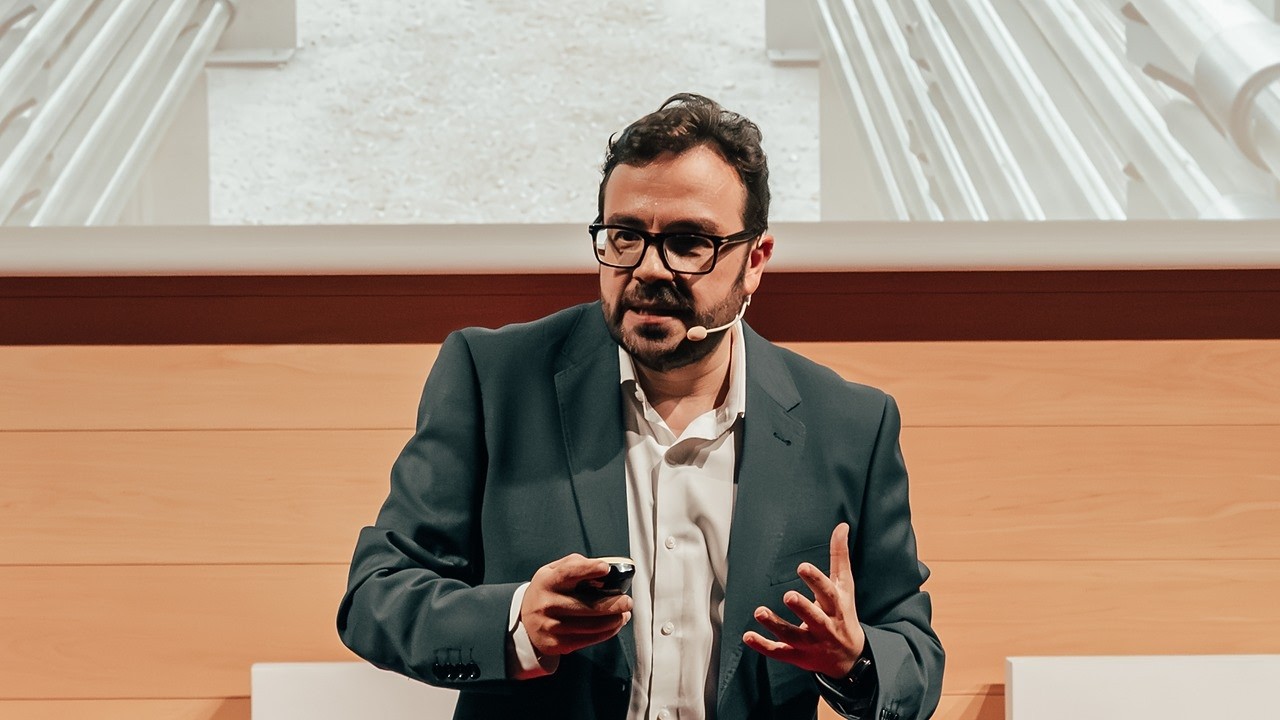
¿Y si las soluciones del futuro ya existieran? | David Iglesias | TEDxAlmería
What if the solutions of the future already existed? | David Iglesias | TEDxAlmería
Keywords
Summary
164 words
Critical Evaluation
Value of the Information & Strength of the Argument
The talk’s value lies in its accessible explanation of how microalgae can be applied in agriculture, bridging scientific potential with industrial practice. The speaker presents a compelling argument for rethinking agriculture by turning to nature’s ancient mechanisms rather than synthetic chemistry. He supports his points with concrete examples: his company’s strain selection process, the largest microalgae plant for agriculture, and specific benefits such as improved nutrient absorption and fruit quality. However, the argumentation is largely anecdotal and promotional, relying more on the speaker’s authority as CEO than on rigorous scientific evidence or comparative data. The focus is on inspiring rather than proving, which weakens the overall strength of the argument.
Scientific Rigor, Source Quality, Title Accuracy
The scientific rigor is moderate. The speaker cites universally known statistics from the UN and FAO but provides no detailed references or data from independent studies. He mentions the Spanish Bank of Algae and collaborations with universities, yet does not name specific publications or offer verifiable results. The quality of sources is thus limited to general knowledge and company claims. The title and content align well: the question about future solutions is answered by proposing existing natural organisms as the basis for innovation. No critical evaluation of the evidence is provided, and the talk functions more as a persuasive narrative than a scientific review.
229 words
Title / Content Match
The title poses a question about future solutions, and the talk answers by presenting microalgae as an existing yet underutilized solution, fully matching the title's promise.
Quality & Reliability
6/10
The talk provides a general overview of microalgae applications in agriculture based on the speaker's industry experience, but lacks detailed scientific citations. The FAO and UN population data are widely known references, yet no specific sources are given. The content is plausible and aligns with existing knowledge, but is presented in an accessible, non-technical manner.
Key Moments
Markers derived by PSI from the transcript: the creator did not define chapters.
- Introduction to the 2050 challenge: UN population projections and FAO food production needs.
- Discussion of oxygen production and the common misunderstanding about microorganisms, introducing microalgae.
- Description of agricultural problems: soil exhaustion, water scarcity, and climate impacts on crops.
- The speaker's encounter with microalgae and decision to apply them to agriculture.
- Explanation of the strain selection process from 2,000 to 18, and the facility in Almería.
- Practical applications: improving root hairs, inoculating microorganisms, and enhancing fruit quality.
- Conclusion: '2050 starts today,' urging the audience to see the potential in the invisible.
Cited Sources
- TEDx Talks — Official TEDx platform link provided in the video description, confirming the talk's origin.
Contribution & Novelties
The talk’s contribution lies in showcasing an industrial perspective on microalgae-based agricultural biostimulants, emphasizing practical challenges and successes. It highlights the importance of translating academic research into marketable solutions, a topic often overlooked in purely scientific discussions.
Pour aller plus loin :
- Microalgae - Wikipedia — Overview of microalgae biology and uses.
- Biostimulants - Wikipedia — Explanation of substances that enhance plant growth, directly relevant to the talk’s products.
- Food and Agriculture Organization (FAO) — Official source for global food security projections.
- Concept de ‘circular economy’ in agriculture, without URL, as it contextualizes the sustainable approach but no direct link is confirmed.
102 words
Radar Profile
The radar profile shows a moderate quantity of information balanced with a slightly lower quality and rigor. The talk is technically accessible, reflecting an orientation toward a general audience, while reliability is average due to the lack of detailed citations. Overall, it is a persuasive presentation rather than a deep scientific analysis.