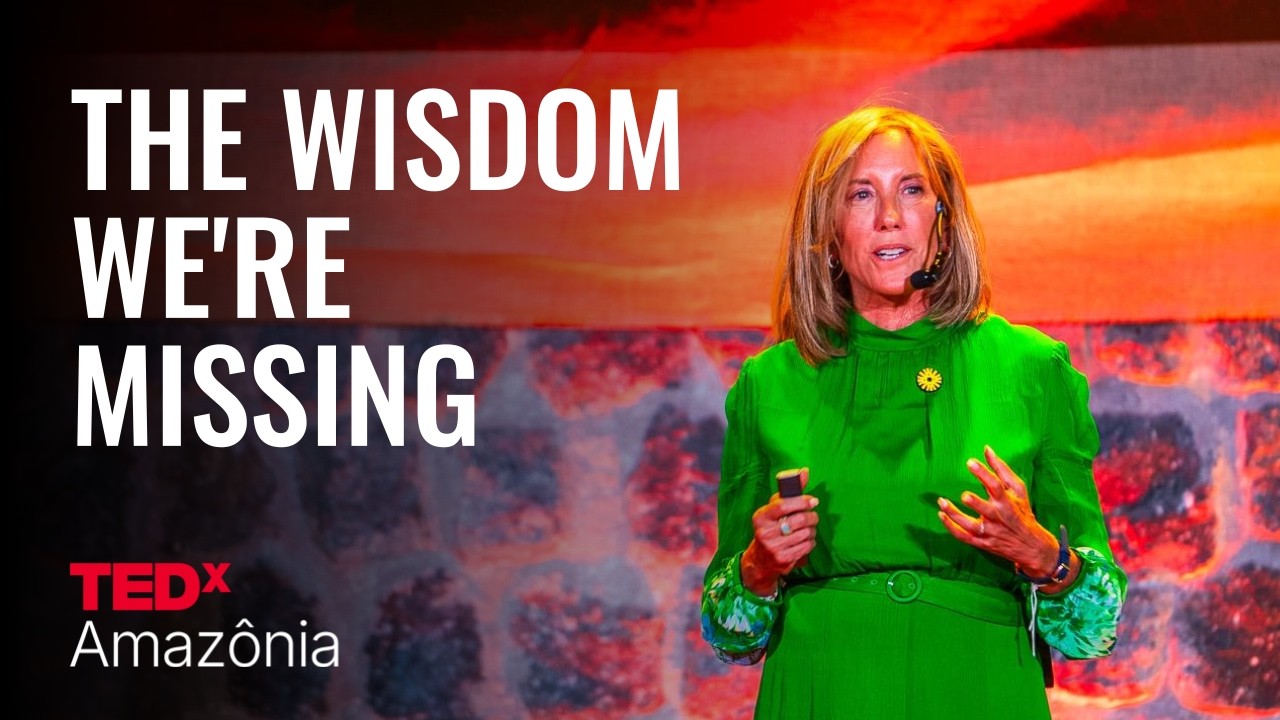
The Hidden Power of Women Sharing What They Know | Ronda Carnegie | TEDxAmazônia
Title history
- The Hidden Power of Women Sharing What They Know | Ronda Carnegie | TEDxAmazônia — observed on 20261027-1738 UTC (YouTube)
Keywords
Summary
170 words
Critical Evaluation
Value of the Information & Strength of the Argument
The talk offers compelling anecdotes that illustrate the importance of local knowledge and trust in community-led climate adaptation. The argumentation is narrative and emotional rather than analytical, drawing on vivid examples to persuade the audience of the value of women’s wisdom. While the evidence is anecdotal, the consistent pattern across cultures strengthens the plausibility of the thesis. The speaker builds a coherent case that knowledge dissemination is as much about relationships and trust as about the information itself, making a persuasive appeal for a connective approach to problem-solving.
Scientific Rigor, Source Quality, Title Accuracy
The talk does not cite external studies or data, relying on personal observations and testimonials. The only explicit reference is the novel ‘The Red Tent’, used as an inspiration, and the description links to the general TEDx platform. The title accurately represents the content, focusing on the often-overlooked power of women’s knowledge sharing. While the lack of verifiable sources limits scientific rigor, the talk is consistent in its message and grounded in the speaker’s extensive international experience.
180 words
Title / Content Match
The title accurately reflects the core theme: the transformative power of women sharing wisdom across communities. The content systematically illustrates this through multiple geographic examples.
Quality & Reliability
6/10
The talk is based on personal anecdotes and field observations, without empirical data or verifiable references, but the speaker's credentials and consistent narrative provide moderate reliability.
Key Moments
Markers derived by PSI from the transcript: the creator did not define chapters.
- Introduction: The question about messages women receive
- Traveling the world to understand patterns in women's wisdom
- The Red Tent and the ancient tradition of women supporting women
- Giving her daughter a wise woman each year
- Circle of wise women at age 16
- India: SEWA women sharing climate adaptation knowledge
- Ethiopia: women innovators in irrigation
- Uganda: farmers needing safe spaces for wisdom sharing
- The dandelion metaphor for spreading knowledge
- The Arhuaco lesson on trust and building relationships
Cited Sources
- TEDx program — Official TEDx page referenced in the video description
- The Red Tent — Novel by Anita Diamant mentioned as inspiration for the wisdom circle
Concurring Sources
- SEWA (Wikipedia) — Corroborates the existence and role of SEWA as a women's trade union in India
- Arhuaco people (Wikipedia) — Supports the description of the Arhuaco community's values and practices
Contribution & Novelties
The talk presents a fresh perspective on climate adaptation by highlighting the role of women’s indigenous and local knowledge, often overlooked in formal discourse. It emphasizes trust-building as an iterative process, challenging the conventional linear approach to interventions. The dandelion analogy effectively conveys how solutions can spread organically through personal connections, offering a metaphor for scalable community-led change.
Pour aller plus loin :
- Self-Employed Women’s Association (SEWA) — Relevant to the Indian case study; provides background on the trade union mentioned.
- The Red Tent (novel) — The book that inspired the talk; offers context on the ancient tradition of women’s gatherings.
- Arhuaco people — Background on the indigenous community in Colombia and their emphasis on trust and reciprocity.
118 words
Radar Profile
The radar profile shows a moderate overall pattern, with relatively higher scores in information quantity and quality (7 and 6) compared to technical level (2) and global reliability (5). This suggests a talk rich in anecdotal insights but lacking scientific depth, aligning with its narrative and persuasive rather than analytical nature.