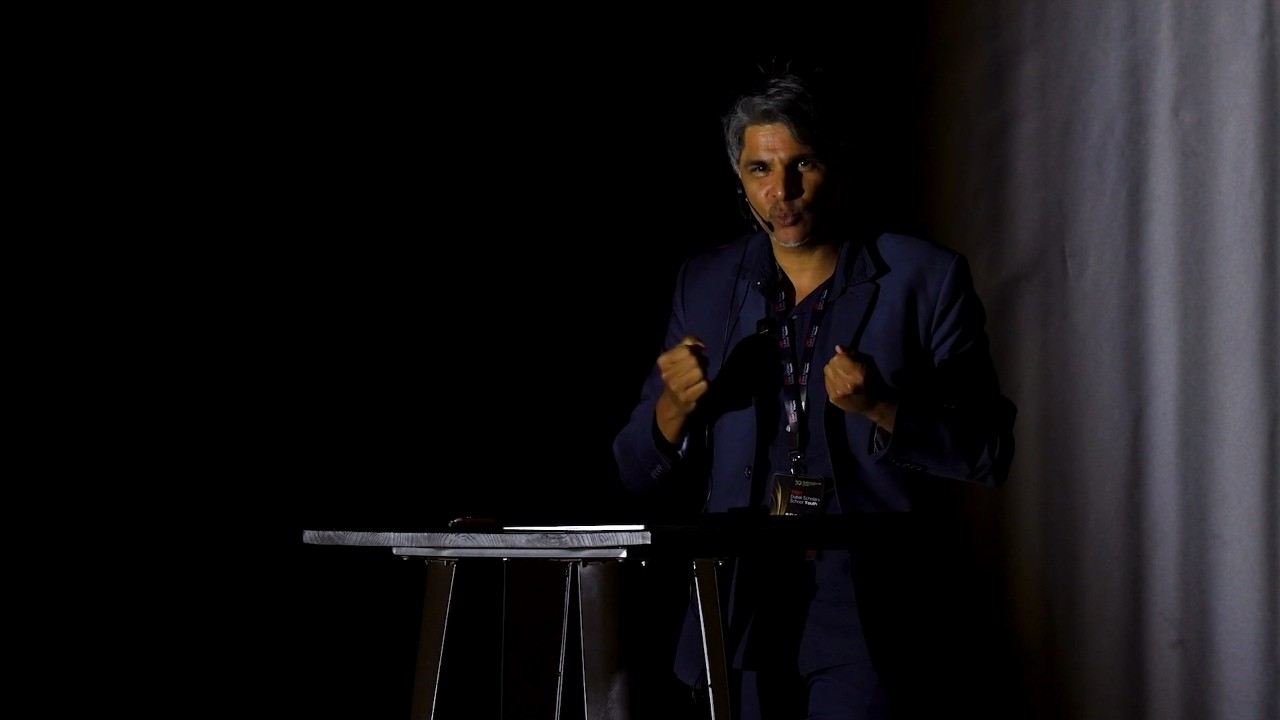
Where's My Armband | Kumar Verma | TEDxDubai Scholars School Youth
Title history
- Where's My Armband | Kumar Verma | TEDxDubai Scholars School Youth — observed on 20261027-0212 UTC (YouTube)
Keywords
Summary
184 words
Critical Evaluation
Value of the Information & Strength of the Argument
The talk offers a valuable reframing of leadership as influence rather than position, introducing the concept of ‘invisible leadership’ that is earned through behaviors rather than bestowed by authority. The argumentation is logically coherent, moving from definition to components, then to practical applications and a concrete example. The speaker’s personal credibility and the relatable anecdote of Ms. Sapna strengthen the persuasion. However, the reasoning is largely based on anecdotal evidence and common-sense observations rather than rigorous research; it synthesizes established leadership concepts without adding empirical depth. The discussion of potential downsides of traits adds nuance, and the final call to act with a moral compass is compelling. Overall, the talk is insightful for a general audience but does not break new ground academically.
Scientific Rigor, Source Quality, Title Accuracy
The talk does not cite specific studies or sources, which is typical for a TEDx presentation; its scientific rigor is moderate, relying on experience and logical reasoning. The speaker’s background in education and leadership lends practical credibility. The title and content are highly aligned: the ‘armband’ serves as a powerful symbol for formal authority that is temporary, while the speaker argues that true leadership lies in behaviors that persist. Adequation is excellent. Since no comments were provided, no public reception analysis is included.
221 words
Title / Content Match
The title 'Where's My Armband' metaphorically refers to the symbol of authority and perfectly aligns with the talk's exploration of leadership identity beyond formal titles.
Quality & Reliability
7/10
The talk presents a coherent and well-structured framework on leadership, distinguishing visible and invisible leadership with practical examples. The speaker has credible professional background in education and leadership, but the content relies on personal anecdotes and does not cite external sources or empirical research, limiting its scientific reliability.
Key Moments
Markers derived by PSI from the transcript: the creator did not define chapters.
- Introduces the mission statement paradox and the question of who is left to lead.
- Defines leadership as influence, not title, and breaks it into process, influence, group, and common goal.
- Explains the three components: tools, traits, and behaviors, and the distinction between given tools and built traits.
- Introduces the four behaviors that earn invisible leadership: doing the right thing at a cost, treating people who can't help you kindly, letting ideas flourish, and leaving behind working systems.
- Cites the example of Ms. Sapna, a principal who became a leader through her impact without a formal title.
- Concludes with the notion that leadership choices (visible, invisible, or none) are valid, and the armband will be taken but the impact remains.
Cited Sources
- TEDx Program — Reference to the TEDx event format and independent organization.
Contribution & Novelties
The talk contributes a fresh lens on leadership by separating formal authority from genuine influence, coining the term ‘invisible leadership’ to describe earned rather than appointed leading. It provides practical behaviors that individuals can adopt to become influential regardless of title, and it emphasizes the sustainability of one’s impact. The personal example of Ms. Sapna illustrates the concept in a real educational setting.
Pour aller plus loin :
- Servant leadership — A leadership philosophy that prioritizes serving others, aligning with the talk’s focus on behaviors over titles.
- Transformational leadership — A theory that inspects how leaders inspire and empower followers, complementary to the idea of influence without authority.
- Leader–member exchange theory — A concept explaining how leader-follower relationships develop and why validation from peers is crucial.
126 words
Radar Profile
The radar profile shows strong scores in quantity and quality of information, and moderate in technical level, reflecting a well-communicated but non-technical presentation. Reliability is slightly lower due to lack of external citations, indicating a synthesis of personal experience rather than empirical evidence.