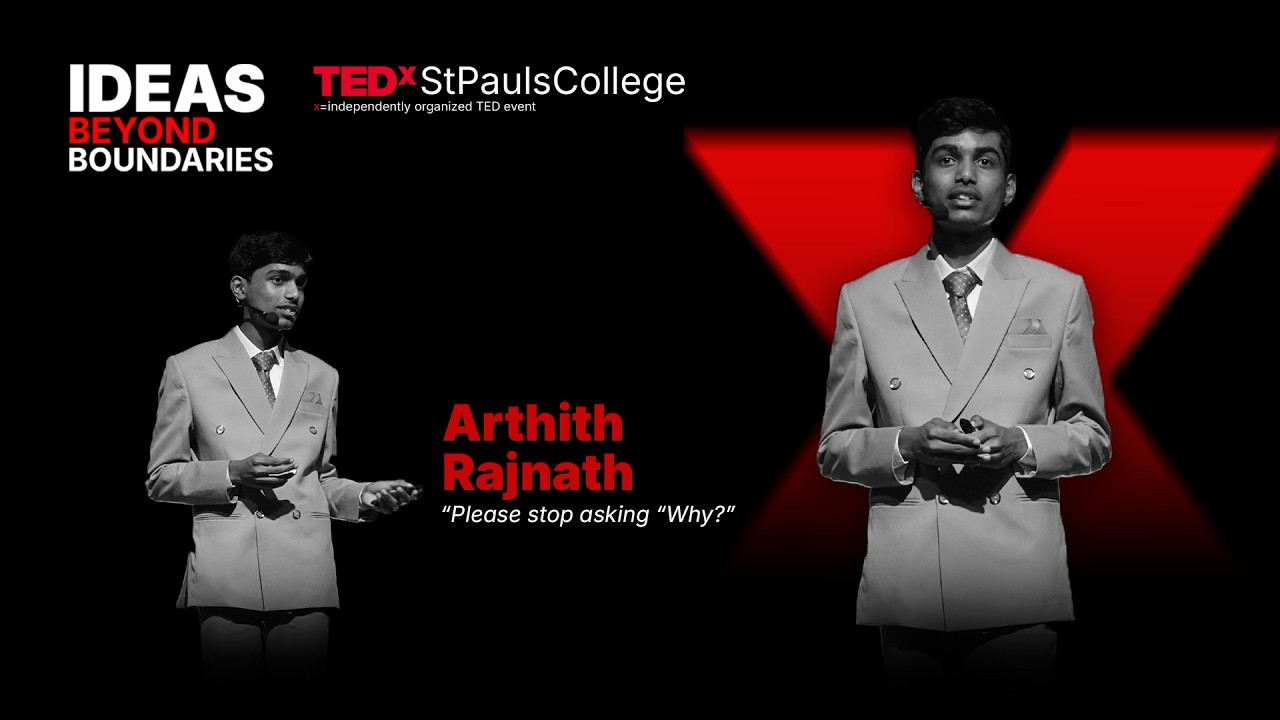
Please Stop Asking “Why?” | Arthith Rajnath | TEDxSt Pauls College
Title history
- Please Stop Asking “Why?” | Arthith Rajnath | TEDxSt Pauls College — observed on 20261029-1651 UTC (YouTube)
Keywords
Summary
142 words
Critical Evaluation
Value of the Information & Strength of the Argument
The talk’s value lies in its clear articulation of a common cognitive pitfall: confusing an answer with understanding. The speaker uses compelling scientific examples to demonstrate that naming phenomena (like dark energy) does not equate to complete comprehension. The argumentation is solid, logically progressing from the Galileo case to modern discoveries, and effectively employs Feynman’s quotes to support the thesis. However, the reasoning sometimes oversimplifies complex scientific concepts, and the philosophical insight, while valid, is not entirely original — similar ideas have been expressed by many scientists and philosophers. The strength is in its accessibility and the personal touch, making it relatable to a broader audience.
Scientific Rigor, Source Quality, Title Accuracy
The talk does not cite specific scientific papers or external sources, relying instead on well-known historical and contemporary examples. The mention of Galileo, Einstein, LIGO, and the Event Horizon Telescope is accurate, but no references are provided to verify details. The title is only partially adequate: it suggests a cessation of ‘Why?’ questions, while the actual message is to shift from answer-seeking to question-embracing. This mismatch could confuse viewers but is clarified early in the talk. Overall, the scientific content is reliable at a general level, but the lack of explicit sourcing limits its scholarly rigor. Public comments were not provided; consequently, no analysis of audience reactions is possible.
230 words
Title / Content Match
The title is slightly ironic: the talk actually encourages asking deeper questions, but urges moving beyond the search for immediate answers. It effectively captures the central theme, though it could be misinterpreted as anti-curiosity.
Quality & Reliability
6/10
The talk is well-structured and scientifically accurate in its examples (Galileo, Einstein, dark energy, black holes), but it remains a personal reflection rather than a rigorous scientific exposition. The claims are generally aligned with established science, but the depth of analysis is limited and the value lies more in the philosophical perspective than in novel content.
Key Moments
Markers derived by PSI from the transcript: the creator did not define chapters.
- Introduction: challenging the habit of asking 'Why?' and setting the theme.
- Galileo and the importance of questioning observations.
- Transition from childhood curiosity to adult conformity.
- Two types of 'why': answer-oriented vs. exploration-oriented.
- Dark energy example: uncertain nature of naming and understanding.
- Black holes and gravitational waves: reality beyond assumptions.
- Embracing 'I don't know yet' as a positive scientific attitude.
Cited Sources
- TEDx Program — The talk was delivered at a TEDx event under the TED conference format, and the description links to the official TEDx page.
Contribution & Novelties
The talk offers a personal perspective on the value of uncertainty in science, blending astrophysics with philosophical reflection. While the core ideal is not new, the speaker’s accessible framing and use of relatable examples provide a fresh angle for a young audience.
Pour aller plus loin :
- Dark energy — The mysterious force driving the accelerating expansion of the universe.
- Black hole — A region of spacetime where gravity is so strong that nothing can escape, exemplifying phenomena once considered science fiction.
- Richard Feynman — Physicist known for his emphasis on questioning and the importance of uncertainty in science.
99 words
Radar Profile
The radar profile shows a talk that is moderate in information quantity and quality, with a low technical level designed for general audiences. The reliability score is average, reflecting the absence of explicit citations. This indicates a balanced but not deeply rigorous presentation, suitable for inspiring curiosity rather than providing comprehensive scientific detail.