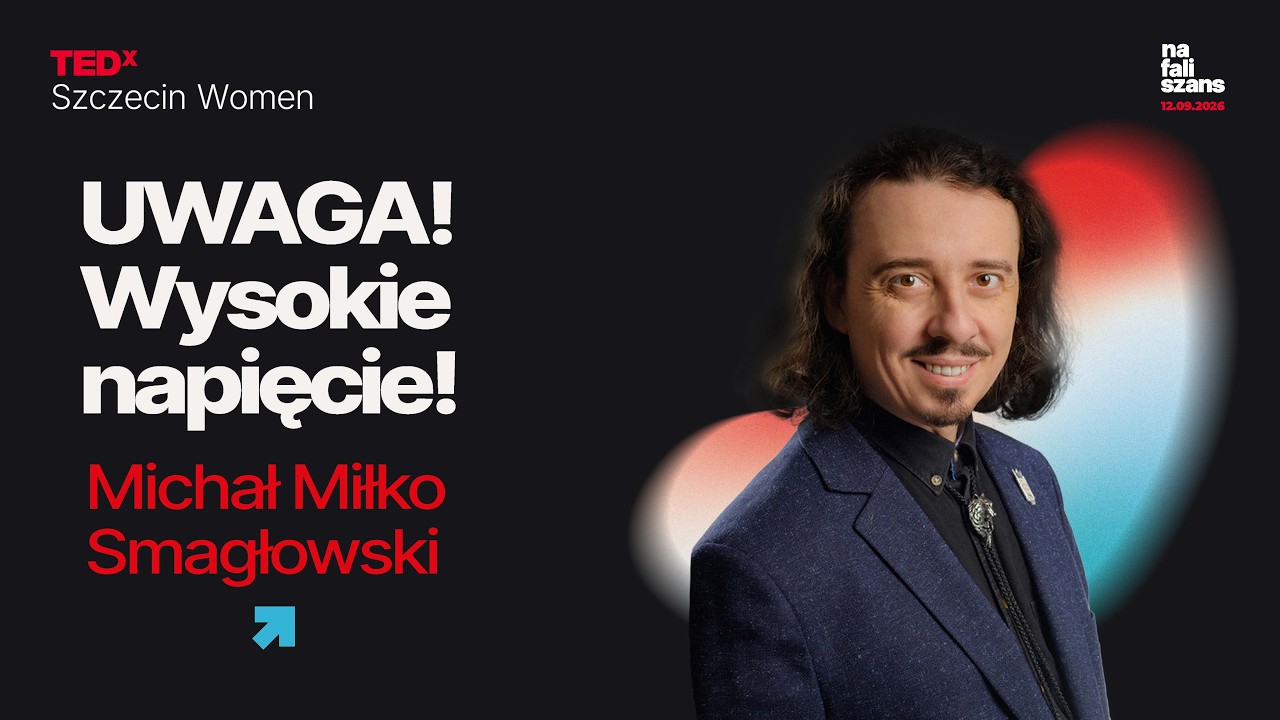
UWAGA! Wysokie napięcie! | Michał „MiŁKo” Smagłowski | TEDxSzczecin Women
CAUTION! High Voltage! | Michał "MiŁKo" Smagłowski | TEDxSzczecin Women
Title history
- UWAGA! Wysokie napięcie! | Michał „MiŁKo” Smagłowski | TEDxSzczecin Women — observed on 20261104-2228 UTC (YouTube)
Keywords
Summary
127 words
Critical Evaluation
Value of the Information & Strength of the Argument
The talk’s strength lies in its accessible integration of psychosomatic principles with everyday examples. The three patient stories offer concrete, relatable evidence of how stress manifests physically. The argumentation is persuasive: he builds a clear link between chronic stress and muscular armor, and supports his claims with references to biological concepts (HPA axis, stress hormones) and expert sources. However, the reasoning relies heavily on anecdotal evidence and lacks rigorous scientific depth. The connection between emotional suppression and specific muscle tension, while plausible, is presented without control studies. The proposed techniques are pragmatic but minimally validated in this context, and their effectiveness is argued by analogy rather than data. The talk would benefit from acknowledging controversies or limitations of psychosomatic interpretations.
Scientific Rigor, Source Quality, Title Accuracy
The speaker cites Kandel’s ‘Principles of Neural Science’ for the neuronal potential, Jerzy Landowski for neurobiology of stress reactions, and Bogumiła Tarasiewicz for voice and articulation. These references lend some academic credibility, but exact sources are not clearly identified (no full citations). The talk is clearly based on professional experience, which provides practical insight but not systematic evidence. The title’s metaphor of ‘high voltage’ is effectively used throughout, and the content does address the theme consistently. The talk appropriately disclaims the need for professional consultation for self-massage.
222 words
Title / Content Match
The title reflects the central metaphor of muscular tension as 'high voltage' in the body. The talk's content aligns with this metaphor well, though the scope is broader than just tension.
Quality & Reliability
6/10
Talk based on professional experience in massage and rehabilitation, with references to scientific concepts (HPA axis, stress response) and expert sources (Kandel, Tarasiewicz, Landowski). However, specific studies are not cited, and claims are presented through personal anecdotes rather than peer-reviewed evidence. The overall reasoning is plausible but therapeutic advice is general and should be interpreted with caution.
Key Moments
Markers derived by PSI from the transcript: the creator did not define chapters.
- Introduction: chronic tension as a signal from the body, not a malfunction.
- First story: Ewa, a marketing director with a rigid neck and jaw, illustrating chronic stress reactivity.
- Second story: Viola, a sports student, needing to learn proper breathing and relaxation before returning to training.
- Third story: Andrzej, a CNC operator, with financial stress leading to back pain and required ergonomic and behavioral change.
- Explanation of the HPA axis and stress hormones (cortisol, adrenaline) as generators of muscle tension.
- The link between voice and muscle tension: how stress tightens the vocal apparatus.
- Practical steps: acceptance of the body, Jacobson relaxation, and self-massage techniques.
- Importance of centripetal (toward the heart) massage direction to support venous and lymphatic flow.
- Concluding message: treat the body as a home, not a rented property, with care and awareness.
Cited Sources
- TEDx Talks official page — Background on the TEDx event format.
- Principles of Neural Science (Kandel et al.) — Reference for the electrical potential of neurons (10 V? probably mV, but as said).
- Jerzy Landowski - Neurobiologia reakcji stresowych — Referenced in the talk for the neurobiology of stress reactions and the HPA axis.
- Bogumiła Tarasiewicz - work on voice and articulation — Referenced for the link between muscle tension and vocal effort.
Concurring Sources
- Principles of Neural Science — Coupled with the speaker's mention of neuronal electrical activity.
- Progressive muscle relaxation (Jacobson) — The technique described in the talk is well-documented.
Dissenting Sources
- Potential oversimplification of stress-psychosomatic link — The talk presents a direct causal chain from emotional stress to specific muscle tension, which is plausible but not universally accepted in biomedical literature. Some researchers emphasize the complexity of stress physiology and the lack of strong evidence for specific psychosomatic patterns.
Contribution & Novelties
The talk’s original contribution lies in its holistic, embodied approach to stress and muscle tension, bridging psychotherapy, sports rehabilitation, and voice coaching. It offers accessible self-care tools that integrate mindfulness, breathing, and self-massage, which may be novel for a general audience.
Pour aller plus loin :
- Psychosomatic medicine — Overview of the field linking psychological states to physical health.
- Progressive muscle relaxation — Technique popularized by Jacobson, central to the talk’s recommendations.
- Hypothalamic-pituitary-adrenal axis — Key biological pathway for stress response mentioned in the talk.
85 words
Radar Profile
The radar profile shows a moderate score in information quantity and quality, but a lower technical level. The talk is strong in qualitative insights but lacks quantitative data and rigorous scientific validation. The credibility score is moderate, reflecting the blend of professional experience and anecdotal storytelling.