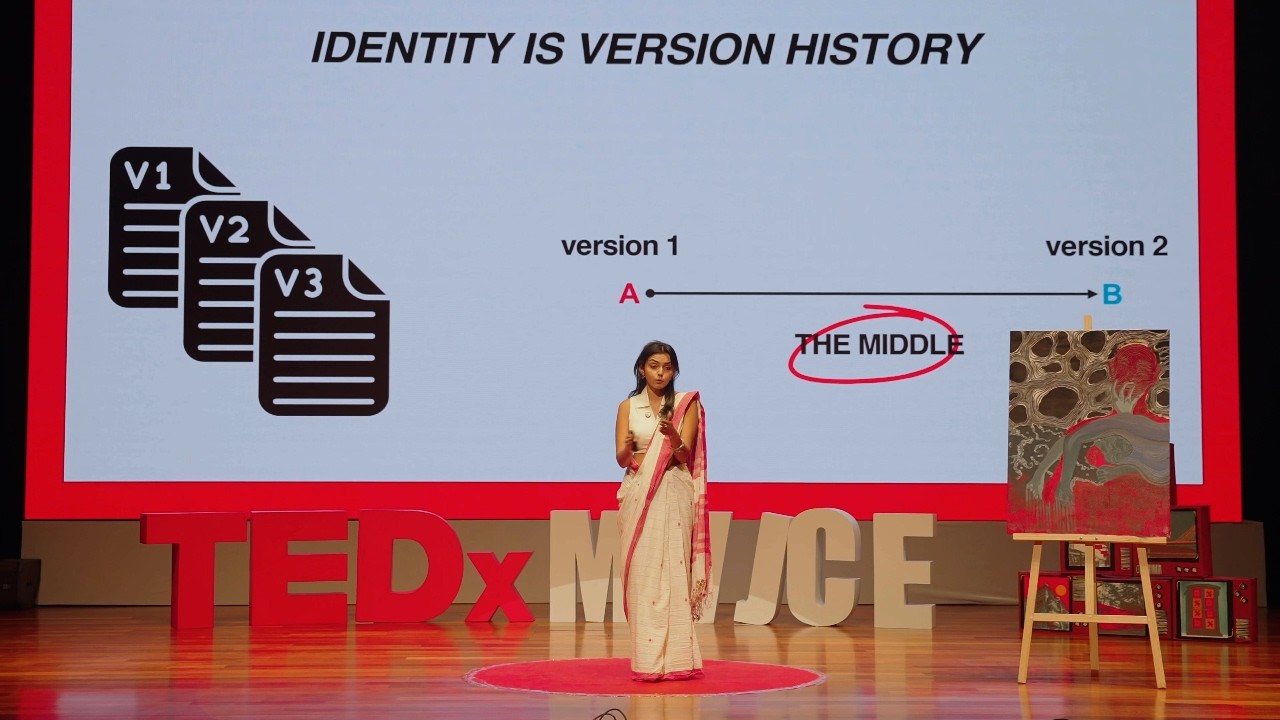
The Messy Middle | Malvika Pattenset | TEDxMVJCE
Title history
- The Messy Middle | Malvika Pattenset | TEDxMVJCE — observed on 20261029-1653 UTC (YouTube)
Keywords
Summary
149 words
Critical Evaluation
Value of the Information & Strength of the Argument
The talk’s value lies in its personal, relatable reframing of transformation, challenging the mainstream narrative of overnight success. The argumentation is built on metaphorically rich analogies—version control, layers of paint, a three-slide carousel—that make the ‘messy middle’ tangible. Internally consistent and emotionally honest, the strongest moments are when the speaker grounds abstract ideas in concrete personal stories: the blue hair crisis, the unfinished finance career, and repainting the same corner for three hours. However, the reasoning is exclusively anecdotal and lacks empirical support or outside perspectives, limiting its generalizability. There is no engagement with psychological or sociological research, making the claims persuasive through narrative resonance rather than evidence.
Scientific Rigor, Source Quality, Title Accuracy
The talk is a personal TEDx presentation with no cited scientific literature, studies, or third-party data. The only external reference in the description is the general TEDx website, which serves as the organizational platform rather than a content source. The title ‘The Messy Middle’ is well-chosen, succinctly capturing the core thesis about the space between beginnings and endings. Adequation between title and content is strong; every section reinforces this central metaphor. From a scientific standpoint, the rigor is low—this is reflective opinion rather than researched analysis.
209 words
Title / Content Match
The title 'The Messy Middle' accurately reflects the central thesis of the talk, which examines the often-ignored process between the start and finish of personal and artistic transformation.
Quality & Reliability
4/10
Personal narrative grounded in lived experience as a self-taught artist and creator; internally coherent and authentic, but no empirical data, studies, or external references are provided. Claims are anecdotal and unfalsifiable.
Key Moments
Markers derived by PSI from the transcript: the creator did not define chapters.
- Opening hook: transformation reels and the desire to be unrecognizable, with the blue hair quarter-life crisis story.
- New Year's grapes ritual and the 'new year, new me' myth—challenging the idea of complete reinvention.
- Introduction of the core metaphor: identity as version history, not a deletable file; the middle space where change actually happens.
- Three-slide carousel critique: how the public narrative hides the process (drafts, changes, and doubts) in favor of 'idea to masterpiece.'
- Reflection on leaving things unfinished: how unfinished paintings became the speaker's greatest learnings as a self-taught artist.
- Personal testimony: leaving the finance career path unfinished is what led her to where she is today.
- Relationships as anchors—endings leave fragments, and every person or experience shapes future versions.
- Redefining consistency: progress, pauses, and direction changes are all part of consistency, not just linear repetition.
- Conclusion: continuity and change coexist—there is no 'new me,' only the accumulation of layers, one draft at a time.
Cited Sources
- TEDx Talks – Official Program — The only external link provided in the video description, used as the platform reference for the TEDx event.
Concurring Sources
- TEDx Talks – Official Program — The TEDx format itself is concordant with the talk's personal, idea-sharing nature, providing a platform for this experiential narrative.
Contribution & Novelties
The talk offers an original perspective by applying the concept of ‘version history’ (from software) and ’layers of paint’ (from art) to personal identity development. Its novelty lies in shifting focus from endpoint-focused transformation narratives to the often-neglected middle process, proposing that unfinished work is generative rather than deficient. The ‘consistency as non-linear’ reframing also challenges simplistic productivity culture.
Pour aller plus loin :
- Growth mindset — Carol Dweck’s concept of embracing challenge and the process of learning, directly related to reframing the ‘messy middle’ as a developmental stage.
- Neuroplasticity — The brain’s ability to reorganize itself through experience, providing biological grounding for the idea that change is layered and gradual.
- Identity (social science) — Theoretical frameworks on how identity is constructed and evolves, supporting the notion of identity as an accumulation of versions.
- Kaizen — The Japanese philosophy of continuous incremental improvement, echoing the talk’s redefinition of consistency as non-linear and process-focused.
153 words
Radar Profile
The radar profile shows low scores in technical level (2) and reliability (3), moderate in quality (5) and quantity (4). This indicates a talk strong on personal resonance and narrative coherence, but weak on empirical rigor and technical depth—typical of a TEDx personal reflection.