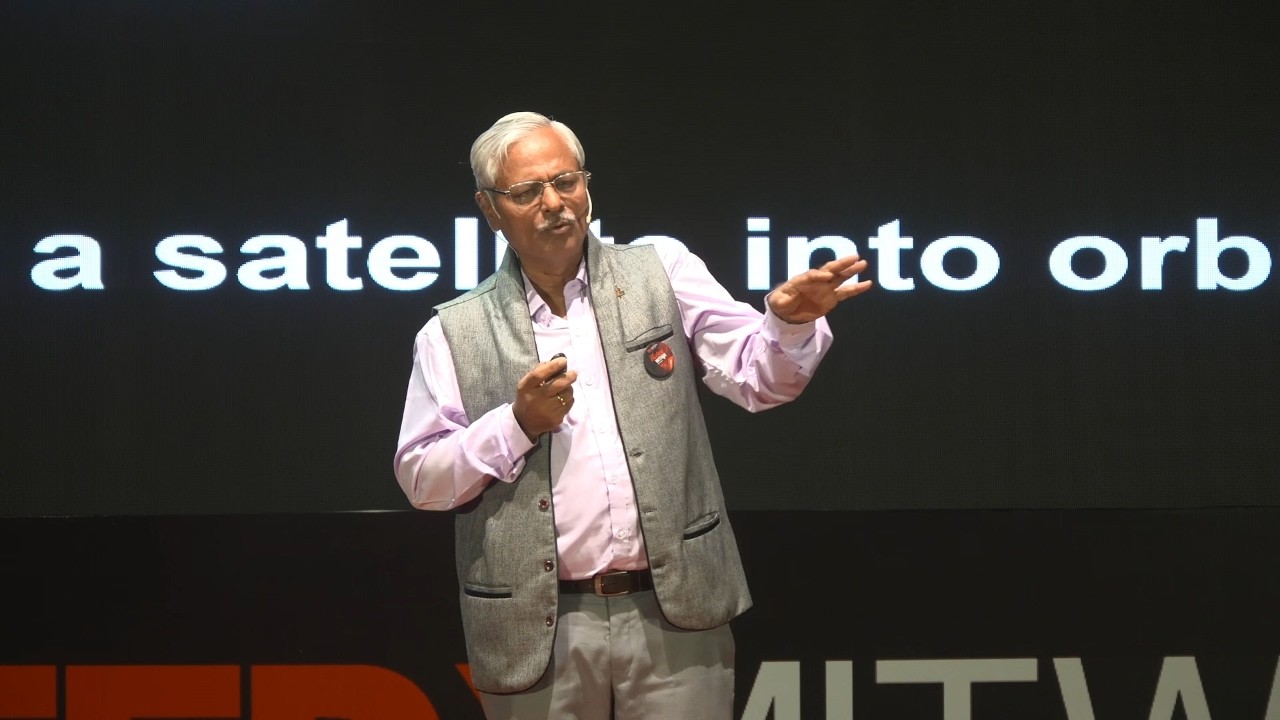
Finding direction when the path is unknown | Madhav Dhekane | TEDxMITWPU
Keywords
Summary
153 words
Critical Evaluation
Value of the Information & Strength of the Argument
The value lies in the authentic, first-hand recounting of major ISRO milestones and failures, offering rare insider perspectives on engineering decision-making under pressure. The argumentation is narrative-driven, weaving technical details into motivational lessons. While the speaker’s credibility is strong, the talk lacks quantitative evidence or external references, making it more inspirational than rigorously analytical. The reasoning is logically structured: each failure is analyzed, corrected, and used as a stepping stone, supporting the thesis that embracing uncertainty and iteration leads to progress.
Scientific Rigor, Source Quality, Title Accuracy
The talk is self-contained, relying entirely on the speaker’s personal experience and historical knowledge rather than cited sources. No academic references are provided beyond the TEDx standard link. The scientific rigor is moderate: technical explanations are simplified but accurate, consistent with public knowledge of ISRO events. The title/content alignment is excellent; the metaphor of navigation and direction precisely mirrors the engineering and personal resilience themes. The lack of external sources means the video serves as an opinion piece rather than a peer-reviewed synthesis.
179 words
Title / Content Match
The title accurately reflects the content: the speaker uses space engineering challenges to illustrate navigating uncertainty, tying directly to the metaphor of 'finding direction'.
Quality & Reliability
7/10
The speaker is a veteran space scientist with three decades of experience in India's launch vehicle guidance systems, providing first-hand insights. However, the talk is anecdotal and lacks data citations, making it reliable for personal experience but not as a formal scientific reference.
Key Moments
Markers derived by PSI from the transcript: the creator did not define chapters.
- Introduction about India's space program origins in Thumba, church building, and humble beginnings.
- Building the first sounding rockets, carrying them on bicycles, and assembling a team of experts.
- First SLV3 launch failure: vehicle tumbled due to oxidizer leak; details of the telemetry analysis and fix.
- ASLV failures and subsequent success; PSLV failure due to software overflow and its recovery.
- GSLV launch abort 4 seconds before liftoff due to engine thrust issue; importance of checkout computers.
- Chandrayaan-1 launch under thunderstorm; decision to proceed; Chandrayaan-2 landing failure and learning.
- Key principles: robust systems, simulation, blame-free culture, and Tennyson's quote.
Cited Sources
- TEDx program page — Standard reference to the TEDx format described in the video description.
Contribution & Novelties
The talk provides a rare insider account of India’s space program, focusing on the engineering and human aspects of failure recovery. It distills decades of experience into actionable metaphors for personal and professional navigation through uncertainty.
Pour aller plus loin :
- Indian Space Research Organisation (ISRO) — Wikipedia — Overview of ISRO’s history and scope, expanding on the institutions mentioned.
- SLV-3 — Wikipedia — Detailed history of the first Indian satellite launch vehicle discussed in the talk.
- Chandrayaan-2 — Wikipedia — The lunar mission whose landing failure and analysis are highlighted in the latter part of the video.
98 words
Radar Profile
The profile shows a balanced information-rich talk with high narrative value and moderate technical depth, reflecting the expert opinion nature. The scores cluster around 7-8, indicating solid but not extraordinary rigor, with slightly lower quantitative information due to lack of external references.